Leibniz-Handschriften zur Mathematik LH 35, 12, 1, fol. 298r
Machine transcription. Not an edition. Errors are expected: about 8% character error rate on Latin and French lines, higher on German. Mean line confidence on this page: 0.75.
Original at the GWLB · Page image · Annotations (IIIF) · Download text
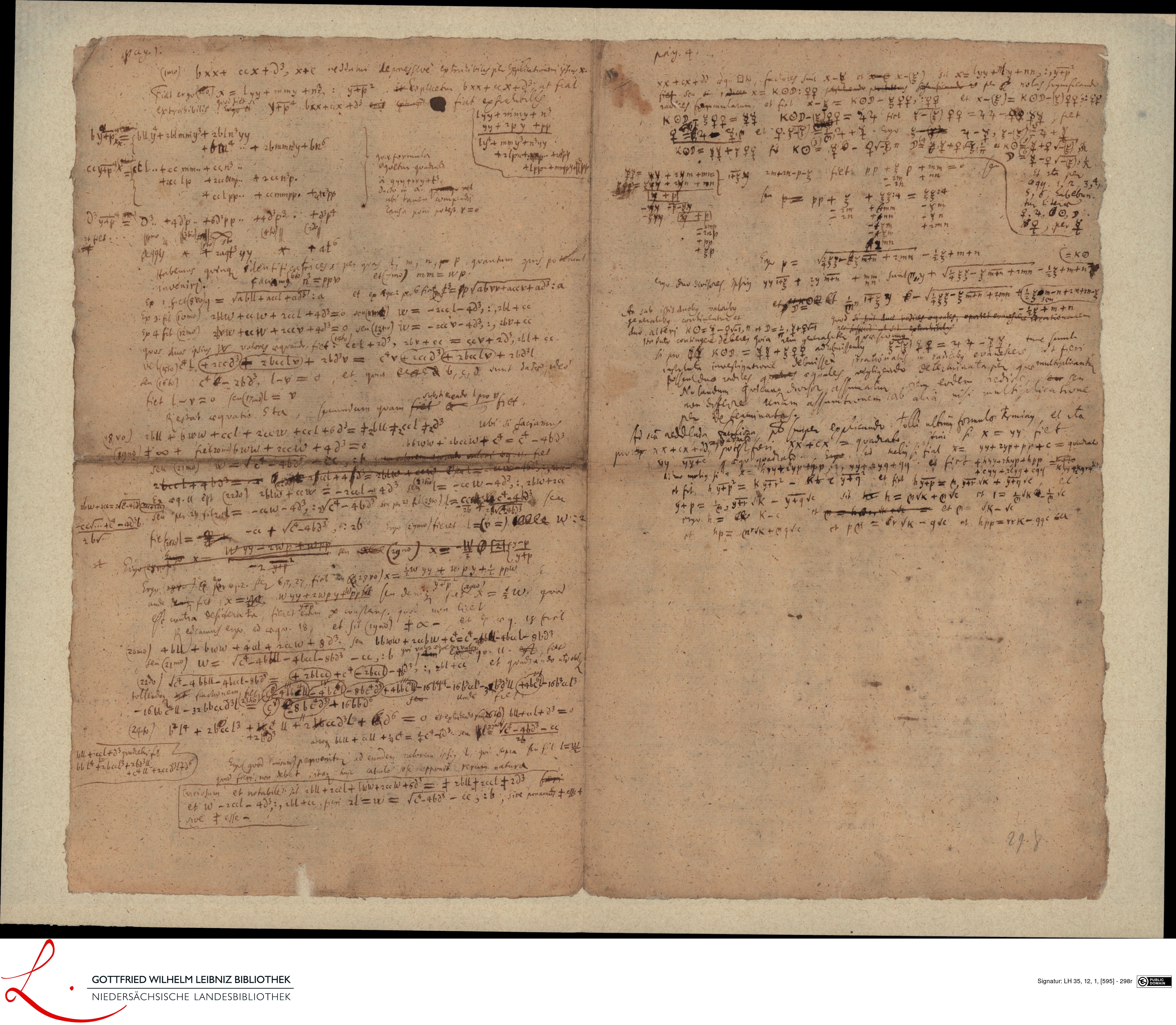
One image of two folio pages side by side, registered by the library under both labels (also fol. 299v); this page is its right half.
The machine reads it as
- pag. 4
- XX + Cx + dd aequ Bto, fuctores suit X - B et ∞ B X - (3) sit X = 9s My + nn, :, ytp
- fiet seu si redices X = K OD: 98. subistituendo periliteras siurficando 2e per notas signifieando
- radices formularum, et fiat - = KOD= B P8,: 84 et X - (5) = k OD - (2) 88,: Et
- 1e
- 28
- 4
- im +mm
- In +nn
- es
- 8
- ta per
- aegg. 1, 2, 3,
- +
- habebun
- C, +
- KOD- (Y) 8 = 22 fiet 8 = (2) 84 =24 - 8G, fiet
- G () 2 -Y, 3- (∞) 22 + 8
- p et 8. 8 (7
- 2 +Z. Ergo
- (0D - +7 8G fi XO= 46 91. 8 3 8 218Z. uno 4t8 st in
- 1157 2mtn p. fiet pP +E1
- sn p = pp + 3
- En
- + 33.4 =
- +Arum
- Aun
- imin
- + nn
- EE: 4
- m
- =0 se
- Ergo p = 1453. B3ntu + 2mu - 22 + mAn
- =40
- ergo duo divisores ipsius yy ite + ry mrn + mm sunt y + 4 55- 5 men + 2ma- 13 + mt uF
- An sub issis duobus valoribus
- generalibus continentur et
- et t XO t L, 1FG _ B - l 9Z- E mon + emu (F G0nan trnrn. 3
- duo alteri n- G - 9F. 1, N et D = =, 4+ 1
- m +n
- quod si sint duae radices aequales, oportet evanestere Arationalem
- nec sufficit ut sit extrahibilis
- 5- (8) 2Q = 21 4 - 78 tunc simili
- Ita puto contingere debere, quia rem generaliter quae sivimus
- si pro 10D = 4+ + 8 8 adhibuissemus
- instiluta investigatione debuisset irrationalis in radicibus evanescere, ut fieri
- possent duae radiles quatres aequales negligendo determinata per quo multiplicantur
- Notandum quicunque divisor assumatur, rem eodem redire, seu seu
- non differre unam assumtionem ab alia, nisi multiplicatione
- per de terminatas.
- Ad rcum reddenda faciliora, pt sumper explicando. Tolli ultinus formula Arminus, et ita
- pro x AX + Cx + dd potest fieri XX + Cx = quadrato Hinc si X = yy fiet
- vy gytc aequ quadrato. Ergo sed melius si fiat X = yy+ Eyp + pp + C = quadrato
- as huc melius si l X- hry + eyp. 1 p, 1, y9+ 2y9+49. et fint Fhuyarhyp+hpp -4t
- + egy + 3Cg9 + eqq Khy axyru
- et fit h y+ p = K gF r = _ c y+ 9 et firt hyrp = _, serk + ytqse
- et
- 9+p = a, ytr sk - 949sC sit h h = VK + e ve et 1 = k in sC
- ergo h = _ K - c et = hr, H + te = et ( = sk = sc
- et hip = nesk + (q sC et per = er LK = qse ut hpp = YrK = 99C LC
- 1n
Cite
Leibniz-Handschriften zur Mathematik LH 35, 12, 1, fol. 298r. Machine transcription, not an edition: Leibniz Legible (model FoNDUE-GD_v2_ft_Leibniz, run 74). https://leibnizlegible.com/page/00068194:0595?run=74