Leibniz-Handschriften zur Mathematik LH 35, 13, 2c, fol. 95v
Machine transcription. Not an edition. Errors are expected: about 8% character error rate on Latin and French lines, higher on German. Mean line confidence on this page: 0.83.
Original at the GWLB · Page image · Annotations (IIIF) · Download text
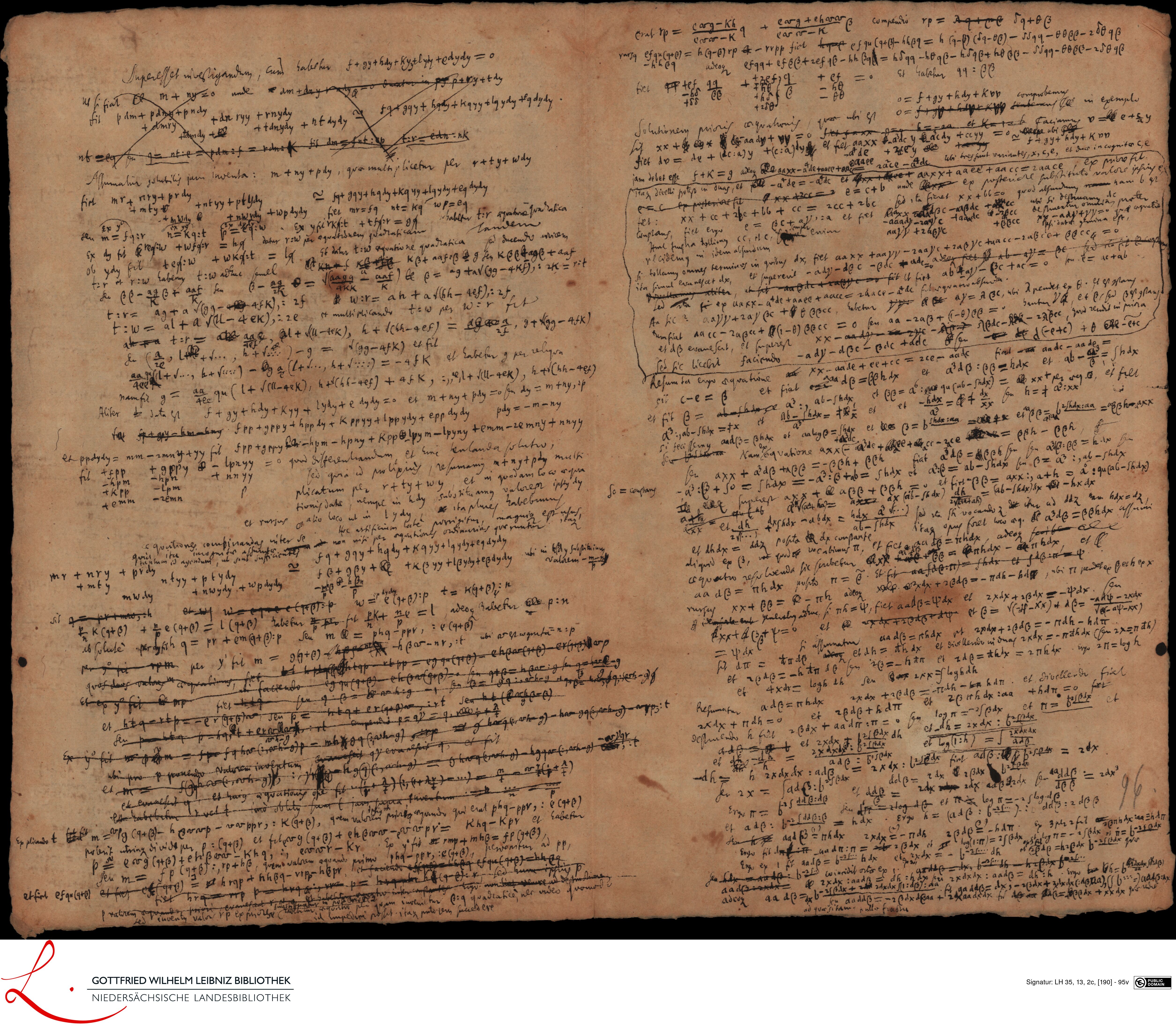
One image of two folio pages side by side, registered by the library under both labels (also fol. 96r); this page is its left half.
The machine reads it as
- Superesset investigandum, cum habetur fr9thayt ky elius tedydu = 0
- ut si fiat E m + ny =0 unde X am +duy r atus -0 ducatur in ps pary+t dy
- fit pdm + pan +pndy
- +amrus
- fgr gqy Fhgtus + tequus telgydus Aequydus.
- nb =eq eu g- nt: e = pam: f = rdn: H sit dn = fut: L r - edm . nk
- umatuur solubilis jam inventa: m +ny +pdus, quae multiplicetur per r+ ty+ ndus
- fiet mr+ arus +prdus
- +mtus v
- Antgus L ptlsdus
- ~ syt gqy +hqdys tRquus Alquydys teg aydus
- + nydus + Wp dydu fiet mr- 59 nt = kg W0p = eq
- seu im = fg: Y n = kq. t p EG: W. Ex yfil r:t + Lff.r = Dg habetur t:r aequature quadhalica
- Ex
- + mvodus
- Ex du fit (eq.W +10 59. Y = hq datur r.1 per aequationem quadraticam
- Tandem
- ob ydu fit t ef: W + WKq. t = lq. Et datur t. u aequatione quadratica sed ducendo arvicem
- Cns XB Y B KB+ aaf: β ~ 9 seu KB(B agB + aas
- seu ββ = aq B + aat seu B - aqe D = 1aagque = aat) de β = a9 + a Y (9g - 4H), : 2k = r. t
- t: r et r: W0 habemus +: W adhuc semel
- t: r = ag + a . (99 - 4 4FK), : 2f
- AKK
- W: r = a h + a (sh - 4ef), : 2f
- t: W = al + a YU - 4 eK), : 2C et multiplicando + : 1o per W : r fit
- at + a t: r. = a aa , l + s(u - 4K), h + tChh - 4 es) = AG a, 9 + Hgg - 4 fX)
- su (a, lA + t...; h + f. ) - 9 = L(gg - 4 fK) et fit
- aa V (iL + s.. ., h + f.. . .) - g a (L+ S. . ., h + t: : .) = - 4 fK et habetur 9 per reliqua
- namfit g = aa qu (L + ((H- 4 eK), h + (hl - 4e5) + a f K, :, 2, L + ((- 4 ex), h + (hih - 4 es)
- aeet
- Aliter L dita est f + gy + hdy + kyy + lydys + e dydus = 0 et m + ny + plus =o seu dus = n +ng, ip
- tt sp + ge - hm ns fPp + goppy + hpp dy + K ppgy + lpp ydy + epp dydus pdus = -m - ny
- et ppaydu = um - amny. +gy fit Spp +grpus Ee -hpm- hpnys + Kpp lpym-lxyny temm-remny + nngu
- fit +spP + oppu _- lxngu = 0 quod differentiandum, et hinc tentanda solutio,
- hum
- TK PP
- +enim
- =hon
- remn
- nngy
- sed quia id prolixius, resumamus mtnytptus multi
- plicatum per r+ty+ Wy, et in quodam loco aequa
- tionis datae, nempe in hdy substituamus valores ipstus dy
- et rursus alio loco ut in lydu, ita plures habebimus
- ce quationes compinandas inter se
- quaptum ed agendum, ut sint su
- quicutum id agendum, ut sint sufficiente
- mr + nru + prdus
- +nt y
- utyus + ptydy
- mus dus
- Hoc artificium late porrigitur, magnique est usus
- non nisi per aequationes ordinarias quaeruntur
- f9 + ggy + hadus + K9yy+ lqydy teu dydus
- FB + 9βy + +K Byy + l Bydy + eBdydy ubi in bsdu substituiuu
- -pip 6 h sen
- et W id = eque cCH P): p W = e (9+B): p + = K G+ B): n
- lydu
- + nwoydus + ropdydus
- Valorem- m.B
- B K (9+ B) + e (9+ () = l (9+ B) habetur Q per fit PH + n e = l, adeoque habetur p: n
- sit 4 = per t mo, . h
- ab solute percysich q = pr + em (4+ β): p seu m = phq = ppY, : e (4+ ()
- per y fit rem per y fit m = OA+ B) Lh hB~ - nY, . t ubi a est coguita n: p
- quos duos valoas aequabimus, fiet b h H tqp. et pp - eg qu Y C) - Ct ae (11 () et (1 ) a p
- ubi faciendo eg qu (qB) et (3~ (G+B) - a seu o+B = h Ba: g seu g ha9
- fiet 1. 1) seu 9. B - N h: g - , seu B = 84: v b- 9 et q p l f9. teh-9G
- et htq- rtp = - er (4+ B) , seu p = ht q + er(quB irt seu ht (k - C)
- et ex y fit ne
- Ex i fit m m = sp. fghas ( h . 5) p = mti X D4 (. oh. 5) s xp ~ f har que vtr 9) - ham 946, e b. 5)- a ppo: t
- seu pht 4 p- tq et + erolla : et compendio P= 4V = 4 r; +
- ubi pro p ponendo Nalorem iaventum evamoscit qy era nescit 4 et fit
- et in = f(gho (, ovh -9),: h9(4) (. arh. 9) = Gha q (, vh ∞) hgqu (., eet ns)
- et evanescit g et hajus aequationis ope fit t 2) (, ( + A) - ...) = ( = o 4(p + Z)
- es habebitur 1 vel F imo oblitus sum C jam supra inventum.
- Explicudo t e m = 9 C9+ () - h C arp = va ppY, : K (4+ B), quem valorem priortque aequindo qui erat phqus - ppY, : e Cq+ B)
- poterit utrinque di vide per p: (9+B) et filevg (9+ B) + eh B0 - V V pY = Khq = KpY et habetur
- p = e g (9+B) + etr βaa = Kh4, :, ea vr = KY. Ex i fit _ emp + ntB = fP (9+ 3)
- seu m = fp (9+B): rp + hβ, quemo valorem aequando primo pha - pPF, : CCG+B), pervenitur ad pP,
- et fiet esqu(qet et fiet e ( que) = hrgp + hhB9 - rip hBp, et faciendo esfed lt q es qu( 41B) th eq
- fiet hrq rep p. hrq r p= hrqpbr h(4 C): Y, sed hura ipsius P
- tu esoer
- ralum imentus veti expiores
- aequata
- qecuu incentur e) qordtatie nes mito quon
- id impedini possit. itaque putorem succed ere
Cite
Leibniz-Handschriften zur Mathematik LH 35, 13, 2c, fol. 95v. Machine transcription, not an edition: Leibniz Legible (model FoNDUE-GD_v2_ft_Leibniz, run 74). https://leibnizlegible.com/page/00068199:0190?run=74