Leibniz-Handschriften zur Mathematik LH 35, 14, 1, fol. 185r
Machine transcription. Not an edition. Errors are expected: about 8% character error rate on Latin and French lines, higher on German. Mean line confidence on this page: 0.82.
Original at the GWLB · Page image · Annotations (IIIF) · Download text
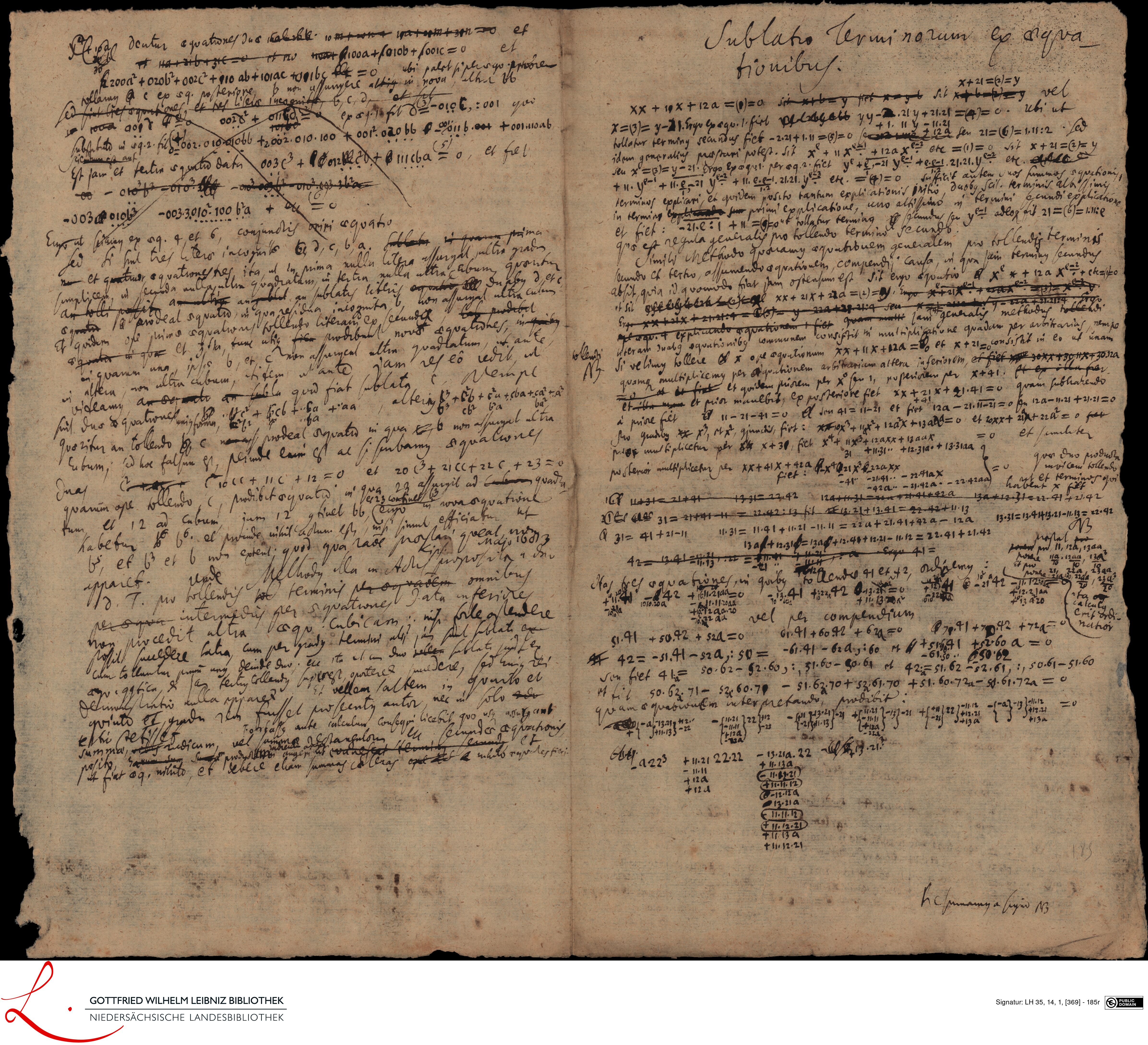
One image of two folio pages side by side, registered by the library under both labels (also fol. 186v); this page is its right half.
The machine reads it as
- AB
- Sublatio Terminorum ex aequa
- tionibus.
- X + 21 =(2) = y
- XX + 1X + 12 a = (1) = 0 sit Xt b = y fiet x a y b sit X + b () y vel
- X = (3) = y - 41. Ergo ex aequ. 1. siet CbGbb yy- 2. 21y + 21. 21 = (4) =0. Ubi ut
- + 1. 11 y - 11. 21
- tollatur terminus secundus fiet - 2.21 + 1. 11 = 5) =0 seu me =12 a seu 21 = (6) = 1. 11: 2. Sed
- idem generalius praestari potest. sit X + 1X + 12 a X ete = (1) = 0 sit X + 21 = (2) = y
- seu X = 3) = y = 21. Ergo ex aequ.1. per aeg. 2. fiet y +C, - 21 y + e. . 1. 21. 21. y etc.
- +11. V + 11. e- 21 y +11. e. C-1. 21.21. y etc. =4) =0 sufficit autem uos summos aequationis
- terminos explicari, et quidem posito tantum explicationis initio, duobus scil. terminis altissimis
- in termine explicando s primi explicatione, uno altissimo in termini secundi explication
- et fiet: - 21. C: 1 + 1 = (9t out tollatur terminus secundus seu y adeoque eit 21 = (6) = 1.1li e
- quae est regula generalis pro tollendo termino secundo
- Simili Methodo quaeramus aequationem generalem pro tollendis terminis
- secundo et tertio, assumendo aequationem, compendii causa, in qua jam terminus secundus
- absit, quia id quomodo fiat jam ostensum est sit ergo aequatio X X + 12 a X r etasto
- it sit erL)C Q XX + uX + 2 a = (2) =B. Ergo X F EIX. + aX ) Xv.
- Ergo XX t 3X + 21, 2. 4 - (3) - y 22a +21 2t:4 seu X c tury- na +3. 2 4. Ergo
- aequ. 4 explicando aequationem + fiet quam multi Jam generalis methodus tollendi
- pteram duabus aequationibus communem consiptit in multiplicatione quadam per arbitrarias, nempe
- si velimus tollere _ X ope aequationum XX + 11X + 1a = B et X+2 - consistit in eo ut unam
- quamque multiplicemus per aequationem arbitrariam altera inferiorem, et fiet 3oxx + 3O HX+ 3oa
- 0 et et fint et quidem priorem per X seu 1, posteriorem per X+41. A ex illa fier
- et illa man et prior manebit, ex posteriore fiet XX + 21 X + 41. 41 =0 quam subtrahendo
- a priore fiet 1 - 21 - 41 =0 _ sen 41 = 11 - 21 et fist 12a - 21. 11 - 21 = 0 seu 12a - 1. 21 + 21. 21 =0
- ptro guadibus XX X, et X, ojunctis, fiet: XK0X + 1X + 12aX + 13aB = 0 et 2XX + 2X + 22a = 0 fet
- =0 et similiter
- po mustiplicetur per X+ 31, fiet X + 1X3+ naxX + BaaX
- 31 +11.31.. +12. 31 a0 + 1331aa 9
- postercor multiplicetur per XX + 41X + ara A X 21X B a XX
- fiet:
- 41. =21. 41.. - 22. +1a X
- -42a. - 7. 42 a - - 22. 42aa)
- ho
- t squ
- en
- 1(P 1+ 31 = 21+41 1331 = 22. 42 12a + 1. 3I = ua +2. 41+ 42a 1a +12. 31 = 22 31 + v. 42
- XEC a~ 31 = 21+41 11 = 22. 42: 13 fit XF13. 2(+ 13. 41 = 22 42 + 11. 13
- a 31 = 41 + 21 -11 11. 31 = 11. 41 + 11. 21 -11. 11 = 22 a + 21. 41 +92 a = 12 a 13. 31 =13. 41413, 21- 11. 13 = 12. 42
- 13af + 12. 31 = 13a+ 12. 41+ 12. 21 - 11. 12 = 22. 41 + 21. 42
- 42 - 13. AI = 1. 35. 22 - fn. H 4H 3t, a Ergo 41 =
- _I.
- cas tres aequationes, in quibus tollendae 41 et +2, ordipemus.
- FI. H oraat 2 + o1 2I-0
- 103a
- u
- rII. 1120aA
- +10. T2aa. 20
- dctI 12 t2 a3. -0
- +11. 1.70~
- a vel per compendium
- 51. HI +50. 22 + 52d =0 61. 41 +6042 +62 =0
- 4 14
- vis ea
- 71. 41 + 3∞ 42 + 724 =
- A 42 = - 51. 41 - 52a,: 50 = - 61. 41 - 624.7:60 et + 516+1 +5260 a = 0
- -61.50. 650 62
- seu fiet 41 = 50. 62- 52. 60, : 51. 60 -80. 61 et 42 = 51, 62 =52. 61, :, 50. 61 - 51. 60
- et fit 50. 62. 71 = 52c60. 71 = 51. 63.70 + 52.61. 70 + 51. 60. 72a = 5. 61. 72a = 0
- quam aequabionem inter pretando, prodibit.
- obes
- egH2 - (11 21 122 42 - st
- 2
- ta
- F11. 21 22. 22
- 11. 1
- +1a
- +12 a
- J.4 +121 2- 19. 21 +(A (22) M a -(ar 13) . 12
- L2GI1. 13
- Hia)S
- = 1. 2a. 22 1). 21.
- + 1. 13a
- (= 11. 17. 21
- (41. II. IL
- - 12. 12a
- ∞13. 21 a
- etL
- +12. 2
- 112. 2
- duia ld tiga
- =0
- F11. 12. 21
- F11, 13a
- Fstih2. 21
- quae duo producta
- invicem tollendo
- prestat pro
- ponere pro, 11, 12a, 13aa
- porere na. naa, 1a
- Et pro
- 21
- 2
- +12. 21aa
- + 13 420
- a, 23ga
- 1230
- ta o
- calcul
- erit ordi
- natior
- Re sumamus a sigio N
Cite
Leibniz-Handschriften zur Mathematik LH 35, 14, 1, fol. 185r. Machine transcription, not an edition: Leibniz Legible (model FoNDUE-GD_v2_ft_Leibniz, run 74). https://leibnizlegible.com/page/00068201:0369?run=74