Leibniz-Handschriften zur Theologie LH 1, 4, 8, fol. 89r
Machine transcription. Not an edition. Errors are expected: about 8% character error rate on Latin and French lines, higher on German. Mean line confidence on this page: 0.93.
Original at the GWLB · Page image · Annotations (IIIF) · Download text
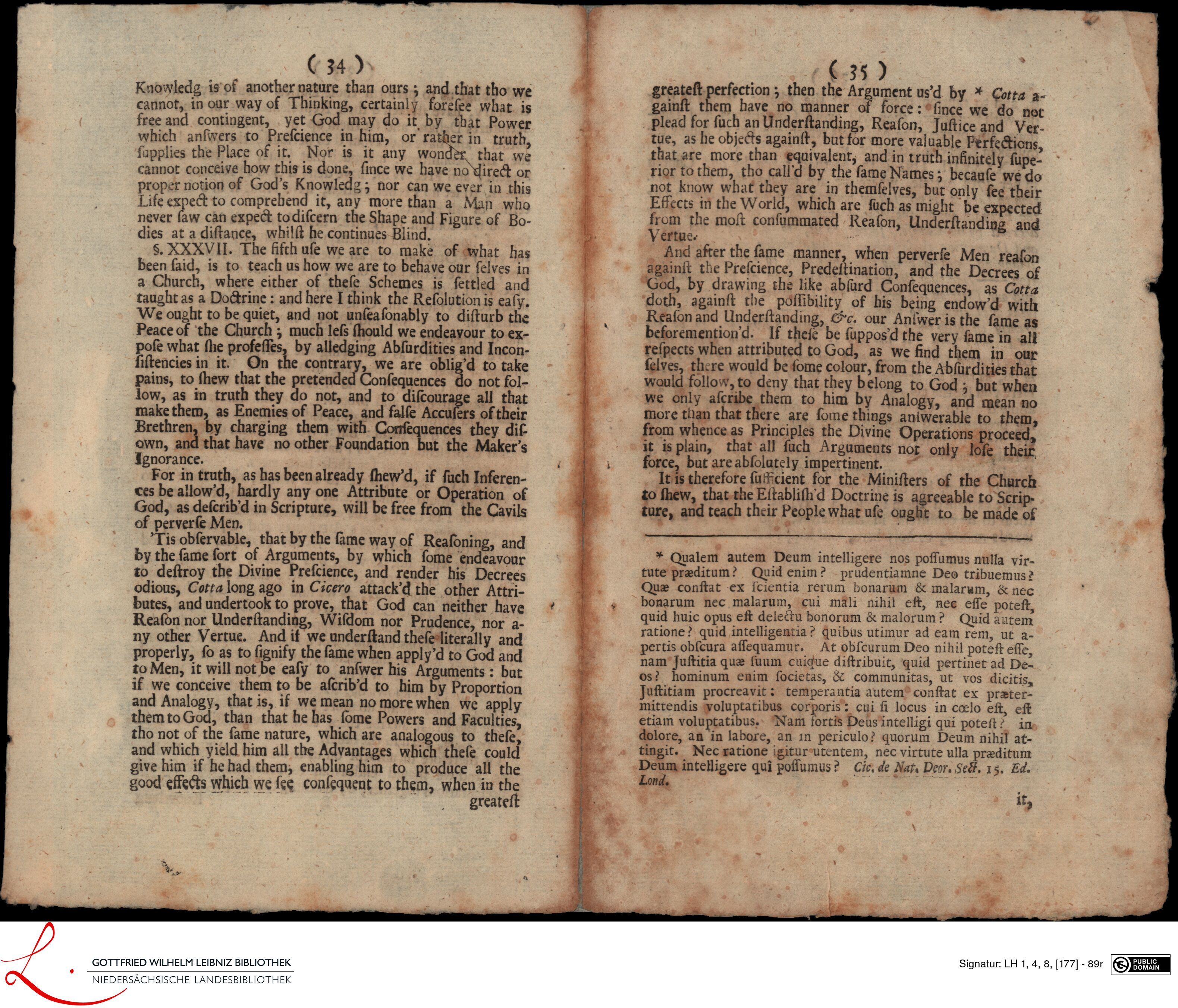
One image of two folio pages side by side, registered by the library under both labels (also fol. 88v); this page is its right half.
The machine reads it as
- Greatest perfection; then the Areument us d By X Cotta
- Painst them hare no manner et Force: lince We do noc
- plead For such an Understandine, Reason, Juctice and Ver-
- tue, as he objects asainst, bue tor more raluable Pertections,
- that are more than equiralent; and in cruch intinitels supe-
- rior tothem, tho calld by che lame Names; because me do
- noc tnom irhac ther are in themletres, buc only sec their
- Liffecis in the World, irhich are such as mietit be expected
- trem che most consummated Realon, Understandins and
- Vertue.
- And atter the same manner, irtien perverse Nen reason
- against the Prescience, Predestination, and the Decrees ot
- Cod, by dramins the likre absurd Consequences, a5 Cotta
- doch, asainst che postibilier of his beins endon d rich
- Reason and Understandins, ec. our Ansiver is the same as
- Detorementiond. IE these be supposdthe very same in aII
- respects irhen attributed to C0d, 25 re find them in oux
- Telres, there rould De lome colour, trom che Absurdicies that
- vould Follon, to denr chat cher belons to God; but nhen
- me onls ascribe them to him b Analoer, and mean no
- more chan chat there are lome thines antverable eo them,
- trom irhence a5 Principles ihic Dirine Operations procced
- ic is plain, chat aII such ArSuments noc onty lose their
- Force, but are absolutely impertinent.
- Ttischeretore susticient For the Ministers oF the Churck
- eo Merr, thac the F Hablistid Docerine is agrecable to Scrip.
- cure, and reach their Peoplenhacuse oushe to be made ot
- Oualem autem Deum intellisere nos pottumus nulla rir-
- tute praeditum: Ouid enim: Prudentiamne Deo tribuemus:
- Oua constat ex scientia rerum bonarum ee malarum, e nec
- bonarum nec malarum, cui mali aihil cAt, nec eAC potest
- quid huic opus es delectu Bonorum ec malorum: Ouid autem
- ratione: quid incellisentia: quibus utimur ad eam rem, ut a-
- pertis obscura assequamur. At obscurum Deo nihil potest ee,
- nam justitia quae Tuum cuidue distribuit, quid pertinet ad DC-
- 05: hominum enim Cocietas, e communitas, ut vos dicitis.
- Justitiam procrearit: temperantia autem constat ex prateF-
- mittendis voluptatibus corporis: cui s locus in coelo cA, cA
- etiam voluptatibus. Nam fortis Deus intellisi qui potest: in
- dolore, au in labore, an in periculo: quorum Deum nihil at-
- tinsit. Nec ratione isitur utentem, nec rirtute ulla praeditum
- Deum intetlisere qui PoNumVS: C10. de Nat. Deor. Sect. 15. Ed.
- Lond.
Cite
Leibniz-Handschriften zur Theologie LH 1, 4, 8, fol. 89r. Machine transcription, not an edition: Leibniz Legible (model FoNDUE-GD_v2_ft_Leibniz, run 74). https://leibnizlegible.com/page/00068331:0177?run=74