The Questions Concerning Liberty, Necessity, And Chance, fol. 160
Machine transcription. Not an edition. Errors are expected: about 8% character error rate on Latin and French lines, higher on German. Mean line confidence on this page: 0.93.
Original at the GWLB · Page image · Annotations (IIIF) · Download text
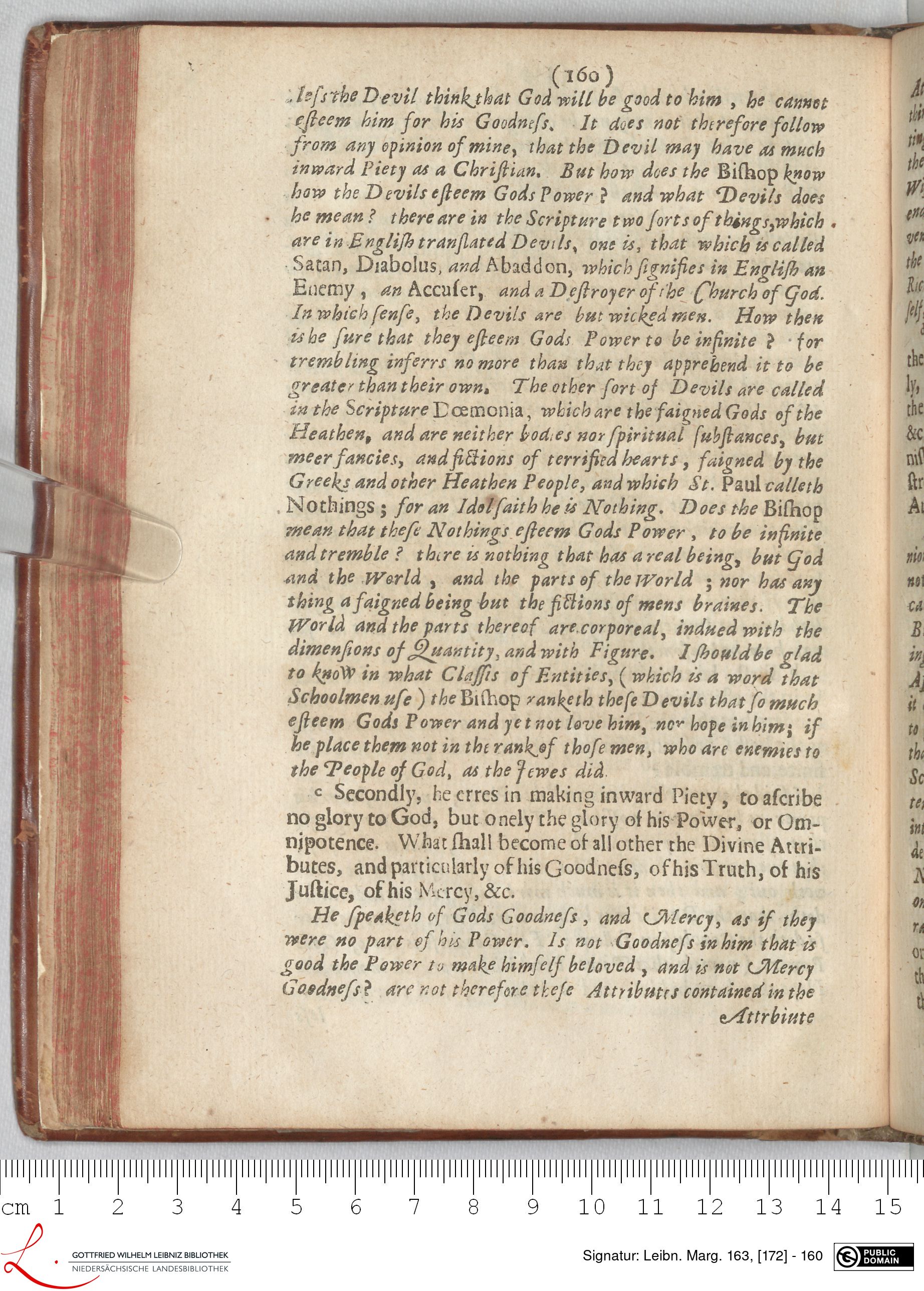
The machine reads it as
- 160)
- lessche Devit think that Cod mill be cood eohim, he cannot
- esteem him for his Coodness. It does not therefore follon
- from any opinion of mine, ibat the Devil may have as much
- inmard Piety as a Christian. But hom does the Bilhop knon
- hom the Devils esteem Gods Pomer d and what Devils does
- hemean? thereare in the Scripture tmo sortsof thines, mhich
- are in Englistranstated Devils, one is, that rhich is called
- Sacan, Drabolus, and Abaddon, irhich sienifres in Fnelis an
- Puemy, an acculer, and a D estroyer ofihe Churchof God.
- In rehich sense, the Devils are but wickedmen. Flor then
- ishe sure that they esteem G0ds Pover to be infinite e. For
- crembline inferrs nomore than that thes apprebend it to be
- rcater thantheiromn. Theother sort of Devilsare called
- in the Scripture Daemonia, wbichare the faiene d Crods of the
- Feathen and are neither bodes nor spiritnal substances, but
- meerfancies, andfictions of terrifsed hearts, faiened by the
- Crcetes andother Flearhen People, and which St. Paul calleth
- Nochines; for an Idol saithheis Nochine. Does rhe BichoD
- mean that these Nochines esteem Cods Porver, 10 be infinite
- anderemble? there is nothine that has areal beine, but God
- and the Worid, and ihe parrs of therrorid; nor has any
- thine a faiened being buc thefictions of mens braines. Tbe
- Worid and the parts thereot are corporeal, indued roith the
- dimensions of Duantity, and mith Fieure. IBonldbe elad
- 10 knom in mhat Classis of Fntities, (which is a mord that
- Schoolmenuse) theBistop ranketh these Devils thatsomuch
- esteem Cods Pomer and petnot love him; nor hope inhim; if
- he placethem not in therant of those men, whoare enemies to
- the People of God as the Fermes did.
- c Secondly, heerres in matine inward Pieer, toascribe
- noglory eo Cod, Duc onelyche glory othis Poiver, OrOm-
- niporence. WhacCall become ot allocher rhe Dirine aerri-
- Dures, and parriculartu oFhis Goodness, ofhis Truct, ot his
- Tultice, oFhis MerCI, EEC.
- Fe speaheth os Gods G0odness, and Meroy, as if theq
- vere no part of his Pover. Is not Goodness in him that is
- e00d the Porver Ls malee himself beloved, and is not Meroy
- Goednesse are not therefore these Actribures contained inthe
- Attrbinte
Cite
The Questions Concerning Liberty, Necessity, And Chance, fol. 160. Machine transcription, not an edition: Leibniz Legible (model FoNDUE-GD_v2_ft_Leibniz, run 74). https://leibnizlegible.com/page/1030877386:0172?run=74