The Questions Concerning Liberty, Necessity, And Chance, fol. 229
Machine transcription. Not an edition. Errors are expected: about 8% character error rate on Latin and French lines, higher on German. Mean line confidence on this page: 0.93.
Original at the GWLB · Page image · Annotations (IIIF) · Download text
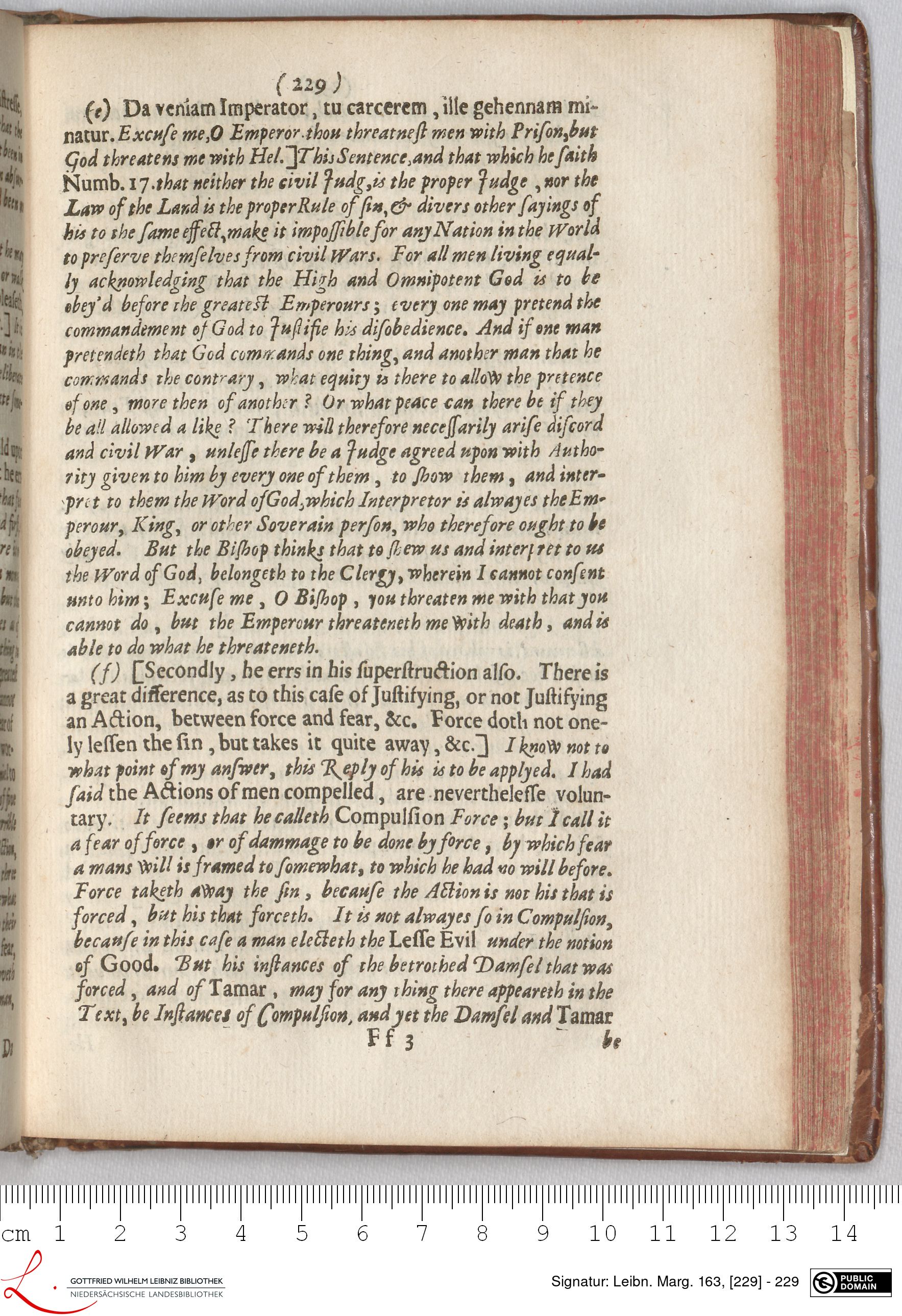
The machine reads it as
- (229
- (e) Da reniam Tmverator, ru carcerem, ille sehennam min
- naTUT. Exeuse me, OEmperor. thon chrearnest men with Prison but
- God threatens me mith Fel.)ThisSentence, and that rhieh he saith
- Nu b. 27. ehat neither the civit Fude, is the proper Fudee, vor the
- Lau ofthe Landis the properRule of sin, es divers other sagines of
- his to the same effect, make it impossible for any Lation inthe Wortd
- eopreserve themselves fromcivil Wars. For al men livine equal
- sy actnomledeins that the Flish and Ommipotent God is to be
- obey d before rhe createst Emperours; cvery one may pretend the
- commandement of Cod ro Fustifie his disobedience. And is one man
- pretendeth that Cod comm ands one rhine, and another man that he
- commands the contrary, wlat equiry is there to allou the pretence
- ofone, more then of another? Or wharpeace can there be if they
- be ail allome da lite? Fhere wil therefore necessarily arise discord
- and civil War, untesse there be a Fadee acreedupon rith Autho-
- rity sivento him by every one of them, to Bom them, and inter-
- pret ro themtheWord os Cod, rhich Interpretor is alvayes the Fm-
- perour, Kins, or other Soverain person, who therefore oucht tobe
- obered. But the Bishop thintes that tostem us and intertr et tons
- the Wordof Cod, belonseth to the C lerey, mherein Lsannot consent
- untohim; Exeuse me, OBishop, rou threaten me mith that jon
- cannot do, buc the Fmperour threarenethme With death, andis
- able to do rhat he threateneth.
- (5) (Secondly, he errs in his superstruction al(o. Thereis
- apreat disterence, asco this case of Justityins, or noc sustityine
- on Action, becreen Force and Fear, ac. Force dochnoc one-
- ly lessen cheun, buc cakes ic quire avay, _cc. ) TknoW not to
- har point of my ansver, this P exlyof his is to be applred. Phad
- said che actions ofmen compelled, are neverchelesse volun-
- TArV. It Seems thac hecalleth Compulsion Force; buc Icall it
- a fearofforce, or of dammaze ro be done byforce, by mhich fear
- amans will is framed to somenhar, to mhich he had uo mill before.
- Force taleth avay the fin, because the Actionis noc his thatis
- forced, bat his that forceth. Tt is not almayes so in C ompulsion
- becanse in this case a man electeth the L. ese Lvil under the notion
- of 600d. But his instances of the betroched Damsel that mas
- forced, and of Tamar, may for any rhine there appeareth in the
- Text, be Instances of Compulsion, and yet rhe Damsel and Tamar
Cite
The Questions Concerning Liberty, Necessity, And Chance, fol. 229. Machine transcription, not an edition: Leibniz Legible (model FoNDUE-GD_v2_ft_Leibniz, run 74). https://leibnizlegible.com/page/1030877386:0229?run=74