The Questions Concerning Liberty, Necessity, And Chance, fol. 288
Machine transcription. Not an edition. Errors are expected: about 8% character error rate on Latin and French lines, higher on German. Mean line confidence on this page: 0.93.
Original at the GWLB · Page image · Annotations (IIIF) · Download text
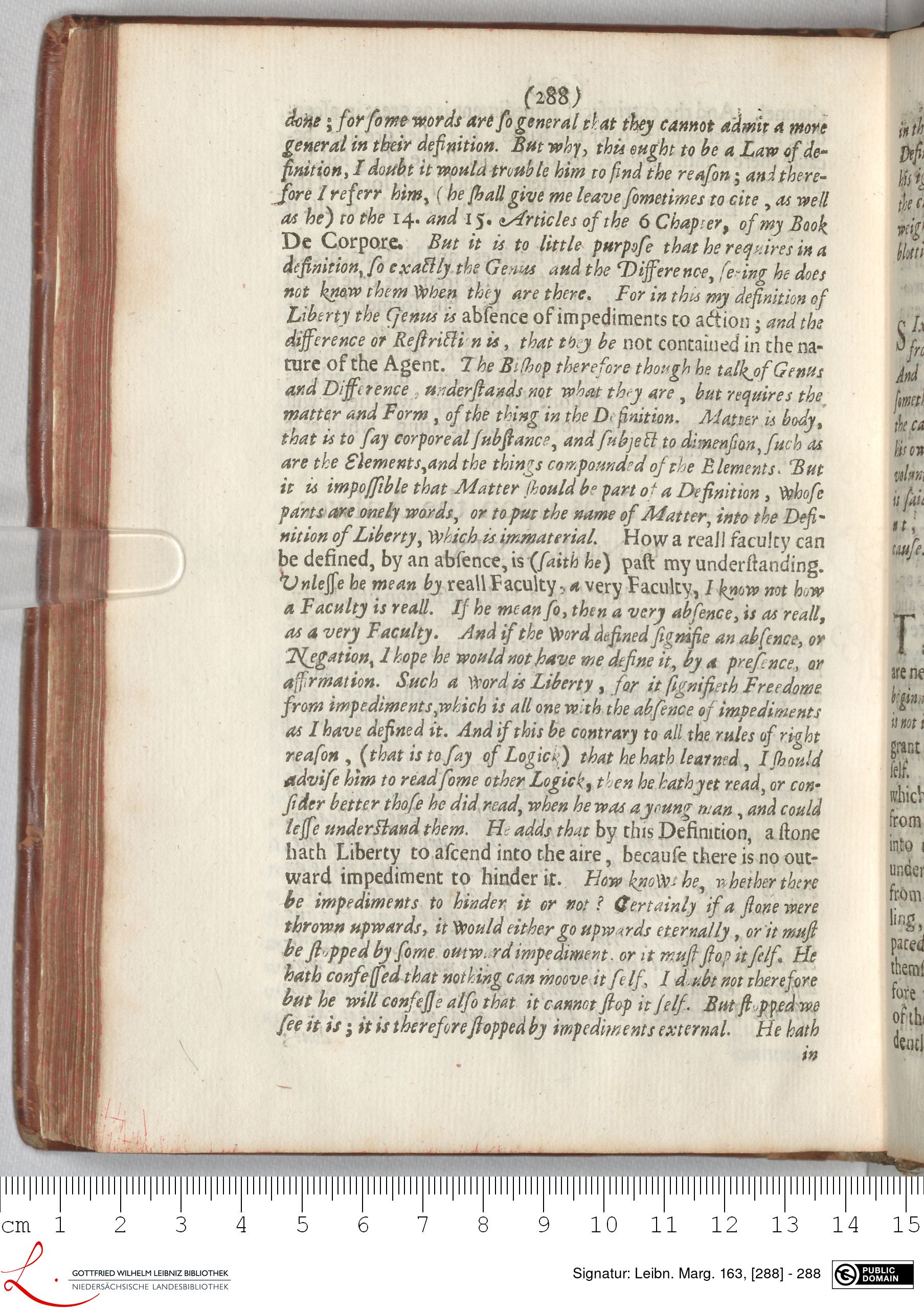
The machine reads it as
- (288)
- done; forsome mords are so generat et at they cannot admir a more
- general in tbeir definition. Bat Why, this oucht to be a Lam of de
- finition. Ldoubt it mould trouble him ro find the reason; and there-
- fore Treferr him. (hesall sive me leave sometimes rocire, as vell
- as he) rorhe L4. and 15. Arricles ofthe 6 C haprer, of my B00k
- De CorpOre. But it is to litele purpose thac he requires in a
- definicion, so exactly the Cenus audthe Difference, se ine he does
- not bnom chem vben ther arethere. For in this my definition of
- Liberer the Genus is absence of impediments eo action: and the
- difference or Restricti nis, that they be noc concaned in chena-
- ture oFche ASCNE. Zhe B, BoD therefore though he talle of Ccens
- and Difference anderstands not mhat theyare, but requires the
- matter and Form, of the thine inthe D. finition. Matuer is body.
- that is to say corporeal substance, and subje et ro dimension, such as
- are the Etements, and the thines componnded of ehe F. lements. But
- il is impossible that Matter Bould be part ot a Definirion, Wohose
- parts are onelr mords, or to pur the name of Matrer, into the Defi-
- nition of Liberry, Which is immaterial. Flow a reall Faculey can
- be detined, by an absence, is (saith he) past my understandins.
- Ontesse be mean by reall. Faculey, a very Faculey, Pbnom not hon
- a Faculry is reall. Is he meanso, then a veru absence, is as reall,
- as a very Faculty. And if the Word defined sienifre an ab ence, or
- Lecation, Lbope he mould not have me define it, by a presence, or
- affirmation. Such a mordis Liberer, for it sienifieth Freedome
- from impediments, which is all one mich the absence of impediments
- as Thave defined it. And is this be contrary to all the rules of richt
- reason, (that isto say of Logict) chat hehath learned, Lsould
- advise him to read some othen Logick, then he bath ret read, or con-
- sider better those he did read, when hemas a yonne man, and conla
- lesse understand them. F. adds thar by chis Definicion, a stone
- hach Liberer eo ascend inco cheaire, because chere is nO OuE
- ard impediment eo hinder ic. Hlon hnolv he, nhether thene
- be impediments to hinden it or not? Gerrainly if a stone mere
- thronn upmards, it vould either eo upmards eternally, or il must
- be stopped by some ommurd impediment. or it must stop it self. Ie
- hath conse sed rhat norhins ean moove it self. L d. ube not therefore
- huc he will confesse also rhat it cannot stop it self. But A.pped ve
- sec it is; it is therefore stoppedbys impediments external. Fle hat
Cite
The Questions Concerning Liberty, Necessity, And Chance, fol. 288. Machine transcription, not an edition: Leibniz Legible (model FoNDUE-GD_v2_ft_Leibniz, run 74). https://leibnizlegible.com/page/1030877386:0288?run=74