The True Intellectual System Of The Universe, fol. 184
Machine transcription. Not an edition. Errors are expected: about 8% character error rate on Latin and French lines, higher on German. Mean line confidence on this page: 0.93.
Original at the GWLB · Page image · Annotations (IIIF) · Download text
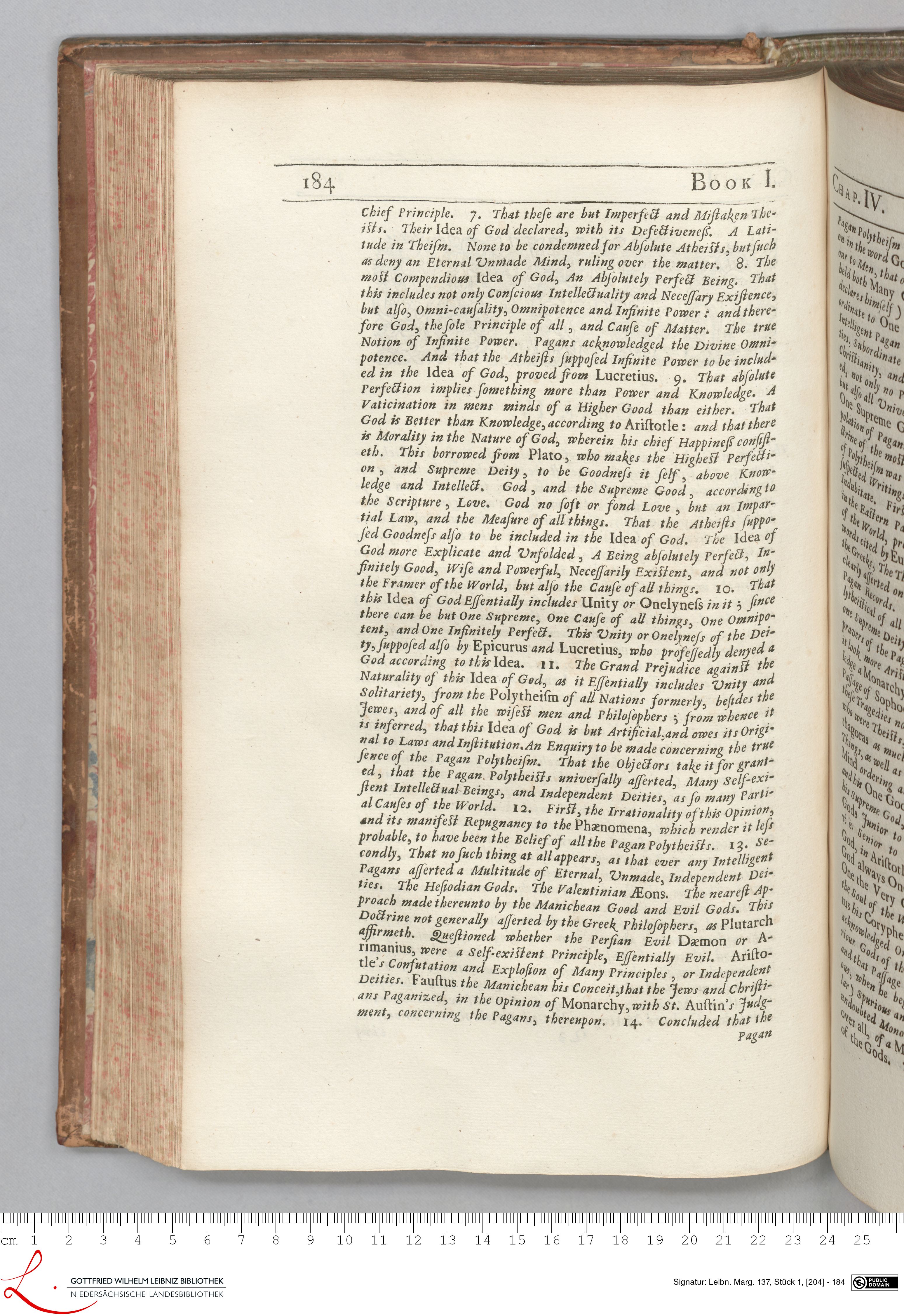
The machine reads it as
- Chief Prhciple. 7. ThatThese are but imperfect and Mistaten ZI
- ists. Therrillea of God declared, with ils Defectiveness. A Lat
- inde in Theism. None to be condemned for absolute Athersts, butsuch
- as deny an Eternal Onmade Mind, ruline over the matter. 8. The
- most compendions Idca of Cod an absolutely perfect Beine. That
- this includes not onty Conseions Intellectuality and Necessary Existence,
- but also Omni-causality, Omnipotence and infinite Pover: and there-
- fore 6od, thesole Principle of all, and cause of Matter. The true
- Notion of insinite Pover. Pasans acknomledeed the Divine omni-
- potence. And that the atheists supposed Insinite Pover to be includ
- ed in the Idea of Cod, proved srom Lucretius. 9. Thar absolute
- perfection implies somethine more than Porver and Knomledse.
- vatioination in mens minds of a Fieher Good than either. That
- Ood is Berter than Knomledee, accordine to aristorle: and thatthere
- is Morality in the Nature of God, wherein his chies Flappines consist
- eth. This borromed srom Plato, who makes the Fiehest perfecti-
- on, and Supreme Deity, to be Goodness it sett, above Knom
- ledee and intellect. Cod, and the Supreme Cood, accordineto
- the Scripture, Love. Cod no sost or fond Love, but an impar-
- tiat Laro, and the Measure of all thines. That the atheists suppo–
- sed Goodness also to be included in the Idea of God. The Idea os
- Cod more Explicate and Onsolded, A Beins absolutely Perfect, In
- finitely G0od, Wise and Poverful, Necessarily Existent, and not onty
- the Framer of the Worid, but also the c’ause of al thines. 10. That
- ibis Idca of Cod essentially includes Ulnity or Onelynels in it; since
- there ean be but one supreme, one cause os all thines, One omnipo-
- tent, andone insinitely Perfect. This 2nity or Onelyness of the Dei
- ty supposed also by Epicurus and Lucretius, uho professe aly denved a
- Eod accordine torhis Idea. IY. The Crand Prejudice aeainst the
- Naturality of this Idea of Cod, as it Essentially includes 2nity and
- Solitariety, from the Polycheilm of al Nations formerly, besides the
- ferves, and of alt the misest men and Philosophers; from inbence it
- is inferred, thatthis Idea of God is but artificial, and omes its orier
- nal to Laros and institution. An Fnquiry to be made concernins the true
- senceof the Paean Polytheism. That the Objectors take it for erant.
- ed that the Paean. Polytheists universally asserted, Many Sels exi
- stent Intellectual Beines, and Independent Deities, as so many Parti
- at Causes os the Worid. 12. First, the Trrationality ofthis Opinion
- and its manifest Repugnancy to the Phaenomena, which render it less
- probable, to have been the Belief of allthe Pasan Polytheists. 23. Se-
- condly, That no such thine at all appears, as that ever any intelligent
- Pasans asserted a Multitude of Eternal, Onmade, Independent Dei-
- iies. The Hestodian Cods. Ehe ralentinian AEONS. The nearest AP.
- proach made thereunto by the Manichean 600d and Fvil Cods. This
- Doctrine not generally asserted by the Creck Philosophers, as Plutarch
- affirmeth. Questioned Whether the Persian Fvil DxmOn or A-
- rimanius, vere a Self. existent Principle, Essentially Evil. Aristo.
- des confuration and Explosion of Many Principles, or Independent
- Deities. Faustus the Manichean his Conceit. That the feros and Christi-
- ans Pasanized, in the opinion of Monarchy, with St. Aultins fude
- ment, concernins ihe Pagans, thereupon. 14. Concluded that ihe
- Pasan
- et
- le
Cite
The True Intellectual System Of The Universe, fol. 184. Machine transcription, not an edition: Leibniz Legible (model FoNDUE-GD_v2_ft_Leibniz, run 74). https://leibnizlegible.com/page/1066509719:0204?run=74