The True Intellectual System Of The Universe, fol. 202
Machine transcription. Not an edition. Errors are expected: about 8% character error rate on Latin and French lines, higher on German. Mean line confidence on this page: 0.90.
Original at the GWLB · Page image · Annotations (IIIF) · Download text
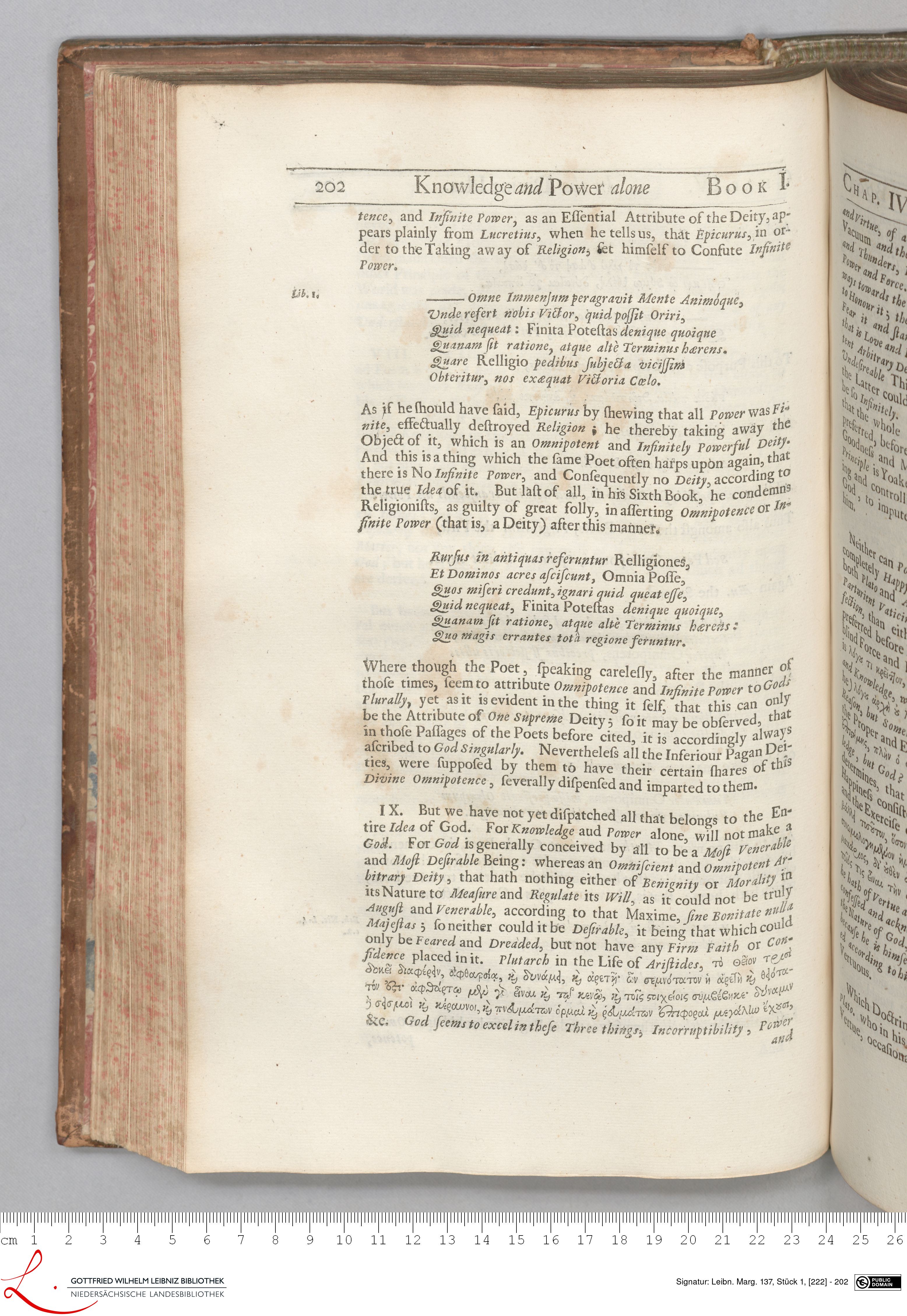
The machine reads it as
- Lnorrledoc and Porver alonc
- tence, and insinite Pover, 25 an Fential Aecribute ot theDCitY, ap
- pears plainty trom Encretins, Wrhen he cellSUS, ThAE Apicurus, in OF
- der coche Pakcins an ay oF Relision, set himselEto Confuce Infinite
- Pover.
- omne immensum peraeravit Mlente Animoque
- Unde refert nobis rutor, quid possit Oriri
- Duid nequeat: Finita POresas denique qnoigne
- Quanam sit ratione, atque alte Terminus haerens-
- Duare Rellisio pedibus subjecta vicissim
- Obteritur, nos exaequat Victoria Caelo.
- A5 je hechould have Paid, Epicurus by Bemins chat all Pomer WasFi
- nite, eectually destroyed Relision; he chereby takcine amay the
- Obicet oE ic, irhrich is an omnipotent and Infinitely Poverful Deity.
- And chis isa chins itrich thC (aC POCE Oscen harps uxon again, thab
- therc is NoInfinite Pover, and Conleguenely no Deity, accordins tc
- theirue Idea OF ic. But lastOF all, in tirs Sixth BOOK, he condemn:
- Relixionilts, as suilty oF great Folly, in altertins omnipotence or In
- finite Porver (chatis, 2 Deity) ascer ThiS MAMHCES
- Kursus in antiquas referuntur Rellisiones
- Et Dominos acres asciscunt, Omnia Pose.
- Duos miseri credunt, ignari quid queat esse
- Duid nequeat, Finita Pocestas denigue quoique
- Quanam sit ratione, atque alte Terminus herens:
- Quomasis errantes totâ resione feruntur.
- Wrhere thoueh the POEF, Spcakins carclesty, aCcer the manner O
- thole times, scemto actribute omnipotence and Infinite Pomer tOCod.
- Plurally, yec asit is evident inche thins it selF, thac chis can ont
- bethe Accribute oF One supreme Dcitr; Coit mar be observed, chau
- in those Pallages oF the Poets before cited, it is accordingly alvay
- ascribed to Cod singulariy. Nevertheless allthe InFeriouE Pagan DCt
- tieo, ere suppoled by them to hiave their certain Bares OF thIS
- Divine Omnipotence, Pererally dispen (ed an d imparte d tothem.
- TX. BUE we have noc yet dispatched all chât BelOneS LO thC EN
- tire Idea OF Ood. For Knomledse aud Pover alone, will not make:
- Cod. For God is generally conceired by aIl to be a Nost Venerable
- and Most Destrable Beins: Whereas an Omniscient and omnipotent ar
- bitrary Deity, that hach nochins cicher oP Benienity Or Morality I
- itSNature to Measure and Regulate itS W ill, 25 it con le nOE BC truI)
- ausust and renerable, accordins eo that Maxime, sine Bonitate null
- Majestas; Concither coulditve Desrable, it Beins that wtich coute
- ouly beFeared and Dreaded, but not have any Firm Faith Or Cdi
- sidence placed init. Plutareh in the Lise OE Aristides, 2d Ocior re
- donei diueredo, aapoia, ns duraud, rs aeerii CV OEIIISTarOV n aieeli Bdra
- ror 63 a Dderco peti ge Eivat ny r nercon n, roi5 501X ciois ovuB e BuXE. dcraetl
- odopeoi i, niecevvo, n, rvo uarcov opuat ris est parcor 67 2Bo eCt pc zel N ex 501
- _C. Eod seemsto excel inthese Three thines; incorrupribility, Pom
- ana
Cite
The True Intellectual System Of The Universe, fol. 202. Machine transcription, not an edition: Leibniz Legible (model FoNDUE-GD_v2_ft_Leibniz, run 74). https://leibnizlegible.com/page/1066509719:0222?run=74