The True Intellectual System Of The Universe, fol. 387
Machine transcription. Not an edition. Errors are expected: about 8% character error rate on Latin and French lines, higher on German. Mean line confidence on this page: 0.91.
Original at the GWLB · Page image · Annotations (IIIF) · Download text
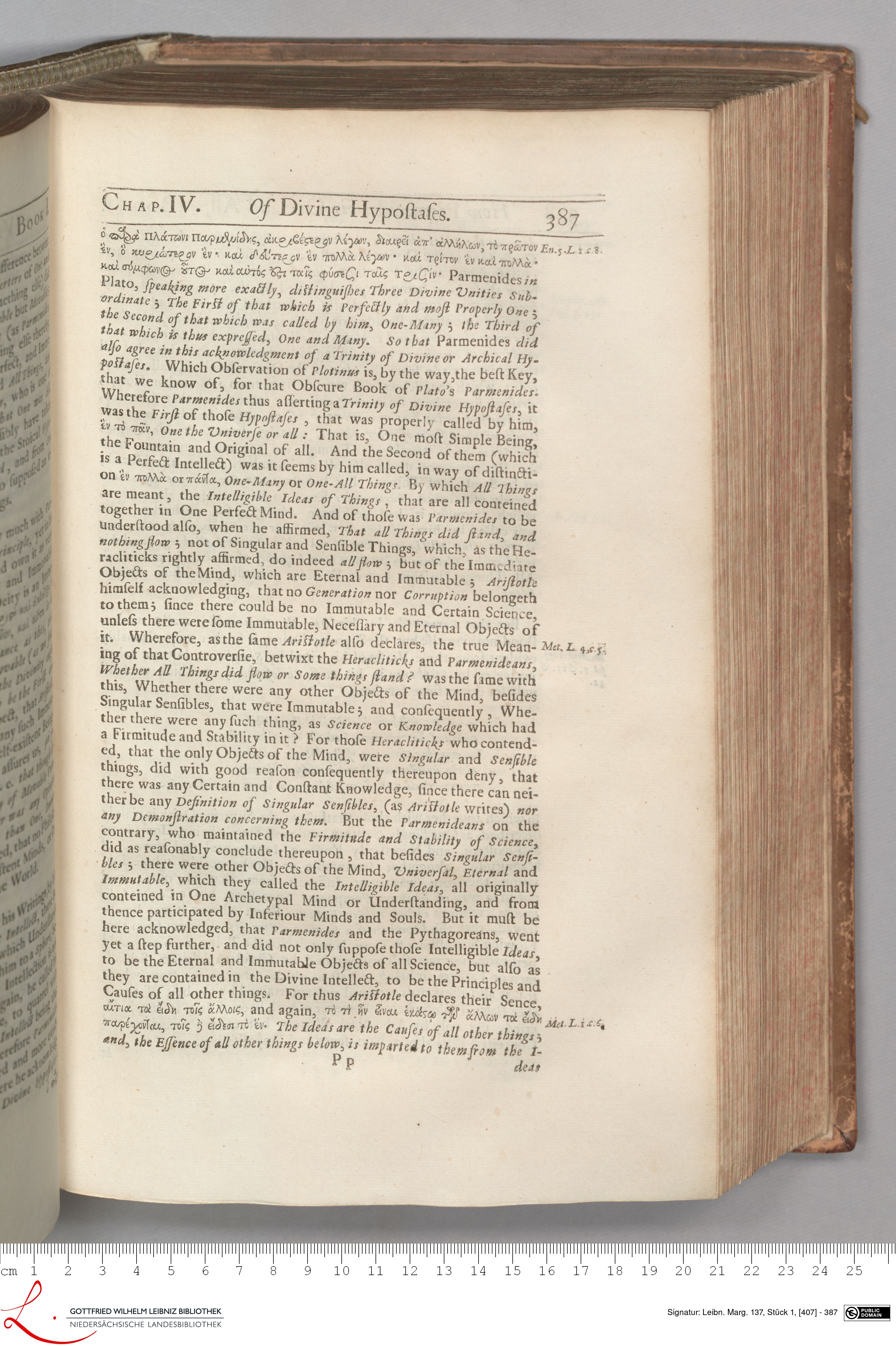
The machine reads it as
- Dirine Iypoctales.
- EDi TINATEoM TaPuIdrS, an C CBESEC GV NeycV, Draceci a n’ ANHNCOV, r0 nec
- Ev, d neoee Ev: nat S8l=COV EV HOMA NércOV. nai TeITOV ev ne l HOMa
- nal ovupco ) 3r9) nai avres S rais DborCI Tais Te Cir Parmenides in
- Placo, speahine more exactly, distinguisses Three Divine 2nities Sub-
- ordinate; The First of that which is perfectly and most Properly One
- the Second of that which mas called by him, One- Many; ihe Third of
- that which is ihus expressed, one and Mang. 50rbat Parmenides did
- also aeree inthis achnomledement of a Frinity of Divine or Archical Hy
- postases. Which Obserration of Plorinus is, by che way, the bestRey.
- FHAE We HnO OF, FOr THAE OBSCure BOOH OE Platos Parmenides.
- WhereEore Parmenides chus altertins a Trinity of Divine Typostases, it
- asthe First oE chole Eypostases, thac mas properly called by him
- v rd neir, One the 2 niverse or all: Fhac is, One most Simple Beinz.
- the Fountain and Oripinal oF all. And the Second ot them Cirhich
- is a Pertect Intellect) mas ic scems by him called, in may os distincti-
- On EV KOMa Ox Xaila, One- Many Or One- AII Thines. By Wtich AI Zhines
- are meane, the Intellicible Ideas of Thines, thac are all conteined
- corecher in One Pertect Mind. And oF chole was Parmenides cobe
- understood alio, when he aftirmed That au Thines did stand, and
- nothine son; noc oE Singular and Sensible Things, Which, as theHle-
- raclicickes righely attirmed, do indecd al stow; buc oF chelmmedisre
- Objects oE chemind, which are Eternal and Immucable; Aristorie
- him(elE ackenomledgins, chatno Generation nor Corruption Belonseth
- cothem; Cince there conld be no Immutable and Certain Science.
- unlels there mere lome immutable, Neceslary and Pternal Objects of
- it. Wheretore, asche lame Aristorle al(o declares, che trUC MCaN- Met. L 4 c.5.
- ing of that Controrerhe, betrixe the Heracliticks and Parmenideans.
- Whether au Thines did Rom or Some thines stand e wasthe Pame wicti
- this, Whether there vere any orher Objects ot che Mind, Belides
- Singular Sensibles, that vere immutable; and consequentr, Whe-
- ther there vere any Puch ching, a5 science or Knomledee whicha had
- a Firmitude and Scabilier in ic d P’or thole Heractiticks Wrho contend-
- cd, chat the ontr Objects oE the Mind, vere sincular. and sensible
- thinos, did wich rood reason consequeney Mereuxon deny, thac
- there was any Certain and Constant Knomledee, Cince there can nei-
- cherbe any Definition of singular sensibles, (a5 Aristotle Weites) nor
- any Demonstration concernine them. But the Parmenideans on thC
- contrary, Wrho maintained the Firmitnde and Stability of Science
- did as reatonably conclude chercupon, thac behdes sineular sense-
- bles; chere mere other Objects oP theMind, 2niversal, Fternal and
- immutable, irtrich chey called che Intelligible Ideas, all originally
- conceined in One Archecrpal Mind or Understanding, and From
- chence participaced by Inferiour Minds and Souls. But ic must BC
- here acknomledsed, chac Parmenides and the Prthagoreans, vent
- vec a Ctep Further, and did noc only supposechole Incellisible Ideas
- eo bc che Eternal and Immutatule Objects oF all Science, Dut al(0 25
- ther are contained in cheDivine Intellect, to bcche Principles and
- Causes oF alI other things. Por thus Aristorle declares thieir Sence.
- aeriae ra eidn rois àMoiS, and again, 7d 7 sv Evaet Evelsco 2d a NCoV ree Eidn atol. L. L. c. 6.
- aDE IS S AdEor rd Er. The Tdeasare the Causes of all other thines;
- end, ihe Essenceof all other thines belom, is imparted to them srom the t.
- deas
- CHaP. IV
Cite
The True Intellectual System Of The Universe, fol. 387. Machine transcription, not an edition: Leibniz Legible (model FoNDUE-GD_v2_ft_Leibniz, run 74). https://leibnizlegible.com/page/1066509719:0407?run=74