The True Intellectual System Of The Universe, fol. 389
Machine transcription. Not an edition. Errors are expected: about 8% character error rate on Latin and French lines, higher on German. Mean line confidence on this page: 0.86.
Original at the GWLB · Page image · Annotations (IIIF) · Download text
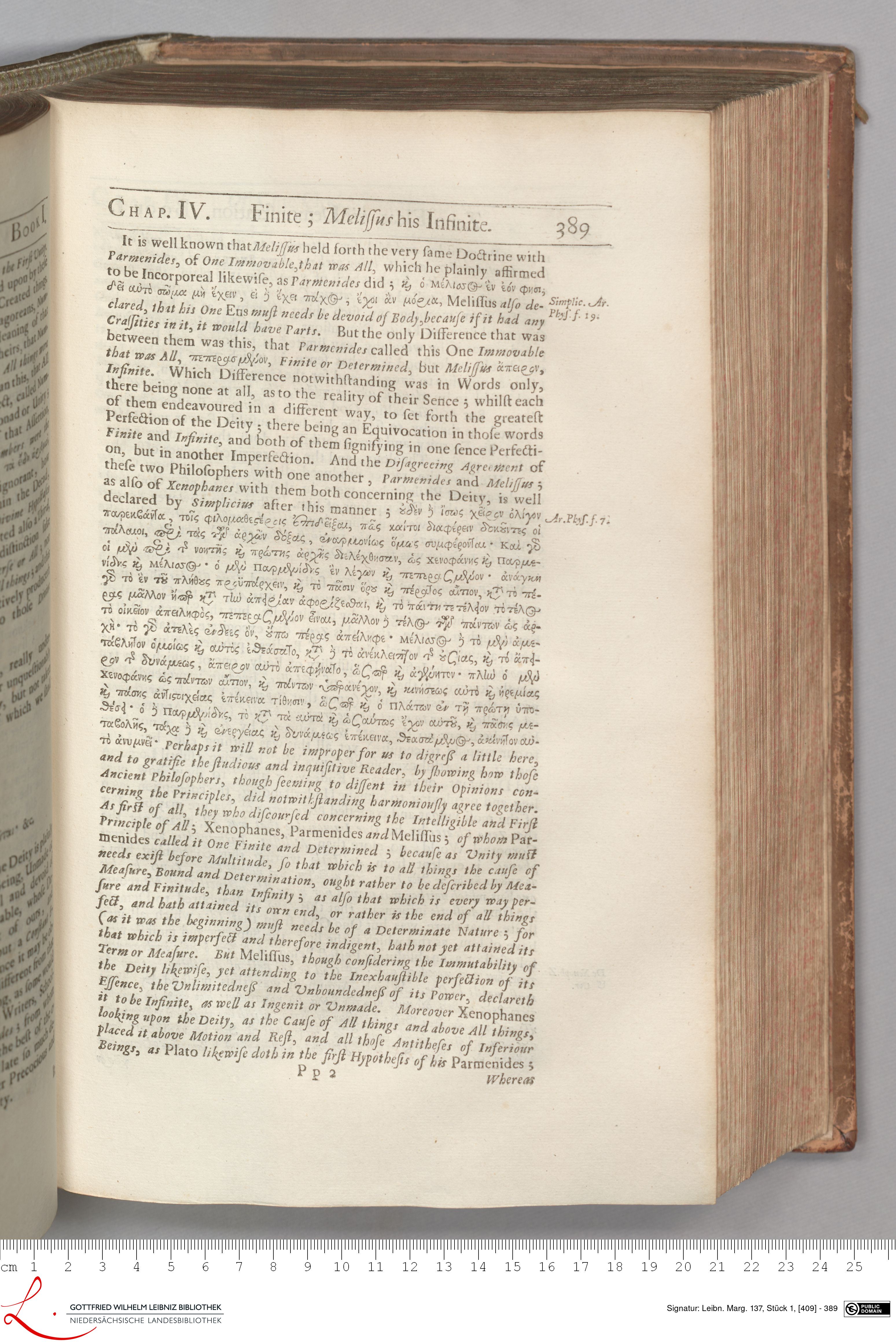
The machine reads it as
- Finice; Melissus his Intinite.
- IE is ell HnomnchatMelissis held Corthche very Same Doctrine wicl
- Parmenides, OF One Immovable, that was AIL, Wvtich he plainty aftirmed
- cobe Incorporeal likemise, as Parmenides did; ses o Menta C ev eoi por
- Sei auro ocojae in exei, ci 3 exa ndX9; 2701 av soeca, Melistus also de Simplic. Ar.
- clared, ihat his one Ens must needs be devoid os Body becanse if it had ang 2 13 S. f. 19.
- Crassiries in it, it vould have Parts. But the only DifFErenCC CMAE ir 2S
- betreen them was chis, that Parmenides called ehis One Immovable
- that was All, EnEegONSOV Finite or Determined, buE Melissus ance g
- Infinite. Which Disterence normichscandino ias in Words only.
- there being none at all asto the realiry oF cheir Sence; Wwhils each
- OF them endearoured in a differene way, to set Forth che greATeCE
- Persection ot che Deity. Chere being an Equivocation in chole mords
- Finite and Infinite, and boch ot them Conifyins in one senee Pertecti-
- on but in anocher impertection. And ihe Disacrecine Aereement ot
- thele emo Philosophers rith one anocher, Parmenides and Melissus:
- a5 al(O OE Kenophanes with them Boch concernins the Deier, is well
- declared by simplicius atter ihis manner; Ediv ) iocos Xeie ct on igoV Mr. Ply 5. f. 7.
- ravencaia, nois ∞ioasteS CCiE naS vairoI dape denS oi
- nahasoI 245 aezur dosac, erappovicos sucs oyupéeoitat. Kat 70
- si pi : D vorS NecoNS aeZIS DICN EXDHOAV CoE XEVODME TaDuE
- vidrs i MENIaSO. o pi TapuidrE Er NErcoV n HEneGC, oV. avecyun
- d 2d Ev IE NiDSS necindexCI i, ro nuo des i néeglos alTIOV, n 70 E
- egS MaMOV n n T ardeiar apoZeada 2d aV En Z =eN doV Yd =E
- 20 oincior aXCIAHOOC, IEHECGC, N SOV EivaI VAMOV; =ENO ~ aVTEV coE a
- Zu. rd q aAES erdres ov, 3nC TÉgS a EIAHDE. MENIaSG y ro pd a
- rabaulor opecicis i avris Edeuoato, 7 y 7d aven A C (oV ~ 8C, 1aG, i, 20 a nd-
- eq dorauraes axceor aurd a epalo, ao C ap n aonrer. XN o udd
- ZEVOPEETHS CG HOVTCN aITIOV, n, HdVTCOV raspaVE2OV, n, nuiorcos avrd n, neculac
- ies nons aliSerXeiaE ExEHCO TIBHON, Cd C cot H O HNCETCV et En recorn Vno-
- deod. o 3 TraxuidrC, r0 72 ra avra u, co C abTCG 270V aV7B, ny n oS E
- reCONHS, raeza ) i ercerea n, DevapCS Erencra, Deaoa O, animtor av
- arouvei Perhapsit will not be improper for us to dieres a litile here-
- and to gratisie thestudions and inguisitive Reader, by stormine horo ihose
- ancient Philosophers, thoueh seemine to dissent in tbeir opinions con-
- cernine the Principles, did notrvit standins harmonionsty aeree tocet her-
- A5 first of altue ther roho discoursed concernine the Intellieible and First
- Principle of AI; Xenophanes, P’armenides and MeliNTuS; of whom PAE-
- menides called it One Finite and Determined; because as Dnity must
- necds exist before Multitude, so that mbict is to alt rhines ihe cause of
- Measure, Bound and Determination, oneht rather to be deseribed by Mea-
- sure and Finitude, than Enfinity; as also that mhich is every may per-
- fect, and hath artained its ornend, or rather is the end of all thines
- Cas it vas the heginnine) must necds be of a Determinate Nature: for
- that which is imperfect and therefore indisent, hath not yet attained its
- Termor Neasure. But Melistus, thouch considerins the immutability of
- the Deiry likeroise, ret attendine to the Tnexhaustible perfection of its
- Essence the Ontimitednes and Vnboundedness os ils Porver, declarett
- et tobe insinite, as velas ingenit or Vnmade. Moreover Zenophanes
- loohins upon the Deity, as the Cause os al thines and above AII thines.
- Placed it above Motion and Rest, and all those Antitheses os Inferiour
- Beines, as Plato likemise doth in the first Hypothesis of his P’armenides;
- Wrhereas
- GHAP. Y
Cite
The True Intellectual System Of The Universe, fol. 389. Machine transcription, not an edition: Leibniz Legible (model FoNDUE-GD_v2_ft_Leibniz, run 74). https://leibnizlegible.com/page/1066509719:0409?run=74