Philosophical Principles Of Natural Religion, fol. -
Machine transcription. Not an edition. Errors are expected: about 8% character error rate on Latin and French lines, higher on German. Mean line confidence on this page: 0.86.
Original at the GWLB · Page image · Annotations (IIIF) · Download text
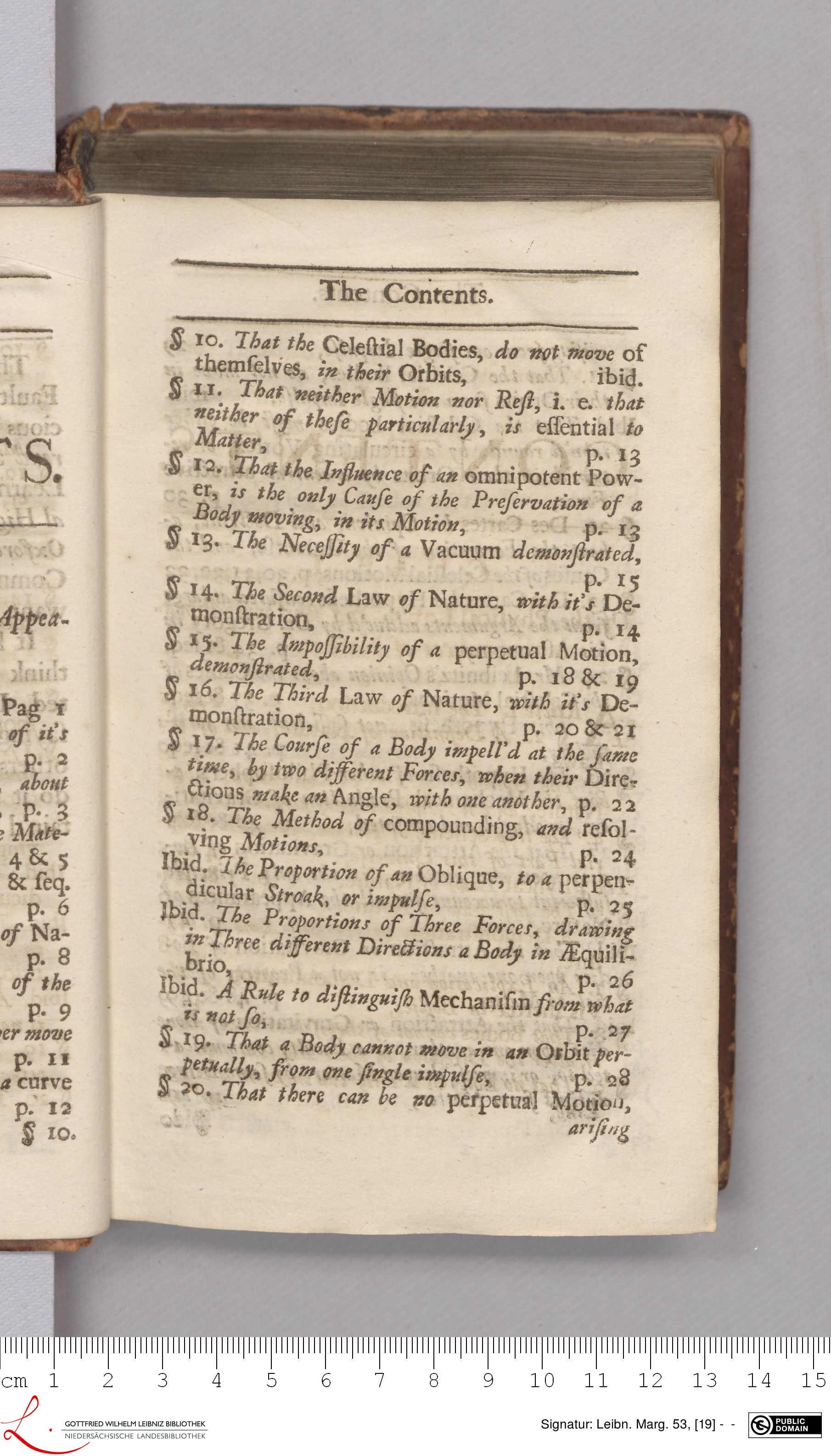
The machine reads it as
- Axpean
- Aeii
- eae
- of it s
- abont
- D..2
- Mate
- 4 eC5
- e lcq.
- D. C
- D. E
- of the
- D. 9
- er move
- P. TI
- D. 12
- 8 10.
- alde WenCo.
- S 2O. That the Celestial Bodies, do not move oF
- themcelres, in their Orbits,
- ibid.
- DTT. That neither Motion nor Rest, I. c. that
- neither of these particularly, is essential s0
- Matier.
- 12. That the Instuence of an omnipotent Por-
- er, is the onty Cause of the Preservation of a
- Body movins, in ils Motion,
- d13. The Necessity of a Vaeuum demonstrated,
- ST4. The Second LaW of Nature, with its De-
- monstration
- 25. The Impossibility of a Perpetual Motion,
- demonstrated.
- D. 18e 19
- 516. The Third LaW of Nature, vith ils De-
- monstration,
- D. 20∞ 21
- d17. The Course of a Body impell d at the same
- time, by tuo different Forces, when their Dire-
- ctions makie an Ansle, vithone another, D. 22
- d18. The Method of compoundins, and relol.
- vins Motions,
- 24
- IBid. The Proportion of an Oblique, to a PerDen
- dicular Stroak. or impulse,
- DBid. The Proportions of Three Forces, dramine
- in Three different Directions a Body in Aequili-
- brio
- P. 26
- bid. A Rule to distinguiss Mechanisim from what
- 25 not s0.
- d. X9. That a Body cannot move in an Orbit per-
- petually, from one sincle impulse,
- 1 eD. 28
- 20. That there can be no perpetuat Morio,
- arisit
Cite
Philosophical Principles Of Natural Religion, fol. - . Machine transcription, not an edition: Leibniz Legible (model FoNDUE-GD_v2_ft_Leibniz, run 74). https://leibnizlegible.com/page/797370323:0019?run=74