Philosophical Principles Of Natural Religion, fol. 8
Machine transcription. Not an edition. Errors are expected: about 8% character error rate on Latin and French lines, higher on German. Mean line confidence on this page: 0.78.
Original at the GWLB · Page image · Annotations (IIIF) · Download text
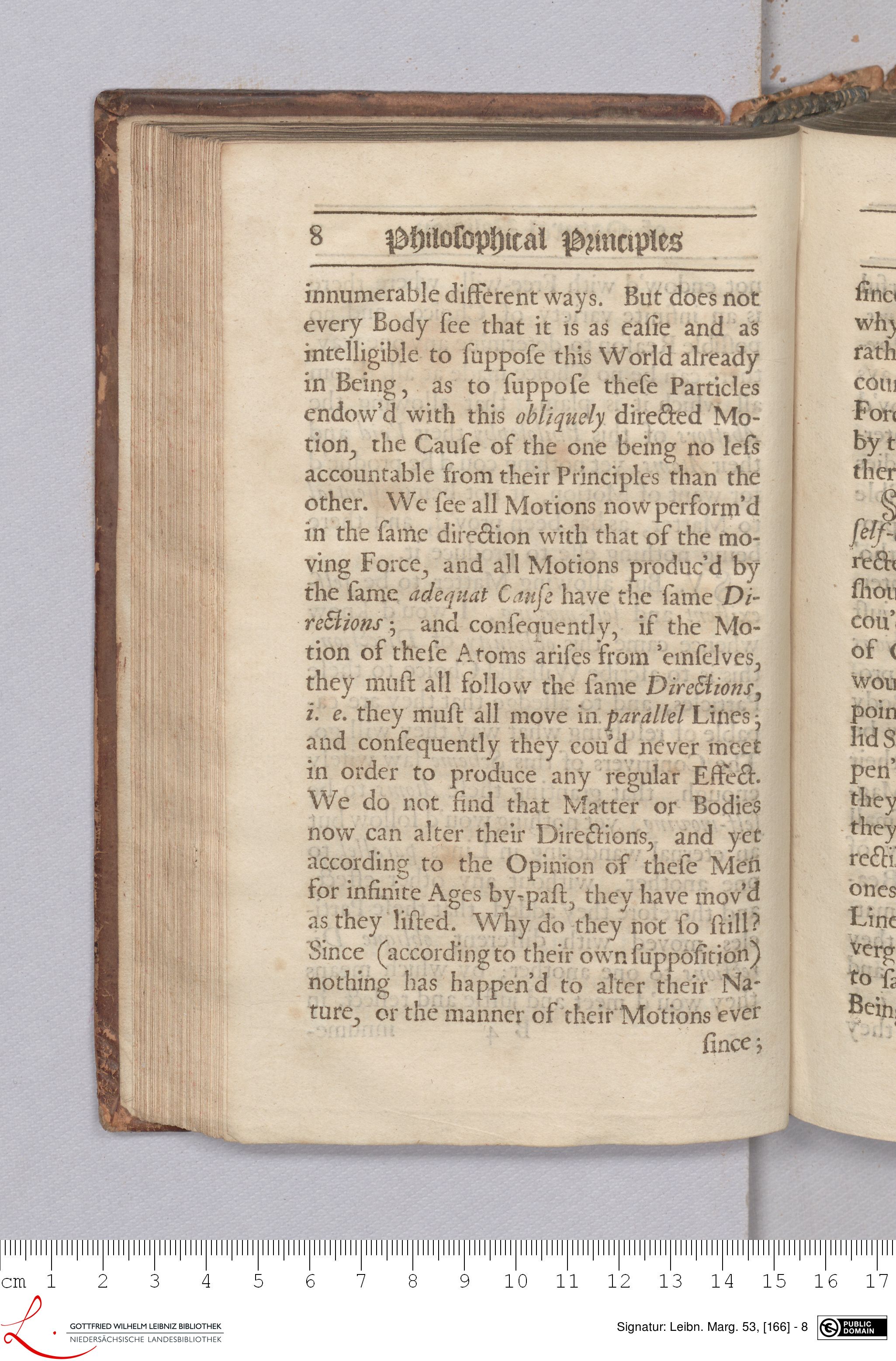
The machine reads it as
- Biloio
- dical princivli
- innumerable diAerenEWayS. BUE does AOE
- ererr Body sec that ic is as calie and aS
- incellisible eo suppose this NVorld already
- in Being, as to suppose chele Particles
- endor d rith ehis oblignely directed Mo-
- tion, the Cause of the one being no lels
- accountable trom cheir Principles than che
- Other. We Sec alI Nlotions non pertormd
- in the Pame direction with Fhat OE the mo-
- vins Force, and all Mocions produc d BY
- the Came adequat Cause have the Tame Di
- rections; and consequentr, il the MO-
- tion ot chelc Atoms arises from emselves
- ther must all Eollorr che Came Directions,
- i. e. they musc all move in parallet Lines:
- and consequently ther cond never méet
- in oeder to produce any regular FAect.
- WVe do net And chat Dtatter or Bodies
- nor ean alter cheir Directions, and vet
- accordino to the Opinion oF chele Net
- For infinire Ages by. past, ther have movd
- as ther listed. WVhy do they noc (0 RiII
- Since (accordingto their otrn suxposicion)
- nochino has happend eo alcer cheir Na
- ture, or the manner oF cheir MOtiOnS evet
- GInCC;
- r
- l’e
- b
- e
- re
- MO
- CoI
- oF
- WVor
- PBI
- lid
- DC
- 10
- BC
- Ehe
- ehre
- tCc
- Onc
- LI
- ve
Cite
Philosophical Principles Of Natural Religion, fol. 8. Machine transcription, not an edition: Leibniz Legible (model FoNDUE-GD_v2_ft_Leibniz, run 74). https://leibnizlegible.com/page/797370323:0166?run=74