Philosophical Principles Of Natural Religion, fol. 19
Machine transcription. Not an edition. Errors are expected: about 8% character error rate on Latin and French lines, higher on German. Mean line confidence on this page: 0.87.
Original at the GWLB · Page image · Annotations (IIIF) · Download text
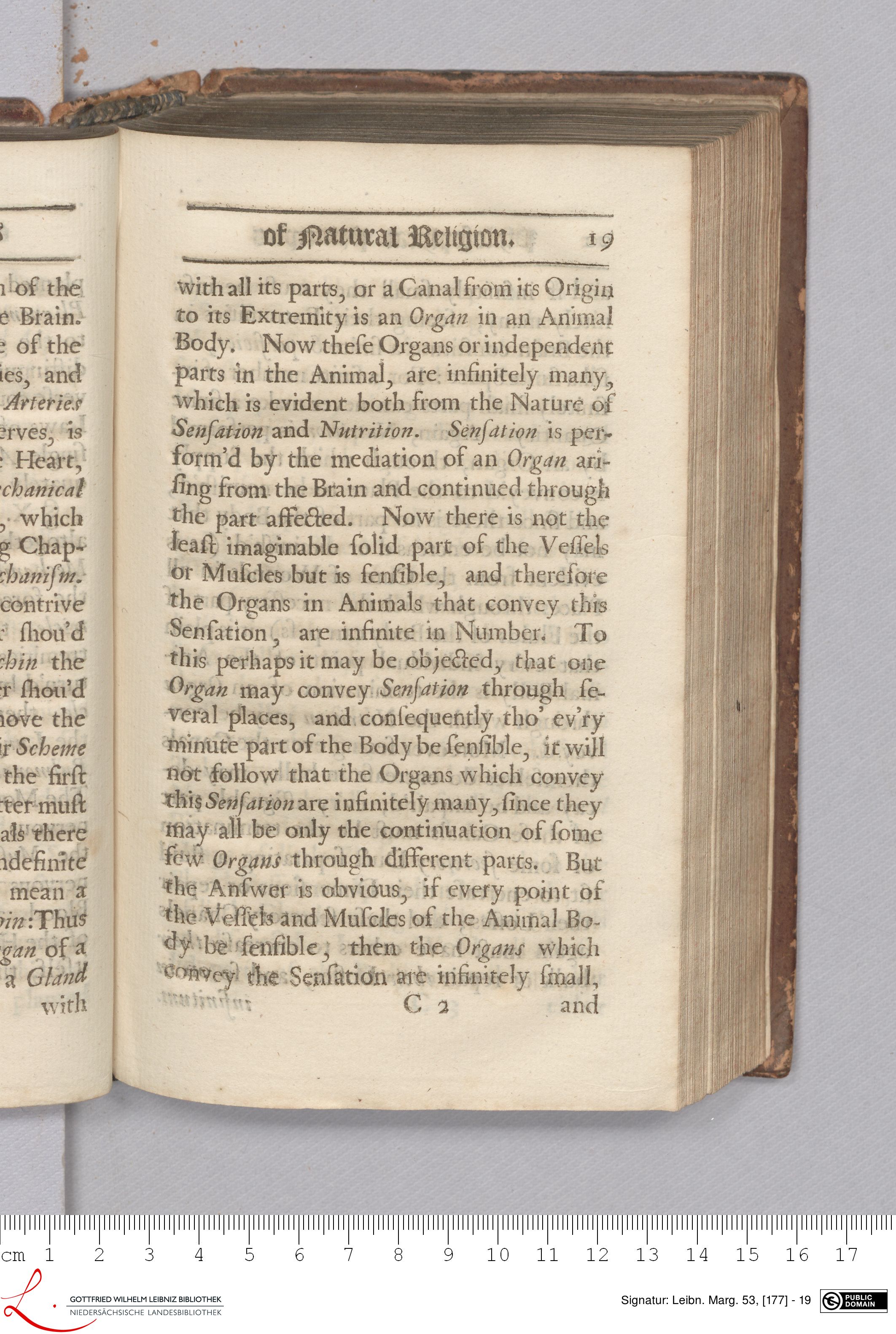
The machine reads it as
- NoE the
- e Brain.
- OF thC
- Co, and
- Arteriet
- erves, i5
- Fleare,
- ertricte
- S Chapi
- contrire
- Moud
- eMoud
- Ove the
- iScheme
- thc Frs
- tetmus
- als Etere
- dehnice
- meaii a
- in: THuS
- ean oF a
- a Oland
- Wricta
- DE saturat vels
- Wich all its parts, or a C analtrom its Origin
- Eo its Extremity is an Organ in an Animat
- Bodr. Nor chese Orsans orindependent
- pares in the Animal, are infinitely manz.
- Wrhich is eridene both trom the Nature of
- Sensation and Nutrition. Sensation i5 PeE
- Form d by che mediation ot an Organ ari-
- Lino From the Brain and continued throuxh
- the pare affected. Norr there is noc thc
- Seast imaginable Colid part of che Velsels
- or Muscles buc is sentible, and theretore
- the Oreans in Animals thac conres this
- Sensation are infinite in Number. T0
- chis perhaps ic may be objccced, thac OnC
- Orsan may conver Sensation chroush Ce
- veral places, and consequentl tho ever
- minute part oEthe Bods besentible, ic will
- noc Follon that the Organs wrhich conver
- chis Sensationare infinitels mans, since they
- Maz all De ouly che continuation ot lome
- Ter Organs chrouoh ditterent PartS. BUE
- ehe Antiver is obrious, it every point ot
- the Vessets and Muselos of che Animal BO.
- ds besentible; then the Organs ertick
- conrey etre Seulation are intinicels (tnalI,
- anc
Cite
Philosophical Principles Of Natural Religion, fol. 19. Machine transcription, not an edition: Leibniz Legible (model FoNDUE-GD_v2_ft_Leibniz, run 74). https://leibnizlegible.com/page/797370323:0177?run=74