Philosophical Principles Of Natural Religion, fol. 91
Machine transcription. Not an edition. Errors are expected: about 8% character error rate on Latin and French lines, higher on German. Mean line confidence on this page: 0.88.
Original at the GWLB · Page image · Annotations (IIIF) · Download text
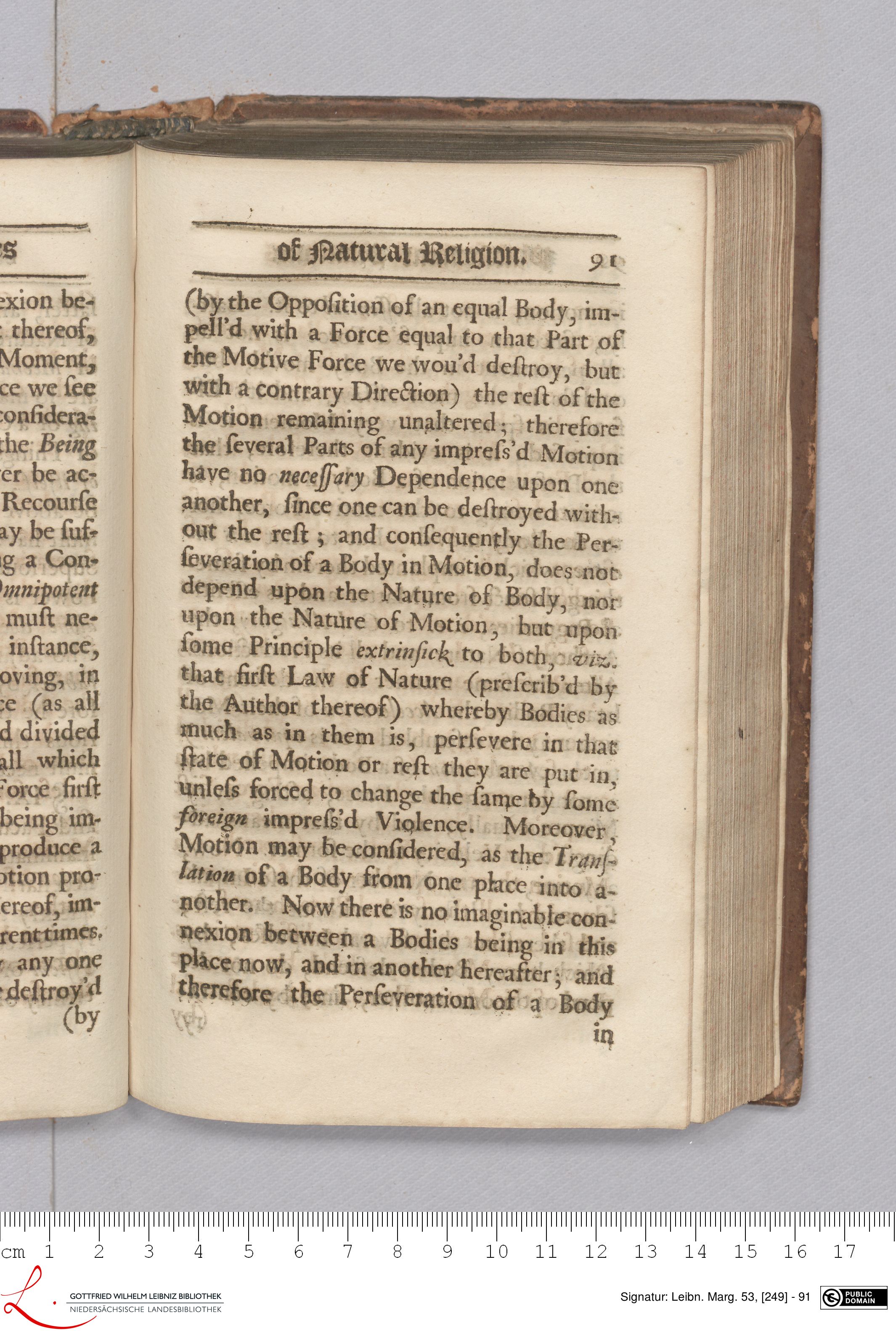
The machine reads it as
- exion be-
- chereot,
- Noment,
- he Beins
- 8 a C D
- must ne-
- instanee,
- produce 2
- any Onc
- destroyet
- st
- ta
- byche Opposicion of un equal Bods, im-
- Pella with a Force equal eo thac Part oF
- chemotire Force re irou d deltror, bue
- ich a contrary Direction) therest ofthe
- Mocion remainins unaltered; theretore
- the several Pares oF any imprels d Mocion
- have no necessary Dependence upon one
- another, since onc can be destroyed with.
- oue che rest; and consequently the Per.
- leveration oF a Body in Mation, doesnoi
- depend upon che Nature dE Body, noc
- uxon che Nature oF Motion, buc rpon
- Tome Principle extrinsick ta both, viz.
- chac Arst Law oF Nacure (Prelerib d by
- the Auchor thereOF) Wrhereby Bodies a5
- much as in them is, perlerere in that
- state oF Motion or rest they are put in,
- intels Forced to change the Pame By lome
- foreien impress d Violence. Morcover.
- Mocion may beconsidered, a5 che Trans-
- lation of a Body From one place into a-
- nocher. No chere is no imaginable eon.
- rexion becween a Bodies being in this
- placenon, and in anocher hereaster; and
- cheretore ithe Persereration lot a Body
Cite
Philosophical Principles Of Natural Religion, fol. 91. Machine transcription, not an edition: Leibniz Legible (model FoNDUE-GD_v2_ft_Leibniz, run 74). https://leibnizlegible.com/page/797370323:0249?run=74