Philosophical Principles Of Natural Religion, fol. 234
Machine transcription. Not an edition. Errors are expected: about 8% character error rate on Latin and French lines, higher on German. Mean line confidence on this page: 0.81.
Original at the GWLB · Page image · Annotations (IIIF) · Download text
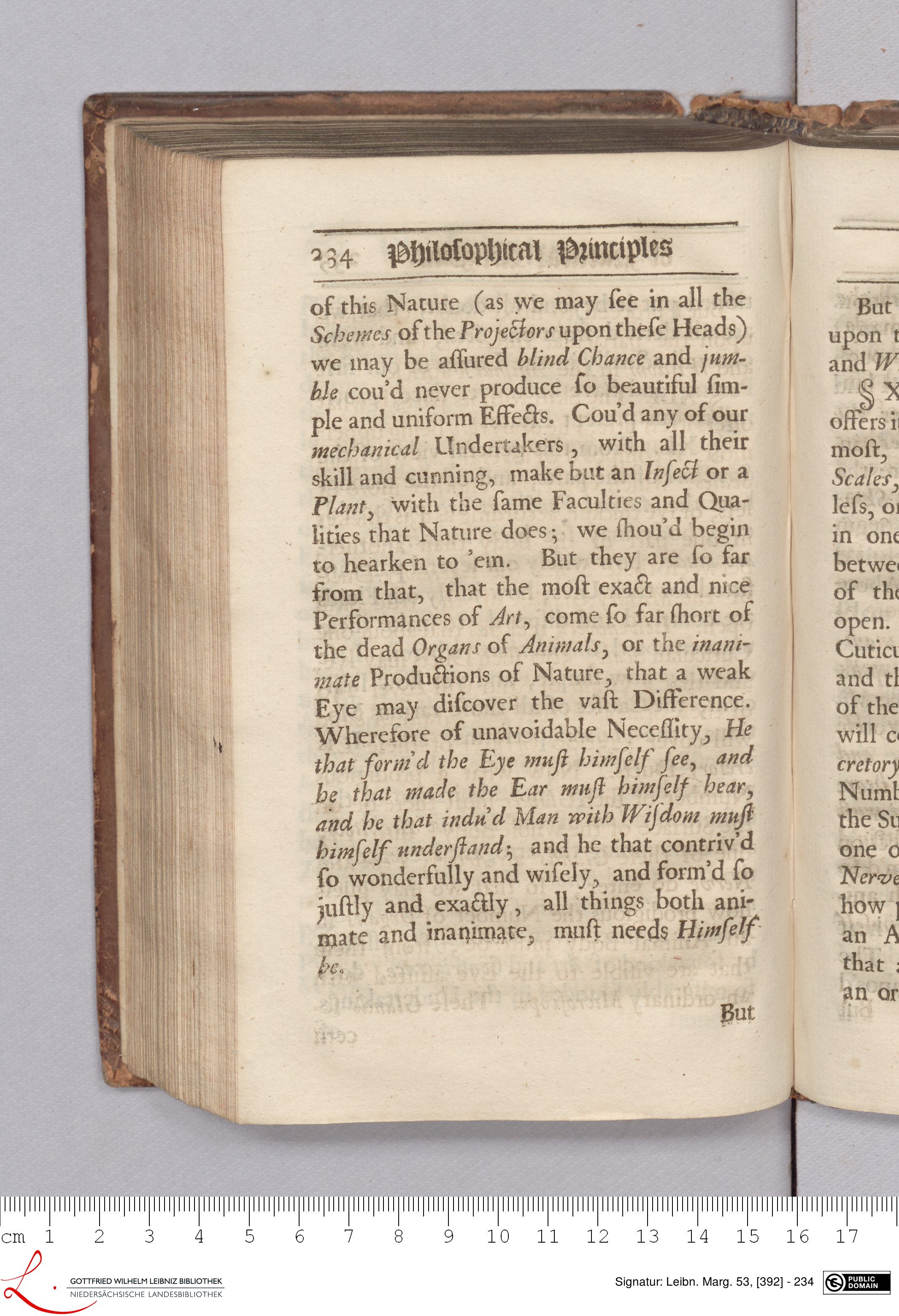
The machine reads it as
- 34
- Dhilotorhicat vrincivle
- oF this Nacure (a5 Wve may sec in aIl the
- Schemes oFche Projectors uponthele Hcads)
- re may be altured blind Chance and jum-
- ble cond never produce (o beautitul sim-
- ple and unitorm PHects. Cou d any ot our
- mechanicat Undercalcers, with aIl theie
- still and cunnins, mahiebur an Insect or a
- Plant, wich the Pame L’aculcies and Oua-
- licies chat Nature does; re hou d begin
- eo hearken to cm. Buc chey are (0 Far
- trom chac, thac che most exacc and nice
- Pertormances oF Ari, come (o Far Morc ot
- the dead Orsans ot Animals, or the inani-
- mate Productions of Nature, chat a Wweak
- Eyc mas dilcover the vast Difference.
- Whcretore ot unaroidable Necesity, Ie
- that form d the Fye must himself see, and
- be that made the Far must himself hear,
- and he that indu d Man ith Wisdom must
- himsels understand; and he thac concrird
- (o mondertully and risely, and form d (0
- ultlu and exaculs, all chines boch ani
- mate and inanimate, mult needs Flimsels
- be.
- Ot
- mOct
- Sca
- II
- C
- O
- Open
- art
- A
- c
- non
- that
- an O
Cite
Philosophical Principles Of Natural Religion, fol. 234. Machine transcription, not an edition: Leibniz Legible (model FoNDUE-GD_v2_ft_Leibniz, run 74). https://leibnizlegible.com/page/797370323:0392?run=74