LBr. 699 · Orban, fol. 90r
Machine transcription. Not an edition. Errors are expected: about 8% character error rate on Latin and French lines, higher on German. Mean line confidence on this page: 0.81.
Original at the GWLB · Page image · Annotations (IIIF) · Download text
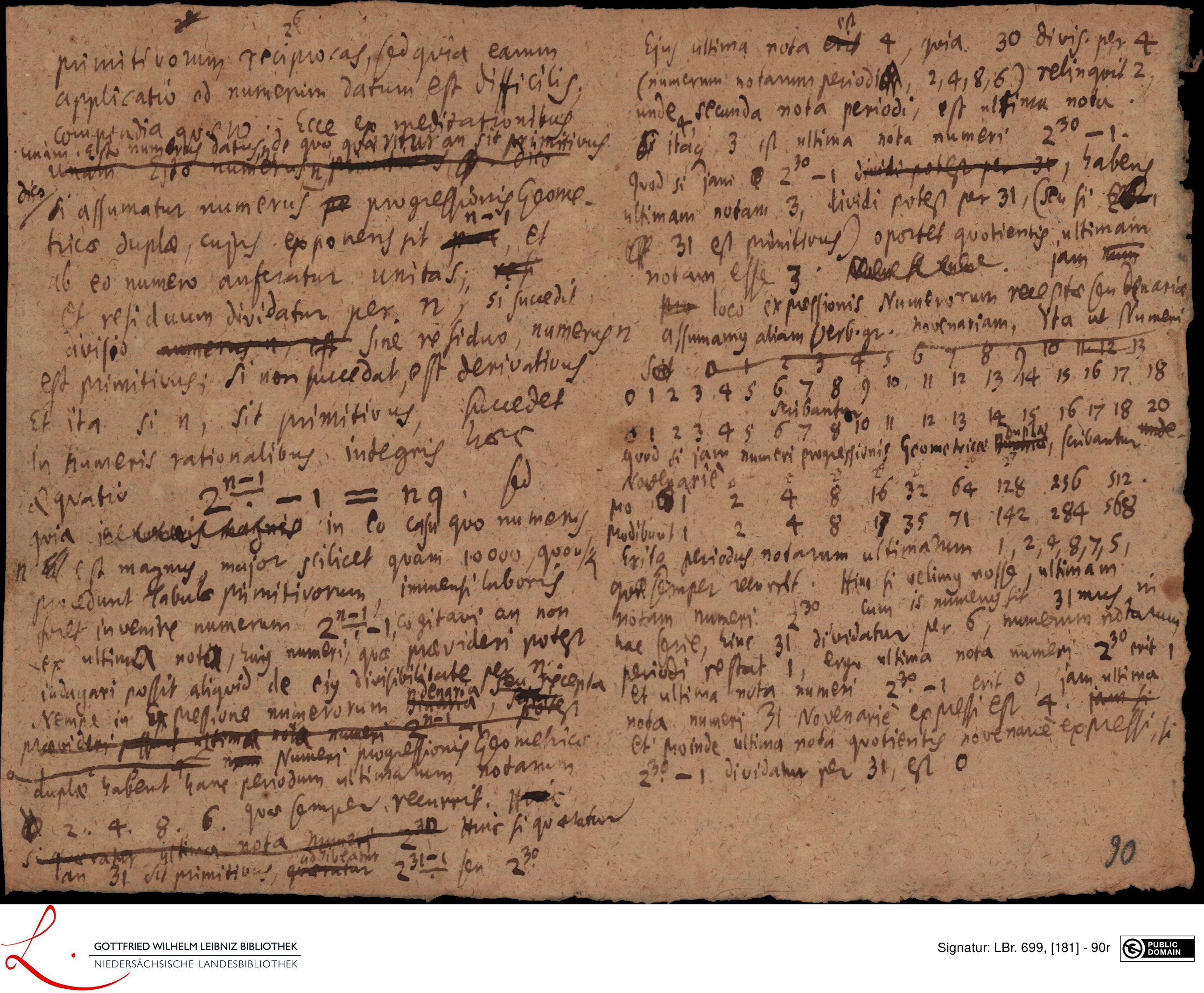
One image of two folio pages side by side, registered by the library under both labels (also fol. 89v); this page is its right half.
The machine reads it as
- est
- Ejus ultima nota erit 4, quia 30 divis. per 4
- (numerum notarum periodia, 2, 4, 8, 6) relinquit 2,
- unde secunda nota periodi, est ultima nota.
- si itaque 3 est ultima nota numeri
- 30 = 1-
- 2.
- quod si jani 2 - 1 dividi potest per 3, habens
- ultimam notam 3, dividi potest per 31, (seu si
- 2
- e
- e
- 2. 31 est primitivus) oportet quotientis ultimam
- +
- notam esse 3
- Nar R Tuve jam num
- pro loco expressionis Numerorum receptae seu benaria
- avisid numerus a, est sine residuo, numerusn assumamus aliam verbigre. navenariam, ita ut Numen
- )
- so 1
- 6
- a
- d
- 9 10 H. 12 B
- 0123. 4 5 6 7 8 9 1, 11 12 1 14 15 16 17 18
- 1 23 45 6 7 8 10 1 12. 13 14 15 16 17 18 20
- unde
- dupla
- scribantur
- quod si jam numeri progressionis Geometricae Buntriae, scribantur.
- Noverarie.
- 2
- po 11dI 2, 4 8 16 32 64 128, 256 S12.
- prodibunt 1
- 2 4 8, 1) 35 71 142, 284 568
- Erila periodus notaram ultimarum 1, 2,4, 8, 7,5)
- qua semper recurrit. Hinc si velimus nosse, ultimam
- motam numeri 330 cum is numenus sit 3Imus
- n
- hac serie, hinc 31 dividatur per, b, numerum notarum
- periodi restat 1, ergo ultima nota numeri
- erit
- 1 erit o, jam ultima
- 10
- et ultima nota numeri
- nota numeri 31 Novenarie expressi est 4. jam si
- 3. = 1 dividatur per 31, est C
- s
Cite
LBr. 699 · Orban, fol. 90r. Machine transcription, not an edition: Leibniz Legible (model FoNDUE-GD_v2_ft_Leibniz, run 79). https://leibnizlegible.com/page/DE-611-HS-860751:0181?run=79