LBr. 258 · Fardella, fol. 230r
Machine transcription. Not an edition. Errors are expected: about 8% character error rate on Latin and French lines, higher on German. Mean line confidence on this page: 0.84.
Original at the GWLB · Page image · Annotations (IIIF) · Download text
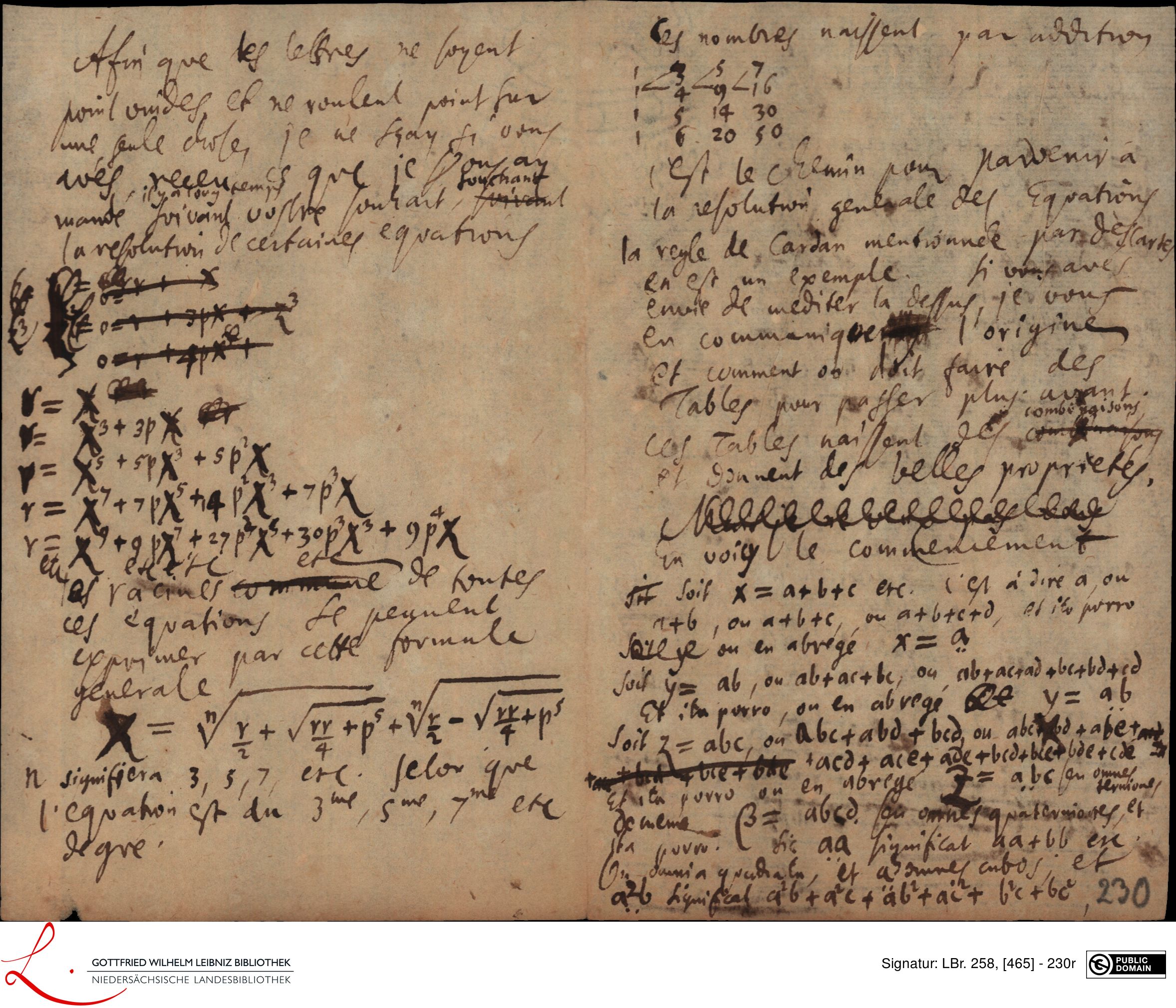
One image of two folio pages side by side, registered by the library under both labels (also fol. 229v); this page is its right half.
The machine reads it as
- les nombres naissent par addition
- Lug 1b
- 5 14 30
- 6 20 50
- s
- est le cilemin pour parvenir a
- G
- la resolution generale des Equations
- la regle de Cardan mentionnée pars
- en est un exemple. Si vous aves
- envie de mediter la dessus je vous
- en commaniquerum
- origine
- et comment on doit faire des
- Cables pour passer plus avant.
- combenaisons
- ces Tables naissent des commnnisons
- e
- ddanent des
- velles propriete
- Marelue vea e del bad
- in voi le commencement
- sit soit X = a+ b+C etc. C’est à dire a ou
- 1+b, ou a +b+C, ou a+b+ etd, et ito porro
- s je ou en abregé X = a
- e
- soit y= ab, ou ab+ ac + bc, ou abractad +bc+bd + cd
- Et ita porro, ou en abrege y = ab
- Soit 7 = abc, on abc + abd + bcd, ou abct bd + aber
- a qbie+ bnc acd+ ac et ade rbcdibe bdetcde
- Etita porro on en abrege = abc seu omnes
- terniones
- dememe β= abcd seu omnes quaternioes, et
- Ita porro. sic aa significat aa +bb ere
- In omnia quadiata, et a omnes cubos, et
- 2
- en
- bC+bC
- u
- a
Cite
LBr. 258 · Fardella, fol. 230r. Machine transcription, not an edition: Leibniz Legible (model FoNDUE-GD_v2_ft_Leibniz, run 82). https://leibnizlegible.com/page/DE-611-HS-971120:0465?run=82