Leibniz-Handschriften zur Mathematik LH 35, 4, 4, fol. 13v
Machine transcription. Not an edition. Errors are expected: about 8% character error rate on Latin and French lines, higher on German. Mean line confidence on this page: 0.86.
Original at the GWLB · Page image · Annotations (IIIF) · Download text
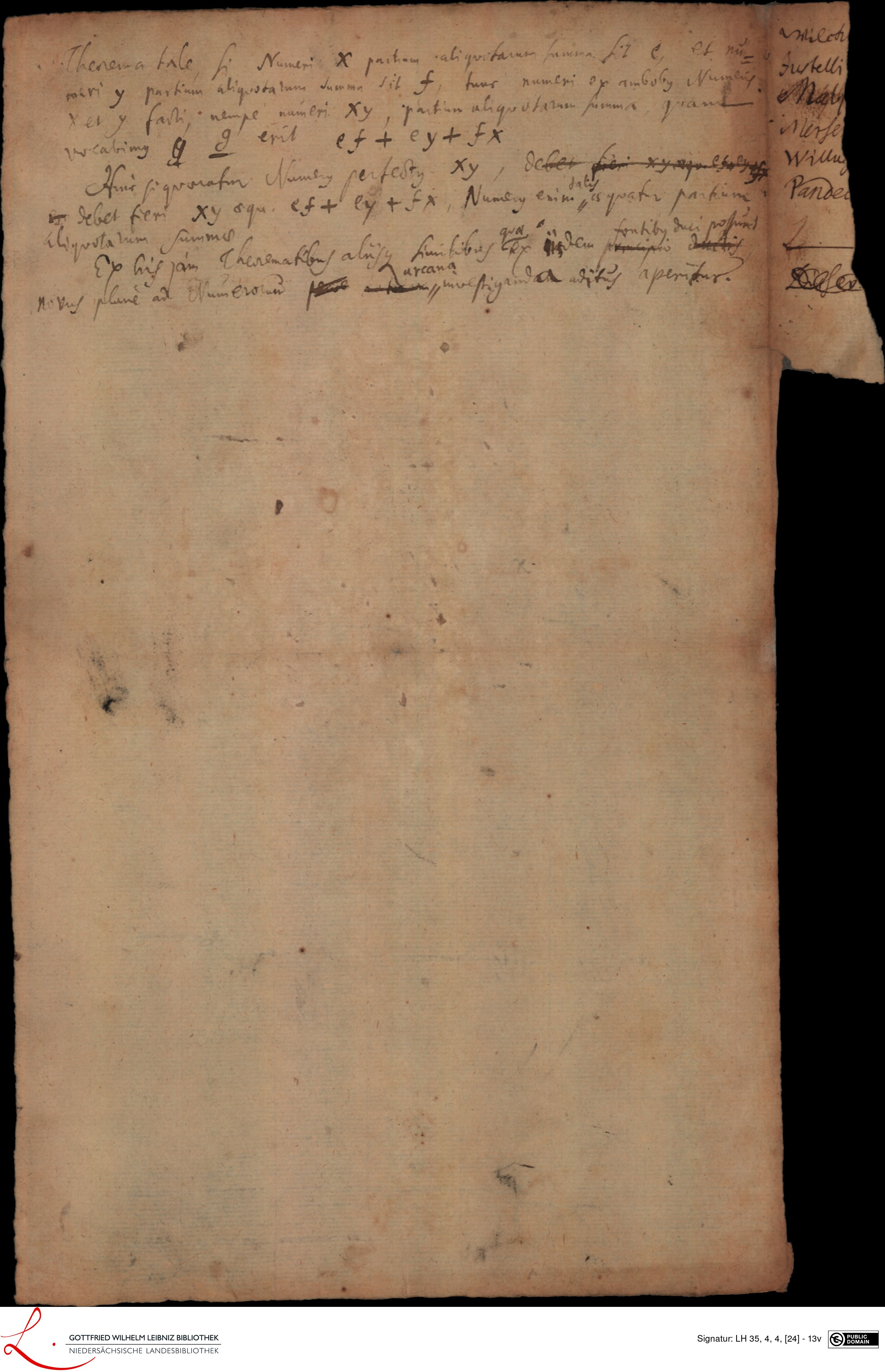
The machine reads it as
- Theorema tale si Numeri X partium aliquitarum summa st e, et nu-
- miri y partium aliquotarum summa sit f, tunc numeri ex ambobus Numeris
- et Y facti nempe numeri Xy, partium aliquotarum summa, quamt
- vocabimus d erit ef + ey + fx
- Hinc si quaeratur Numems perfectus Xy, debet fieri xyaegues
- datis
- Mite
- dustelli
- Ml
- Merso
- Willud
- en debet fieri Xy aequ. ef + ey + fx, Numerus enim aequatur partium. Tandet
- aliquotarum summae
- quae a
- fontibus duci possunt
- Ex his jam Theorematibus alisque similibus cex uidem principio ductis
- K arcana
- novus plane ad Numerorum tinvestiganda aditus aperitur.
- 2.
- u
Cite
Leibniz-Handschriften zur Mathematik LH 35, 4, 4, fol. 13v. Machine transcription, not an edition: Leibniz Legible (model FoNDUE-GD_v2_ft_Leibniz, run 73). https://leibnizlegible.com/page/00068001:0024?run=73