Leibniz-Handschriften zur Mathematik LH 35, 4, 13, fol. 4v
Machine transcription. Not an edition. Errors are expected: about 8% character error rate on Latin and French lines, higher on German. Mean line confidence on this page: 0.95.
Original at the GWLB · Page image · Annotations (IIIF) · Download text
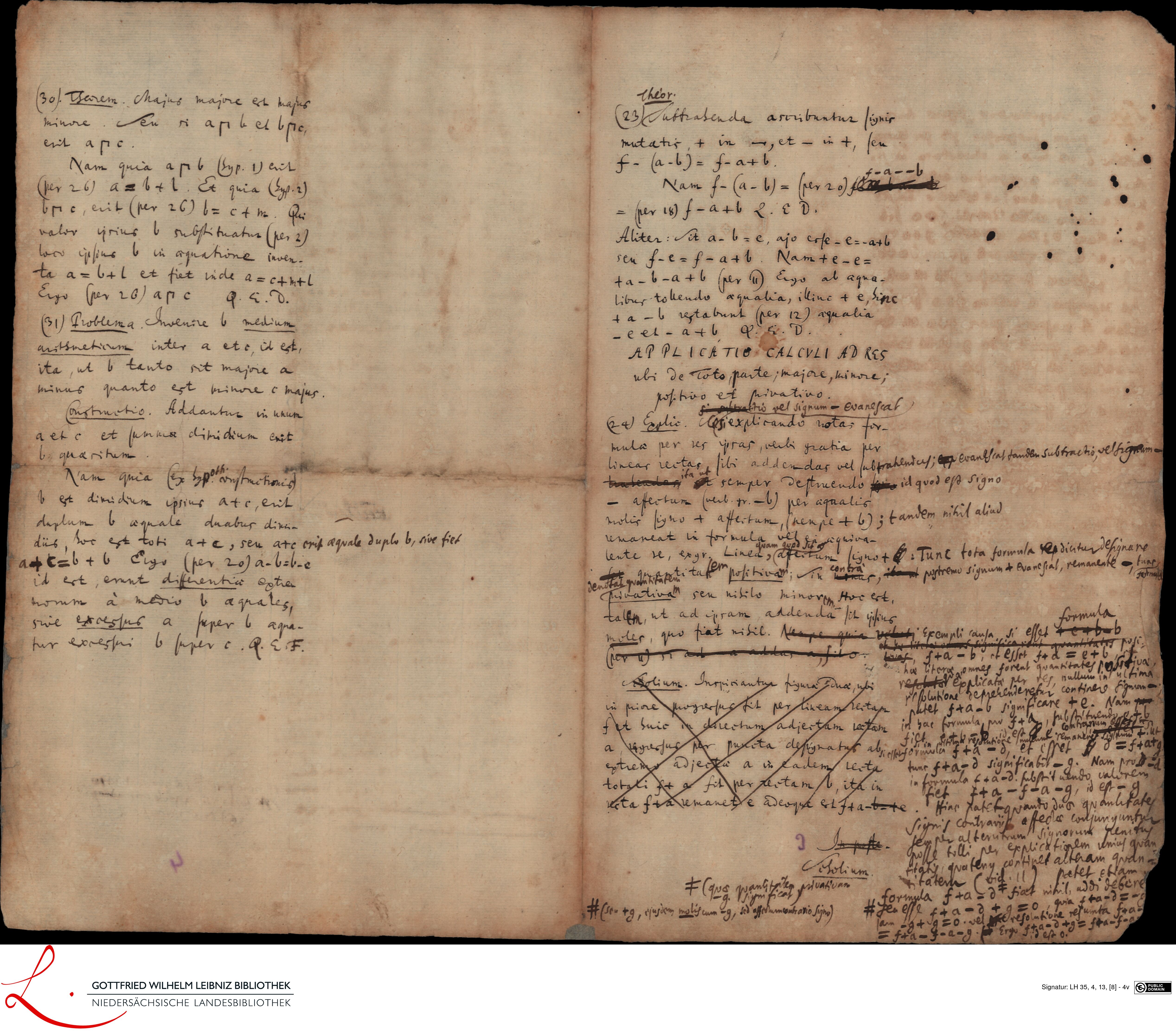
One image of two folio pages side by side, registered by the library under both labels (also fol. 3r); this page is its left half.
The machine reads it as
- (30). Theorem. Majus majore est majus
- minore. eu si a pi b et bpc,
- erit a pc.
- Nam quia a p b (hyp. 1) erit
- (per 26) a = b + l. Et qui a (hys. 2)
- bp c, erit (per 26) b = c + m. Qui
- valor ijrius b substituatur (per 2)
- loco ipsius b in aquatione inven.
- la a = b + l et fiet inde a = c + m+ L
- Ergo (per 26) a p C g. E. D.
- (31) Froblema. Onvenire b medium
- arithmeticum inter a et c id est,
- ita, ut b tanto sit majore a
- minus quanto est minore c majus.
- Constinetio. Addantur in unum
- a et c et summae ditridium enit
- b, quaritum.
- Nam quia (ex hype constructionis)
- b et dimidium ipsius a+ c, erit
- duplum b aequale duabus dinci-
- dub, hoc est toti a +C, seu atc erit aequale duplo b, sive fiet
- at C =b + b Ergo (per 20) a- b -b- c
- id eet, erunt differentia extie
- honum a medio b aequales,
- sive excessus a super b aequa-
- tur excessui b super c. 4. E. F.
Cite
Leibniz-Handschriften zur Mathematik LH 35, 4, 13, fol. 4v. Machine transcription, not an edition: Leibniz Legible (model FoNDUE-GD_v2_ft_Leibniz, run 73). https://leibnizlegible.com/page/00068010:0008?run=73