Leibniz-Handschriften zur Mathematik LH 35, 14, 1, fol. 272r
Machine transcription. Not an edition. Errors are expected: about 8% character error rate on Latin and French lines, higher on German. Mean line confidence on this page: 0.79.
Original at the GWLB · Page image · Annotations (IIIF) · Download text
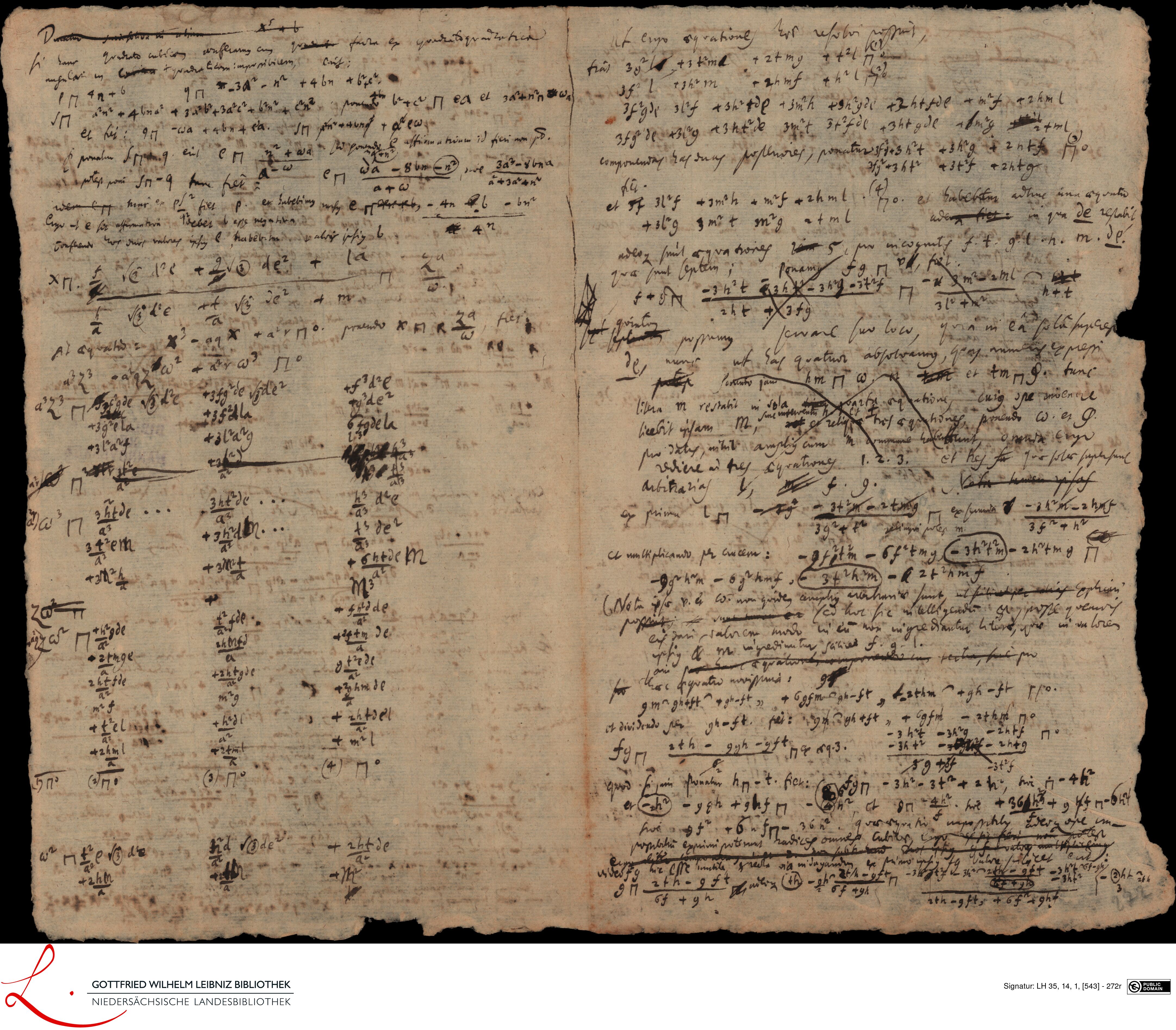
One image of two folio pages side by side, registered by the library under both labels (also fol. 271v); this page is its right half.
The machine reads it as
- AL ergo aequationes hac resolvi possint
- frat 35 l +3tma + 2+ mu + +2l po
- 35l 23h M + qtmf + h l, 90
- 3F9de 31f +3h Fde a3mh +3h9de +2htfde = m f, 4 2hm l
- 2tg de 1319 +3nF de 3ne t 3Ffde 13ht gde aniq Am
- componendas has duas posteriores, ponatur Hy,3ht +3kg + 2nt f f0
- fiit.
- 3fy 13hF +3tf + 2ntg
- et ff 31f +nh nef + 2hml. 40. et habebtur adhuc una aequatio
- + 3l9 3 m t m g a + ml
- adeuque fiet: in qua de restabit
- adeoque sunt aequationes 5, pro incognits f. +. 9.l. h. m. de.
- quae sunt septem;
- Ponamus fg p vH, faet.
- Aie
- -3h t 3h _ - 349 - 3+25 = X 8 m = 2 BL + +
- f+5H
- quintam
- 2h F + 3f9
- h+ +
- p possumus servare suo loco, quia in ea sola superes
- de, nunc ut has quatuor absolvamus, quas numeris expressi
- potes simento jam hm Y C, H L et tmp G. tunc
- litera m restabit in sla
- licebit ipsam M, et reliquae tres aequationes, ponendo co. et G.
- pro datis, nihilamplius cum M dommine habentunt, omenda ergo
- rediere ad tres aequationes 1. 2. 3. et Res quae solae supersunt
- arbitrarias V, f. 9.
- Neta tamen ipsas
- ex prima l - F9 = 3+2 = 2 tMg ex sumda _ - 3k m - 2 hpf
- et multiplicando per crucem:
- 392+ t relinqui potest m.
- 352 + h
- -9+tm -6f tmg (= 3ti Fm) - 2h + m g 7
- 9sttem -6st haf, ( 3frhm - C2t2kmf
- Nota ipsae V. er Co. non quidem amplius arbitrariae sunt, ut sciliat per alias Explicari
- possint; sunt samon ea sed hoc sic in telligendum estposse quenvis
- eis dari satorem modo in cum non ingrediantur literae, quae in valorem
- ipsius m ingredimitur scilicet f. g. l.
- jam p hanc aequationem componendo cum tertia, sie pro
- haec aequatio novissima. 9t
- gma ghest +gna f + 6gfm Cgh -st f 2tam + gh -ft ps0.
- et dividendo per oh - ft. fiet : 9p 2gh + ft, + 69fm = 2+ hm B0
- f9 2th = gyh -gfl ec 44.3.
- quod si um ponutur hp. t. fier: ( SgB
- - 3h+ -3k9 - 2htf
- =3h +2 -Y - 2h+9
- 59 +f
- -3tf
- 10
- =3h - 3+ + 2 H, sire 1- 4h
- et =k) - 9 ch + 9hf p7 - ah et Be 4. hie 43b Ath + 9 H5 r bh
- 2
- sive 9f. +6a fp - 36h. Quae aequatio umpossititus adeoque ope im-
- possibilium exprimi poterunt radices omnes cubite, ergo res sic fieri non potest
- erno aliter com te non subtrohem uos iptiu ct valores multiplicemg
- videoFu hic esse mutile, et recta via indagandum ex primo ipsius fu valore scilacet erit.
- 2th - 9 f+
- es 7.9u.
- Gadeoque (th - oh et M - 9f+, - 3k l 1- 32 22th = 96+ -3het vs. pus
- es u1
- Fyto =hht (= (3hF 2th
- Ilnay sto et of. 29nt
- in
Cite
Leibniz-Handschriften zur Mathematik LH 35, 14, 1, fol. 272r. Machine transcription, not an edition: Leibniz Legible (model FoNDUE-GD_v2_ft_Leibniz, run 74). https://leibnizlegible.com/page/00068201:0543?run=74