Leibniz-Handschriften zur Mathematik LH 35, 15, 2, fol. 37v
Machine transcription. Not an edition. Errors are expected: about 8% character error rate on Latin and French lines, higher on German. Mean line confidence on this page: 0.84.
Original at the GWLB · Page image · Annotations (IIIF) · Download text
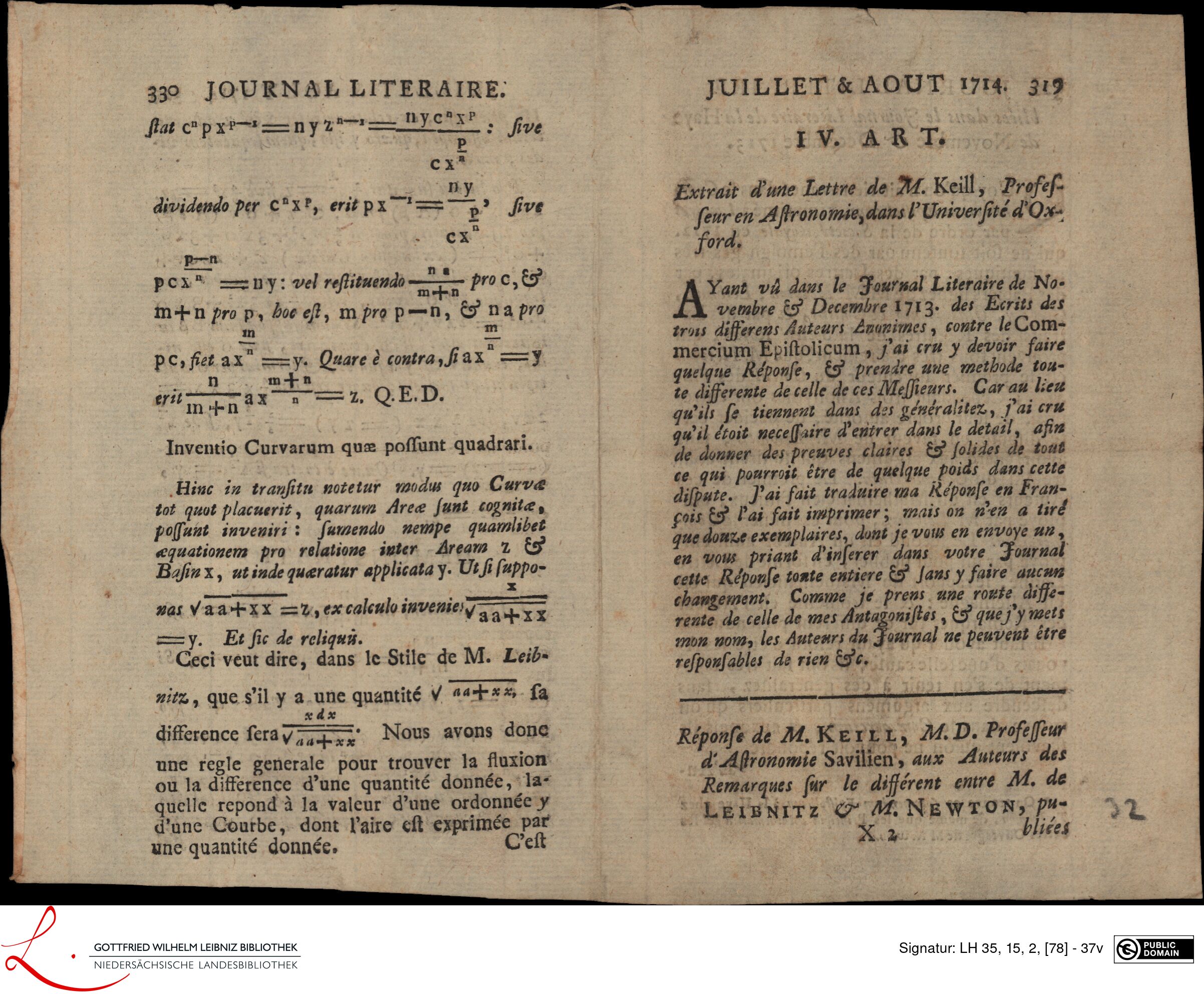
One image of two folio pages side by side, registered by the library under both labels (also fol. 32r); this page is its left half.
The machine reads it as
- TODRNAL LITERACKCS
- sat CA PXP 1 =- n y 2
- dividendo per CaxP, erit DX
- n
- DCX = = = VY: vel restituendo-, proC, C9
- m
- t. Fn pro D, hoc est, M pro P = n, C n a pro
- in
- DC, fiet 2X = - Y. Ouare e contra, st aX =
- erit
- n
- in +n
- IM B aX a = 2. Q. F. D.
- Inventio Currarum quae possunt quadrari.
- Hinc in transitu notetur modus quo C’urvae
- tot quol placuerit, quarum Areae sunt cognitae.
- possunt inveniri: sumendo nempe quamlibet
- aequationem pro rolatione inter Arear 2 Es
- Basin X, ut inde quaeratur epplicata Y. DEsi suppo-
- ==Y. Ft sic de reliquis.
- ad+ XX
- Ceci reut dire, dans le Stile de M. Leib.
- nisz, que s’il y a une quantité V aant XX Ca
- X dx
- difference Perav aa L xx Nous arons donc
- une reste generale pour trourer la Auxion
- ou la ditterence d’une quantité donnéc, 12.
- quelle repond à la raleur d’une ordonnée y
- d’une Courbe, dont l’airo cAt exprimée DaE
- UnC quantite donneo.
- CeA
- AV
- X
Cite
Leibniz-Handschriften zur Mathematik LH 35, 15, 2, fol. 37v. Machine transcription, not an edition: Leibniz Legible (model FoNDUE-GD_v2_ft_Leibniz, run 74). https://leibnizlegible.com/page/00068204:0078?run=74