Leibniz-Handschriften zur Mathematik LH 35, 3 B 11, fol. 13r
Machine transcription. Not an edition. Errors are expected: about 8% character error rate on Latin and French lines, higher on German. Mean line confidence on this page: 0.78.
Original at the GWLB · Page image · Annotations (IIIF) · Download text
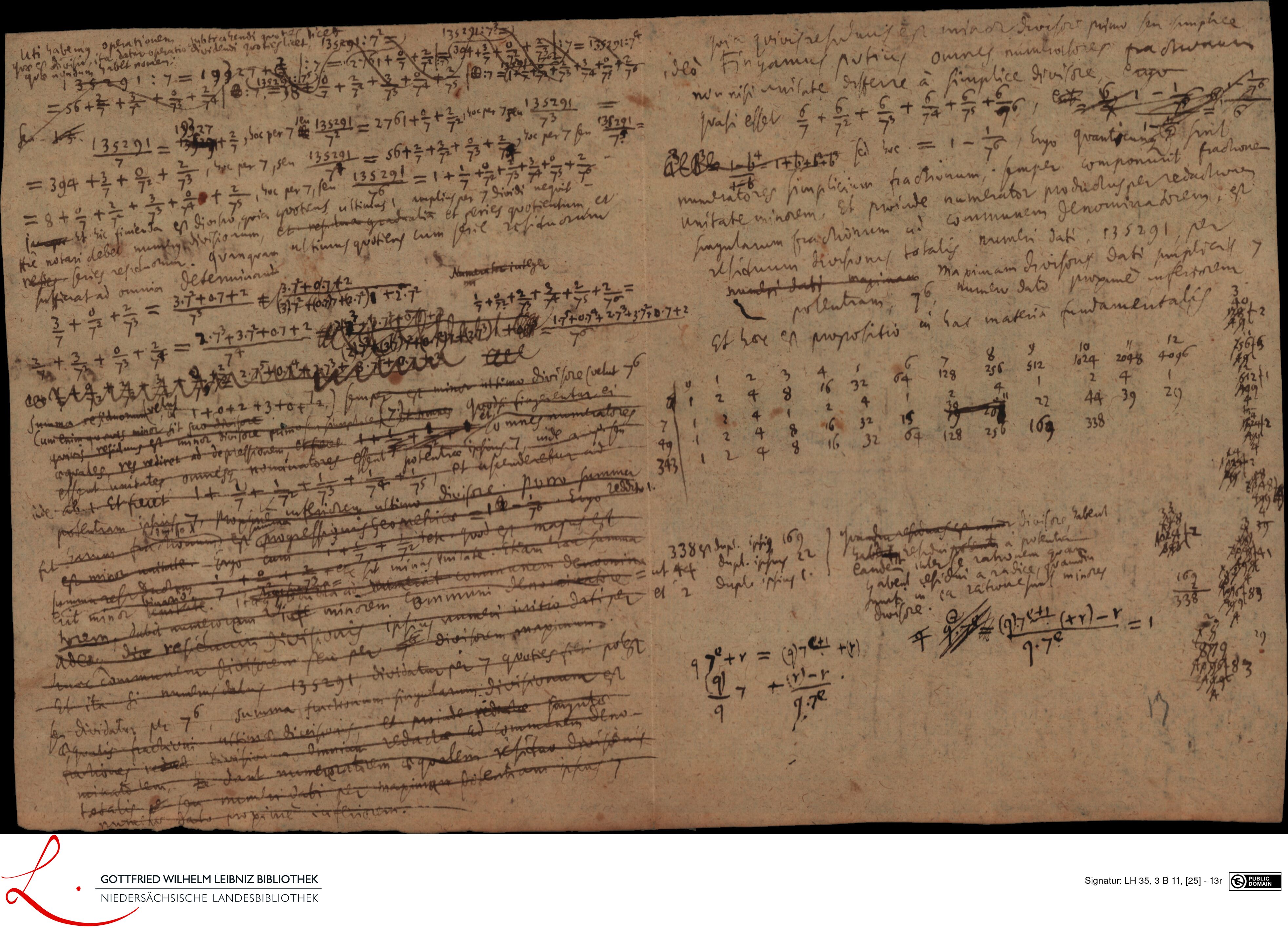
One image of two folio pages side by side, registered by the library under both labels (also fol. 12v); this page is its right half.
The machine reads it as
- quia quivis residuris est minor divisore primo seu simplice
- deo
- non nisi unitate differre a simplice divisore, ergo
- quasi esset + B +
- 2
- + +E + et
- 7a
- 15
- p
- 1e
- 26
- p sed hoc = 1 - 6) Ergo quantocunque D sint
- nundratores simplicium fractionum, semper componunt
- a
- ABB 1 b- 1+ b + b +b
- 6
- fractione
- unitate minorem. Et proinde numerator productus per redactionem
- +b
- singularum fractionum ad communem denominatorem, est
- usiduum divisionis totalis numeri dati, 135291 per
- numeri dati maximam maximam divisoris dati smplicits
- potentiam.
- Et haec est propositio
- 6 numero dato proxime inferiorem
- in hac materia fundamertalis
- 128
- 256
- 512
- 2
- 10
- 12
- 1024 2098 4096
- 2
- 4
- 44, 39
- 338
- 21)
- 16
- et
- 128
- quandm residuas est minor divisore habent
- sunt in ea ratione sunt
- divisore.
- habentu residui potenti a potuli
- eandem inter se rationem qu
- minores
- 338 est dupl. ipsius 169
- 4c
- 2
- dupl. ipsuis E2
- duplo ipsius C
- e +Y
- habent residui a tedice, quamdim
- (Y=
- 40
- A
- 2
- 76]B
- eq
- N211
- 99
- 1
- i
- c2
- A
- p2
- ee
- EAB
- 4)
- e
Cite
Leibniz-Handschriften zur Mathematik LH 35, 3 B 11, fol. 13r. Machine transcription, not an edition: Leibniz Legible (model FoNDUE-GD_v2_ft_Leibniz, run 74). https://leibnizlegible.com/page/00068261:0025?run=74