The Questions Concerning Liberty, Necessity, And Chance, fol. 147
Machine transcription. Not an edition. Errors are expected: about 8% character error rate on Latin and French lines, higher on German. Mean line confidence on this page: 0.81.
Original at the GWLB · Page image · Annotations (IIIF) · Download text
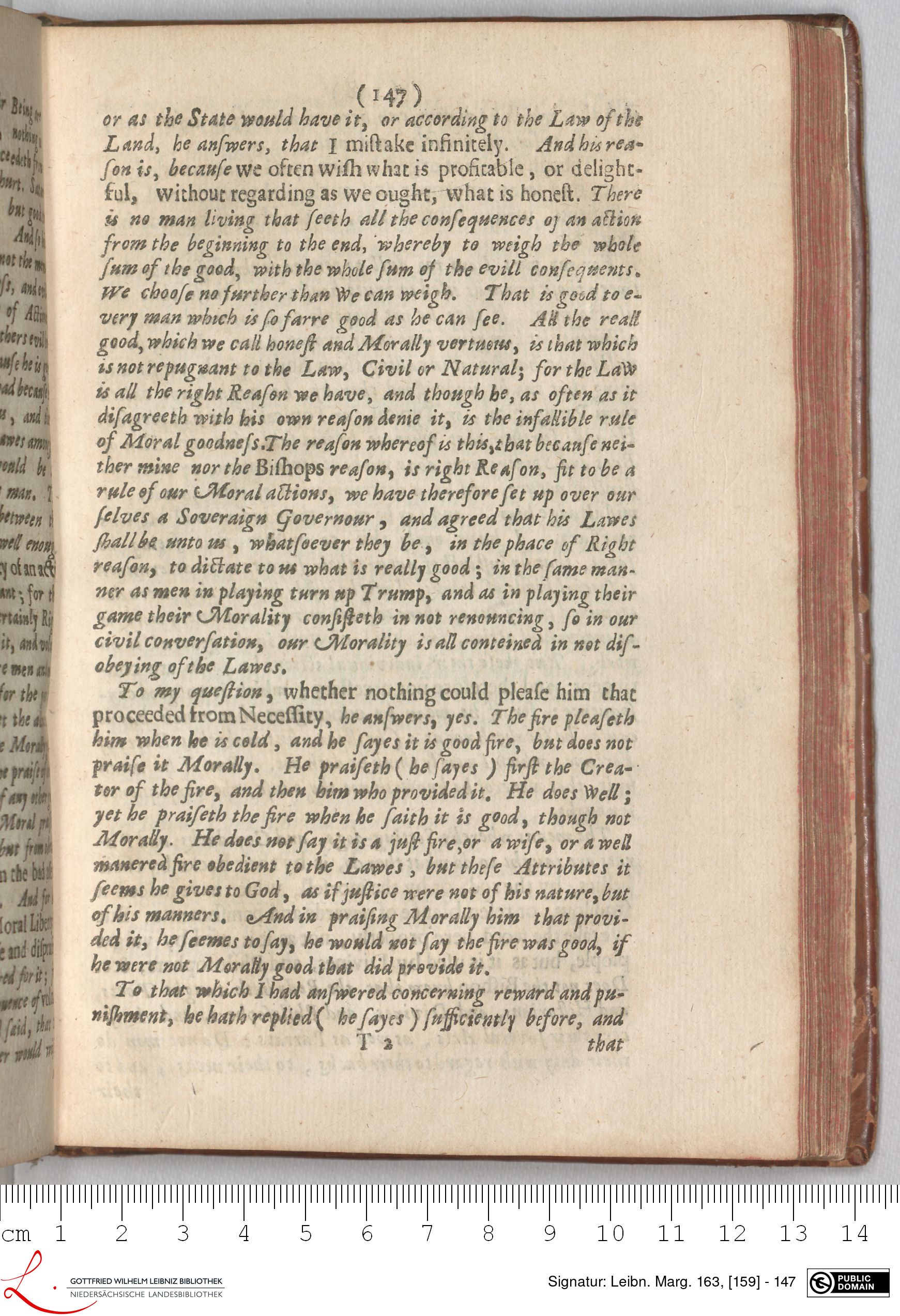
The machine reads it as
- es A
- L1S1D
- )e1B
- ot I
- etitu be
- Minto
- etBCH
- vell entom
- Jolana
- adbecu
- ant
- mes aM
- 1M. F
- 1a
- 1t, At
- eBEMA
- or the
- ibe
- Mora
- pra
- an
- Nori
- et
- 1
- 47
- or as the State monld have il, or accordine 1o the Lam of the
- Land, he ansmers, that Y miltate inAinirely. And his rea-
- son is, because e olten wistr whseis proficable, or aelighe
- Ful, Wichoue resardins as we oughe, What is honelt. There
- is no man livine that seeth all the consequences oy an action
- fromthe becinnine to the end, mhereby to meich tho wole
- sum ef ihe 500d, mith the mhole sum of the evill consequents.
- e choose ne further than We can meieh. That is 500d t0e-
- very man rhieh is (o farre eood as he can sec. AH thc real
- ceod, which me cal honest and MCorally vertuons, is ihat Whicts
- isnot repuenant tothe Lam Civit or Natural: forthe L aW
- is al therieht Reason mehave, and thonchbe, as ofren as it
- disaereeth mith his omn reason denie it, is the infaltible rule
- of Moral coedness. Fhe reason Whereof is this, Lbat becanse nei-
- ther mine northe Bistops reason, is richt Reason, fit 1obe a
- ruleos our Moral actions, e have therefore set up over our
- selves a Soveraien Governour, and acreed chat his Lares
- Ballbe antons, whatsoever they be, in the phace of Riebt
- reason, to dictare rons what is really co0d; in the Came man-
- ner asmen in plagine turn ap Trump, and as in plagine their
- came their Morality consisteth in not renonncine, so in our
- civil conversation, our Morality is al conteined in not dis-
- oberins ofihe Larres.
- 20 my question, Whecher nochinq could pleale him chac
- proccededtrom Necestey, heansvers, jes. Thefire plea (eth
- him nhen he is cold, and he sayes it is e00d fire, but does not
- praise it Morally. He praiseth (be sayes) first the C rea-
- tor of thefire, and then bim mho providedit. Ile docs Well
- yet he praiseth the fire whenhe saich it is cood, thouch not
- Morally. Fle does not say it is a just fire, or amise, or a mett
- manered fire obedient tothe Lames, but these Actributes it
- seems he sivesto God, as il justice rere not of his nature, but
- efhis manners. And in praisine Morally him that provi-
- ded it, hescemes tosay, he mould not say the fire mas eood, if
- hevere not Morally e00d tbat did provide it.
- 20 that which Lhad ansmered concernine remard and pu-
- nistment, hehath replied (hesayes) sufficientir before, and
- that
Cite
The Questions Concerning Liberty, Necessity, And Chance, fol. 147. Machine transcription, not an edition: Leibniz Legible (model FoNDUE-GD_v2_ft_Leibniz, run 74). https://leibnizlegible.com/page/1030877386:0159?run=74