The Questions Concerning Liberty, Necessity, And Chance, fol. 189
Machine transcription. Not an edition. Errors are expected: about 8% character error rate on Latin and French lines, higher on German. Mean line confidence on this page: 0.89.
Original at the GWLB · Page image · Annotations (IIIF) · Download text
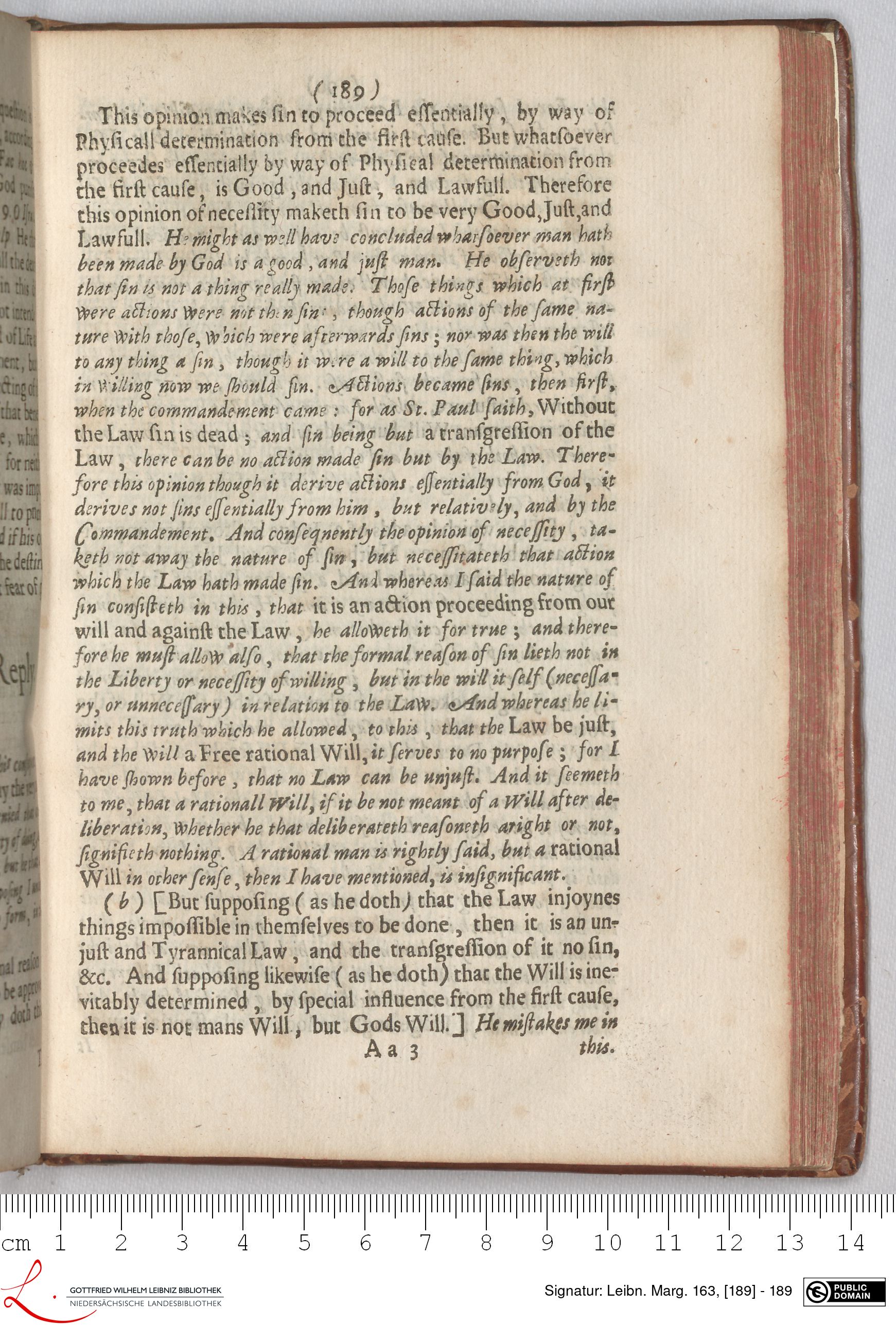
The machine reads it as
- TOrn
- 1
- lit
- edel
- et
- (180
- This opinion mares An eo proceed essentially, hy way oE
- Phylicall decerminarion from etre AeA cause. BVE Whacloever
- proceedes essentially by waz of Phy Pieal decerminacion From
- chetirst cause, is Ciood, and Tust, and L. aWFull. Pheretore
- ehiis opinion oEnecesier matiech sin eo be very C00d, sust, anc
- T. aWSuII. FI. micht as mell havs concluded mharsoer er man hath
- beenmade by God is a good, and just man. Fle observeth nor
- that sin is noc arhins really made. Those thines mhich at first
- vere actions vere nit ihen sin: thoueh actions of the same na-
- ture With ehose, Whichvere afcermards sins; nor mas thenthe mill
- to any thine a sin, thonch it vere a ill to the same rhing, Which
- in villine nom ve sould sin. Actions became sons, then Arst.
- whenthe commandement came: for as Sr. Paul saith, WVichouE
- ehe Lam sinis dead; and sin beine but d eransgrection ofthe
- Lau, there canbe no action made sin but by ihe Lao. There-
- fore this opinion thouchit derive actions essentially from God, it
- derives not sins essentially fromhim, but relarively, and by the
- Commandement. And conseguent ly the opinion of necessicy; ta-
- keth not amay the nature of sin, but necessirateth that action
- rhich the Laro hath made sin. And rhoreas Lsaid the nature of
- sin consiteth in this, thar ie is an action proccedins From our
- willand asainst che Lan, he alloveth it fortrue; and there-
- forehe must allov also, that the formal reason of sin lieth not in
- the Liberey or necessiry of willine, but in the mill it sels (necessa-
- ry or annecessary) in relation to the LaW. And mhereas heli-
- mirs this truch mhich he allorved, corhis, that the L a De just
- and the Will a Frec rarional Will, it serves to no purpose; for L
- have sovnbefore, chat no Lam ean be uniust. And it seemeth
- tome, thar a rationall ill, is it be not meant of a Will after de
- liberation, Whether he thar deliberateth reasoneth aricht or not
- sienifieth nothine. Arational man is richely said, but a racional
- Nill in ocher sense, then Thave mentioned, is insienificant.
- (b) TBuc supposins (ashedoch) chac the L au injoynes
- chinssimpossible in chemselres eobedone, then ic is an un-
- just and TrrannicalLam, and che cranscrestion oF ic no tn,
- ecc. And supposins likemise (as he doch) chac ehe Willis ine.
- vicabli determined, by special inAuence From che Airs cause,
- chenic is noc mans WilI, buc C0dsWNViII. ) Femistakes me in
- A a 3
- this.
Cite
The Questions Concerning Liberty, Necessity, And Chance, fol. 189. Machine transcription, not an edition: Leibniz Legible (model FoNDUE-GD_v2_ft_Leibniz, run 74). https://leibnizlegible.com/page/1030877386:0189?run=74