The Questions Concerning Liberty, Necessity, And Chance, fol. 190
Machine transcription. Not an edition. Errors are expected: about 8% character error rate on Latin and French lines, higher on German. Mean line confidence on this page: 0.90.
Original at the GWLB · Page image · Annotations (IIIF) · Download text
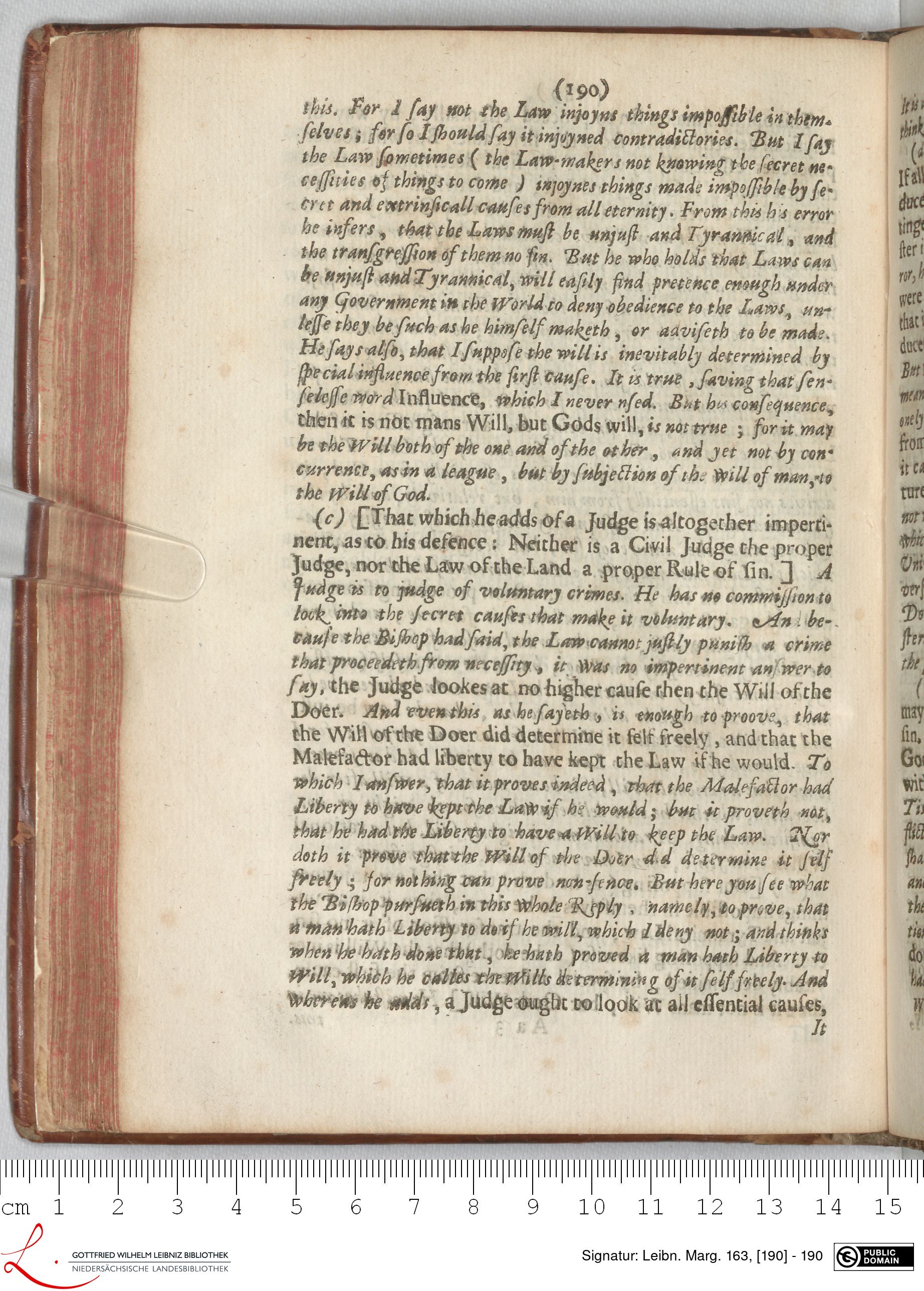
The machine reads it as
- (190)
- ibis. P’or a say not the Dam injorns thines impossible in them.
- selves; for s0 TBould say it injoyned conradictories. But Isay
- the Lar Somotimes (the Law. makers noc lenomins tbesecret ne-
- cessiries of thines to come) injoynes chines made impossible by se-
- erce and exrrinsicall causes from all eterniey. Firom this his error
- he infers, thar the Lans must be uniust and Tyrannical. and
- the transcression of themno fn. But he rho holas that Lars can
- be unjust and grannical, will ensily find pretence enonzh undor
- any Goverument in the Wortd eo deny obedience to tbe luaos, un
- lesse they besuchashe himsels maketh, or adviseth tobe made.
- Flesays also, that Y suppose rhe willis inevirably determined by
- special instmence fromthe first canse. Tr is true. saving thar sen
- selesse mora IniAtuenco, which L nevernsed. But hu consequence
- ehon ie is noc mans NVilI, buc Cods will, is not erue; for it may
- berhe W ill bothof ehe one and ofthe other, and yet not by con-
- currence, as in a leagne, but by subjection of th. Will of man, 10
- the Willos God.
- (5) FThac Whichheadds of a fudse is altogerher imperei
- nenc, asco his defence: Neicher is a Ciril Judse the proper
- Judse, norte Lan ofcheLand a prover Rule oF sIn. Y A
- Judce is ro jndee of voluntary crimes. Ile has ne commissionto
- lock ino the secree causes that mahe it voluntary. Anlbe-
- eause rhe Bistop had said, the. Lau cannot justly punist a crime
- that proceedeth from necessitys, it Was ne imperrinent ansver to
- Say. che Judse lookesac no trisher cause rhen the Will ofche
- Doer. And eventhis as hesayetho is enourh to proove that
- etie Wiss oFetre Doer did determine ic Polf Freely, and chac che
- Maletactor had liberey co hare kepr che La ithe vould. 70
- hich Tansiver, that it proves indeed, rhat the Malefactor had
- Liberry io have keperhe Lavis he monld; bur it proveth not
- that he hadehe Liberer to havea illto Reepthe Lam. Cor
- doth it prove thatrhe Will of the Doer dd determine it sels
- frecly; for nochine van prove non fenee. But here ron see mbar
- the Bishop pursceth in ehis Wnle F sply. namelY, 10 prove, that
- a manhath Liborry to dois hevill, which i deny noti; and thintes
- ihen hehach donetbat, e hach proived n man harb Liberty to
- Will, which he oatios hemills dererminine of ic sels freely. And
- uberens he vads, a sudee ous tc vollook ac all essential caules,
Cite
The Questions Concerning Liberty, Necessity, And Chance, fol. 190. Machine transcription, not an edition: Leibniz Legible (model FoNDUE-GD_v2_ft_Leibniz, run 74). https://leibnizlegible.com/page/1030877386:0190?run=74