The Questions Concerning Liberty, Necessity, And Chance, fol. 217
Machine transcription. Not an edition. Errors are expected: about 8% character error rate on Latin and French lines, higher on German. Mean line confidence on this page: 0.93.
Original at the GWLB · Page image · Annotations (IIIF) · Download text
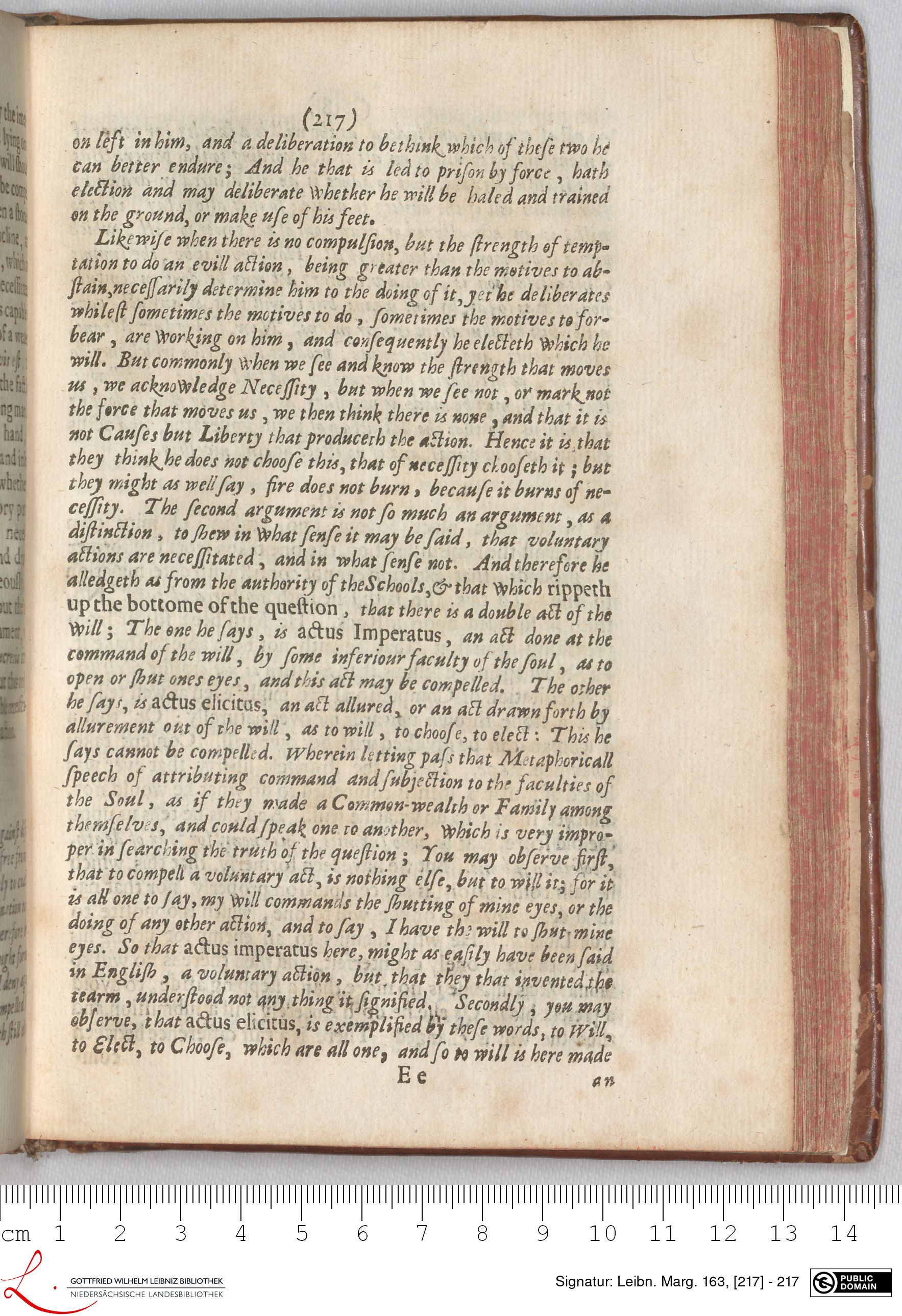
The machine reads it as
- 217
- on lest inhim, and a deliberation to bethink whichof these eme he
- ean berter endure; And he that is ledro prisonbyforce, harh
- election and may deliberate vhether he mill be baled and trainea
- on the cronnd, or make use of his feet.
- Likerrise rhenthere is no compulsion, but the streneth of temp–
- ration ro do an evill action, beine creater thanthe motives to ab-
- stain necessarily determine him co the doing of it, pet hc deliberates
- rhil est sometimes the motives to do, somerimes the motivesto for-
- bear are vorkine on him, and consequently heclecteth vhich he
- vill. Bur commonly When me (ec and lnom the streneth that moves
- us, me actnovledee Necessity. bnt hen me sec not, or marte not
- the force that moves us, we rhenthinte there is none, and that it is
- not Causes but Liberey that producech the action. Flence it is that
- they thinte hedoes not choose this, that of necessiry et 0osethit; but
- thez misht as mellsar. fire does not burn. because it burns of ne-
- cessity. The second argument is not so much an areument, as a
- distinction, tosem in vhat sense it may besaid, thac voluntary
- actionsare necessitated, and in rhat sense not. Andtherefore he
- alledeeth as from the authority of the Schools, ex that which rippect
- uptheboctome ofche quection, thar there is a double act of tho
- Will; Theone hesays, is actus Imperatus, an act done at the
- commandofthe milt, by some inferiour faculty of the soul, as to
- open or sutones eres, andtbis act may be compelled. The orher
- hesays, is actus elicitus, an act allured, or an act drann forch bys
- allurement ont ofche mill, as to will, to choose, to elect: This he
- Cays cannot be compelled. Wrherein terring pass that Mecaphoricall
- speech of artriburinqe command and subjection rothe faculties of
- ihe Soul, as if they made a Common- mealchor F’amily amone
- themselves, and conta speat one re ansther; Whichis very impro-
- per in searchine the truthof the question; Tou may observe first.
- that to compell a voluntary act, is nothine else, buc eo willits for it
- is at one to jay, my vill commands the Buctine of mine eyes, or the
- doine of any other action, and ro say. Thave th: will ro shut mine
- eges. Sothat actus imperacus here, miehe as easily have been said
- in Enslis, a volumary action, but that they thac invented ebe
- rearm, understood not any thine it signified. Secondly, non may
- observe, that actus elicieus, is exemplified by these mords, to W ill
- to EbcCt, to Cihoose, which are al one, and so to will is here made
Cite
The Questions Concerning Liberty, Necessity, And Chance, fol. 217. Machine transcription, not an edition: Leibniz Legible (model FoNDUE-GD_v2_ft_Leibniz, run 74). https://leibnizlegible.com/page/1030877386:0217?run=74