The Questions Concerning Liberty, Necessity, And Chance, fol. 235
Machine transcription. Not an edition. Errors are expected: about 8% character error rate on Latin and French lines, higher on German. Mean line confidence on this page: 0.90.
Original at the GWLB · Page image · Annotations (IIIF) · Download text
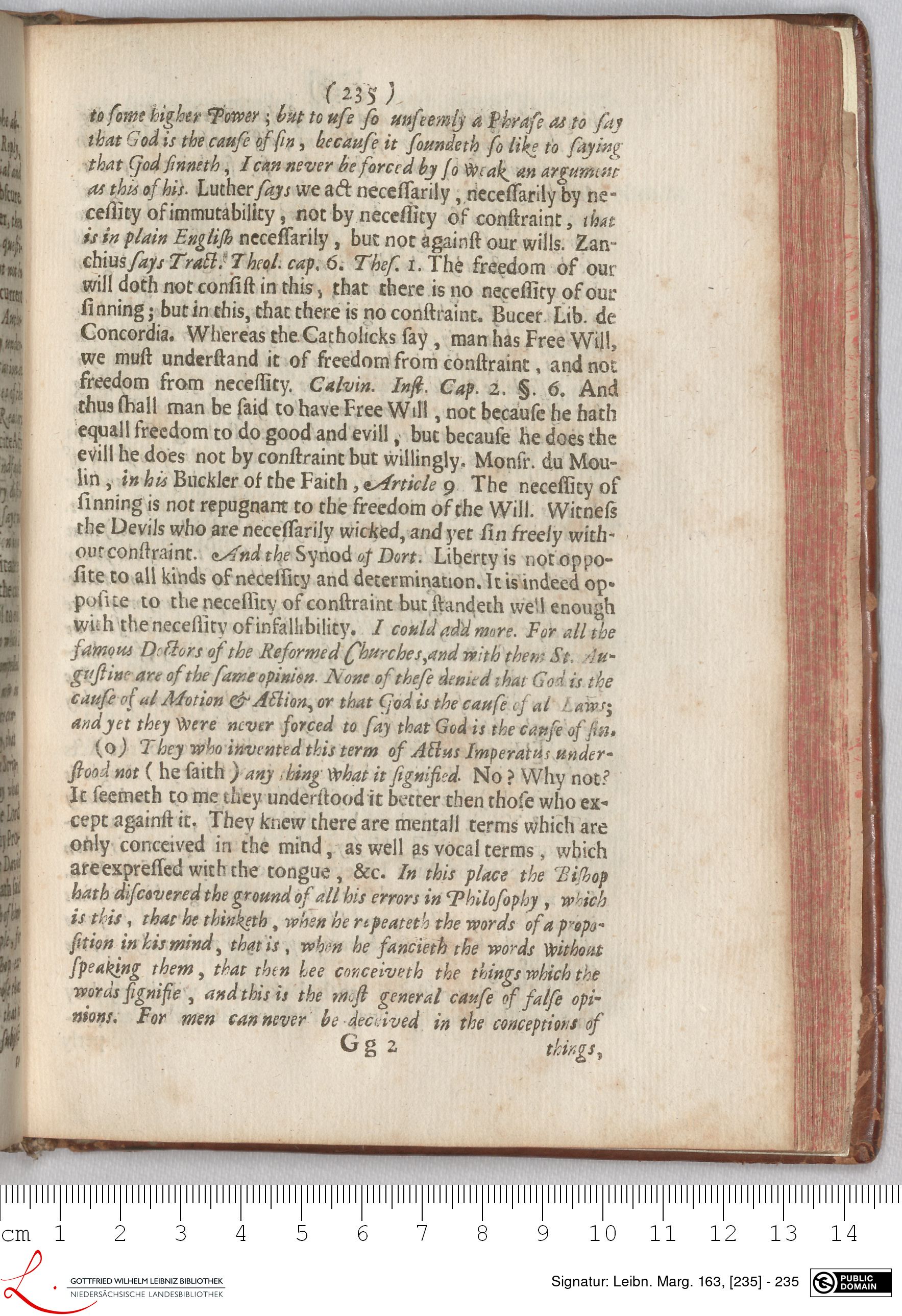
The machine reads it as
- 238
- eosome bicher Dover; bat touse so unscemly à Phrase as 10 say
- ihat Codis the cause of sin, becanse it sonndeth so like to sayine
- that God Sinneth. Jean never be forced by so vcal an areumss
- asthis ofhis. Lucher says We act necessarily; necessarily by ne-
- celtier ofimmutabilley, noc by necectier oF constraine, ihat
- is in plain Fneliss necellarily, buc noc against our wills. Z an
- chiussars Tract. Theol. cap. 6. Thes. L. The Froedom of our
- Will doth noc consist inthis, ehac chere is no necelsiey oF Oue
- sinmine; bue inchis, ehac chere is no constraint. Bucer. LIb. de
- Concordia. Whereas ehe Cacholieks Pay, manhas Frec Will.
- we must understand ic of freedum From constraine, and nOc
- freedom trem necestier. Calvin. Inst. C ap. 2. 5. 6. And
- ehus ChaII man be said cotare Frec WiII, noc because he hach
- equall Ercedom eo do 5o0d and eril; buc because he doesthe
- erillhe does noc by constraine but willinsly. Monsr. du Mou-
- lin, in his Buckler ot che F’aich, Arricle 9. The necestiey ot
- Tinnins is noc repusnam to che treedom ofche Will. Wienels
- the Verils who are necessarily wicked, ands et sn freelv wich.
- our constraine. And the Synodof Dort. Liberey is nOEODDO.
- Sice co all kinds of necellier and decermination. Ic is indeed op.
- potice 1o chie neceslier ot constraine buc Kandech ell enousti
- rich chenecestiey oFintalhbilier. L conld add more. Por all ibe
- famons Dectors of ihe Reformed Churches, and mirh them S6. AW
- sustine are ofthe same opinion. Nonc of these denied rhat Cod is the
- cause of al Motion es action, or that Godis thecanse of al Lavs;
- and yet they vere never forced 1o say that God is the canse of sict.
- (0) Theymbo inventedthis term of Actus Imperatus under-
- Aood nor (heCaieh) any, bine what it signified. NO: WVhy nOL?
- Ic scemeth come cher understood it becter chenthose wo ex-
- cept asainstic. Ther knem chere are mencaII cerms Whichare
- otily conceired in che mind, a5 ell es vocalterms, which
- are expressed wichche congue, _c. In this place the Bisop
- hath discoveredthe cronndof all his errors in Philosophy, which
- is this, thac hechinheth, inhen he repeateth the mords of a propo-
- sition inbismind, tharis. wohen he fancierts the mords ithont
- speatine them, thar ehen hec conceiveth the trines hich the
- mords signifie, andthis is the most senerat cause of false opi
- nions. For men cannever be deciived in the conceptions of
- 5 2
- thines.
Cite
The Questions Concerning Liberty, Necessity, And Chance, fol. 235. Machine transcription, not an edition: Leibniz Legible (model FoNDUE-GD_v2_ft_Leibniz, run 74). https://leibnizlegible.com/page/1030877386:0235?run=74