The Questions Concerning Liberty, Necessity, And Chance, fol. 253
Machine transcription. Not an edition. Errors are expected: about 8% character error rate on Latin and French lines, higher on German. Mean line confidence on this page: 0.93.
Original at the GWLB · Page image · Annotations (IIIF) · Download text
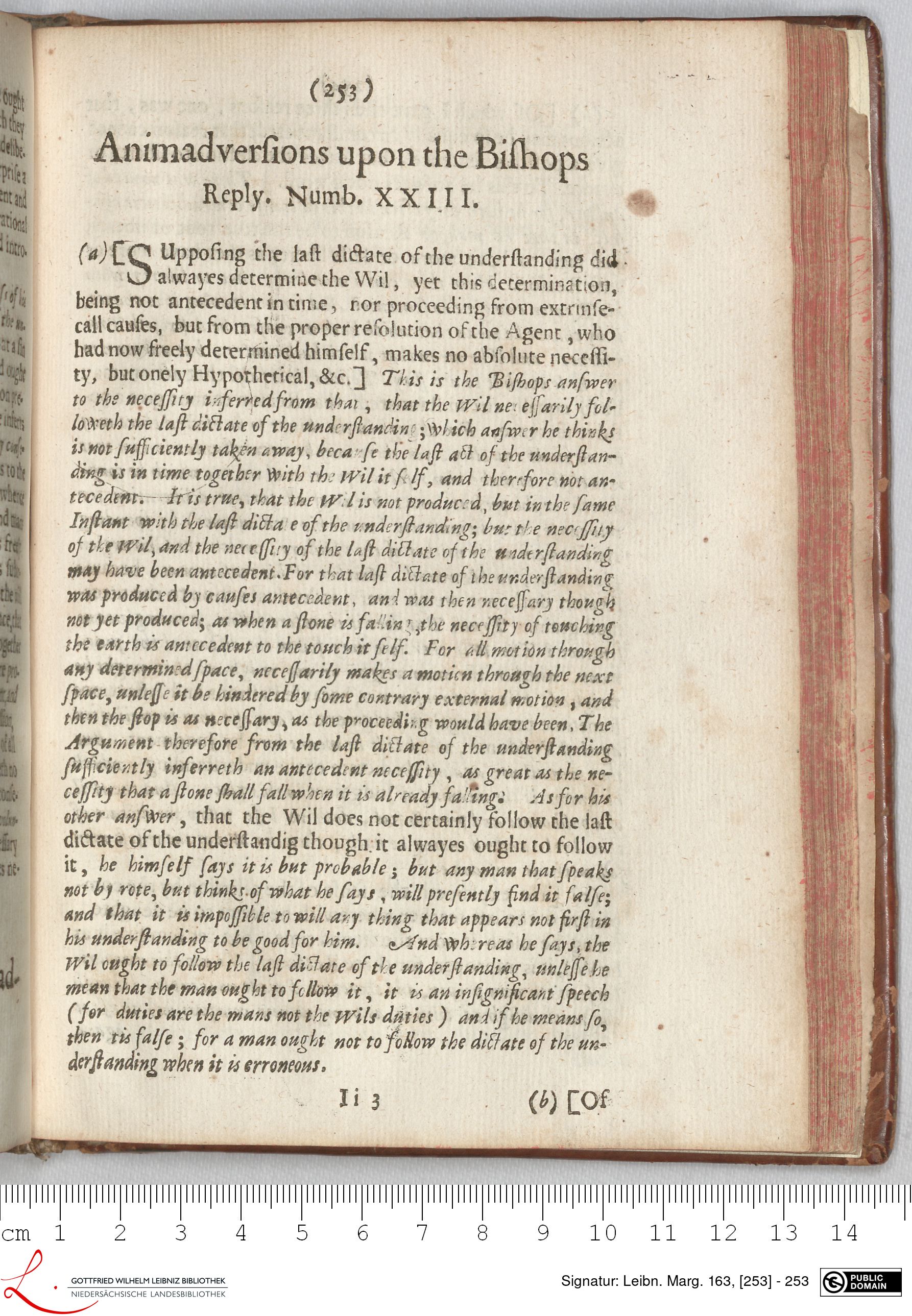
The machine reads it as
- Animautertions upon the Bistrops
- Rexly. Numb. XXIII.
- (a) CC Upposins che last dictare ofche understandins did
- alvares decermine cheWil, vec this decermination,
- beins noc ancecedent intime, ror proceedins trom extrinse.
- calleauses, bur trom ehie properresolurion oFthe AgenE, Who
- hadnon frecly determined himselF, makes no ablolure neceM-
- e, buc onely Hypotherical, _C.) Flis is the Disops ansver
- 1o tho necessitu inferredfrom thar; that the Wil ne: essarily fol-
- Lorreththe last dictate of the understandine; lich ansiver he thintes
- is nor sufficient ly talen amay. becarse the last act of the understan-
- dine is in rime cosether with rh. Wil it self, and therefore not an-
- recedem. Tris true rhat the WV: lis not produced, but inthe same
- Instant with the last dicta eof the understandinq; bu: Yl. e necessicy
- of ie ril, and the nece ssiry of the last dictate of che understandine
- may have been antecedent. F’or that last dictate of lhe understandine
- vas produced by causes ancecedent, an Lmas then necessary thouch
- not yet produced; as rhen astone is fallinr, the necessiey of rouchine
- the carth is amecedent to the touch it sels. For all motion throneh
- any derermined space, necessarily makes a morien thronch the next
- space, antesse it be hindere d by some contrary external motion, and
- ehen thestop is as necessary, as the proccedir. mould have been. The
- dreument thcrefore from the last dictare of the understandine
- sufficiently inserreth an antecedent necessity, as creat as the ne-
- cessity thar astone sall fallehen it is already falline. Asfor his
- other ansiver, thac che Wil does noc certainty follon che las
- dictate ofche understandis chovgh. ic alvayes oughero follon
- ie, he himsels says it is but probable; but any manthat speales
- not by roce, but thintes. of vohat hesays, will presently find it falsez
- and that it is impossible tomill any thine that appears not first in
- his understandine 1o be cood forhim. And Wh: reas he Cars, the
- Wil ouche to follon the last dictare os ete understandine, unlesse he
- mean tharthe man oushe ro fellon it, it is an insienificani speech
- (for duries areche mans not the Wils duries) andis he means so
- then ris false; for a manouche not to follor the dictate of the un-
- derstandine rhen it is erroneons.
Cite
The Questions Concerning Liberty, Necessity, And Chance, fol. 253. Machine transcription, not an edition: Leibniz Legible (model FoNDUE-GD_v2_ft_Leibniz, run 74). https://leibnizlegible.com/page/1030877386:0253?run=74