The Questions Concerning Liberty, Necessity, And Chance, fol. 254
Machine transcription. Not an edition. Errors are expected: about 8% character error rate on Latin and French lines, higher on German. Mean line confidence on this page: 0.85.
Original at the GWLB · Page image · Annotations (IIIF) · Download text
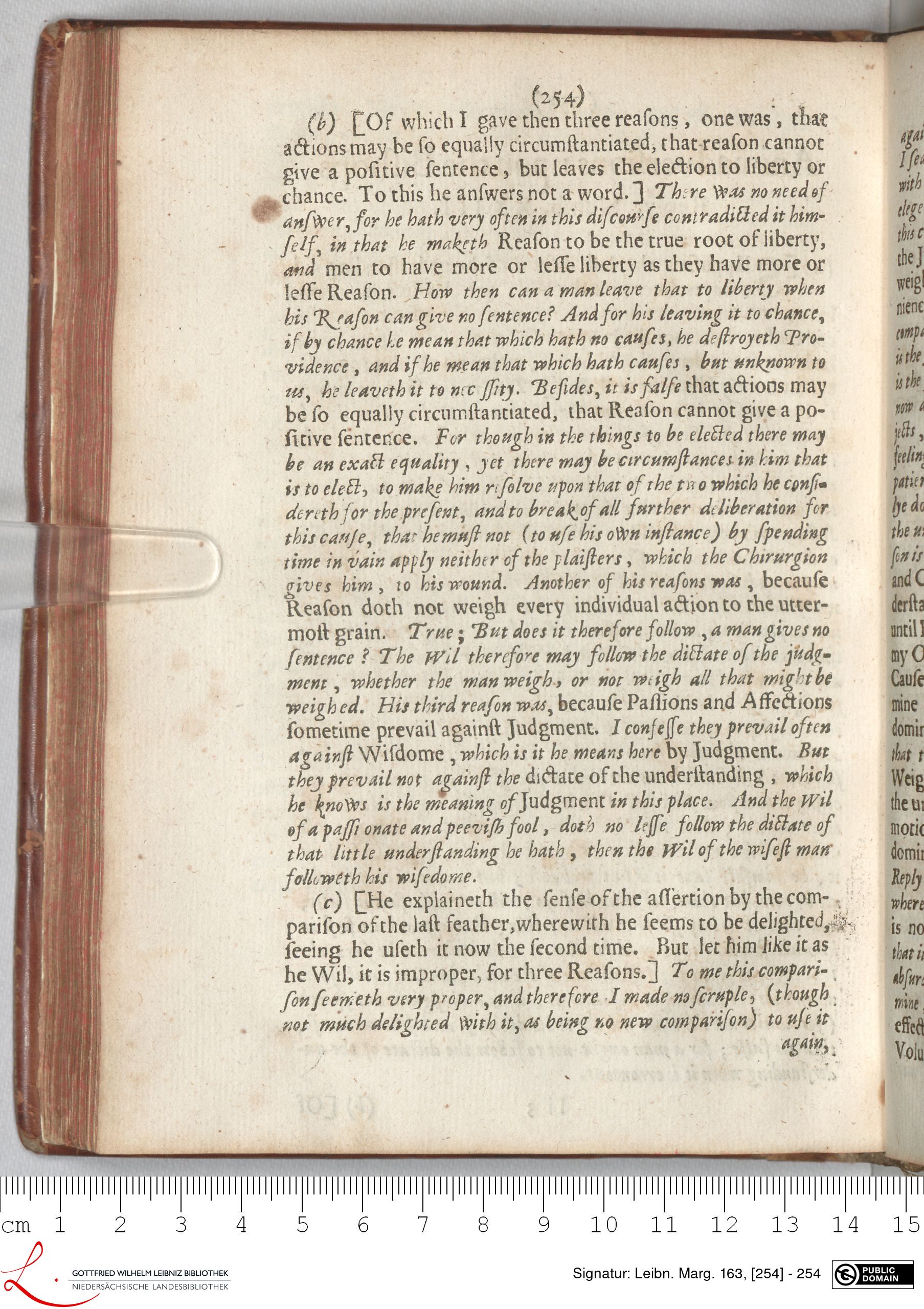
The machine reads it as
- (254)
- (b) TOF wtrich I save then chreereasons, one Was, thac
- actionsmaz De so egually circumscantiaced, chat reasOn CaNNOL
- sire a posicire sencence, buc leares cheelection to liberty or
- chance. TOchis he ansivers noc a word. ) There Was noncedof
- ansiver, for he hath very often inthis discourse contradicted it him-
- self, in that he maketh Reason eo be the erue root ot liberer,
- and men co hare more or lesse liberey as cher hare more or
- lesse ReaIOn. Hlom then can a manleare that to liberey when
- bis Pcason can civeno sentence. And for his leavine it to chance,
- if by chance le mean that rhich hath no causes, he destroreth Pro-
- vidence, and if he mean that rhich hath causes, but untnonn to
- us, he leavethit tonce ssity. Besides, it is false chac actious may
- bes0 equally circumstanciaced, chat Reo son cannor sive a po-
- fcire sentence. Por thouch in the thines to be electe d there may
- be an exact equaliry, et there may becircumstances in lim that
- is to elect, tomake him re solve upon thar of rhe rno rhich he consia
- dereth for the present, andto breale of all farther deliberation for
- this cause, ehas hemust not (touse bis ovn instance) by spendine
- time in vain apply neither ofthe plaisters, which the Chirureion
- sives him, 10 his mound. Another of his reasons mas, because
- Reoson doch noc weish every indiridual action to che vrter-
- moltsrain. True; Dut does it therefore follom, a man cives no
- sentence? The il therefore may follon the dictare os the jude-
- menc, rhether the manmeich, or noc mcich all that michibe
- veiched. His third reason mas becouse Pastions and Afections
- Tometime prevail asainst Judsmene. Iconfesse they prevail often
- aeainst Wisdome, nhichis it he means here by Tudsmene. But
- ther prevail not acainst the dictare ofche understandins, which
- he enovs is the meanine of Judsment in this place. And the Wil
- of a passi onate andpecviss fool, doth no lesse follon the dictate of
- that lirele understanding hehath, then the Wil of the misest man
- follemethhis misedome.
- (C) THe explainech the sense oFthe aserrion by thecom-
- parilon ofche last feacher, wheremith he Peems to be delighted, iso
- secins he uleth ic non thesecond eime. Buc lec him like it a5
- he Wil, ic is improper, For chree ReaTOnS.) T0 methis compari-
- son seemeth very proper, andtheretore. I made no scruple, (thonch
- not much delichred vithit, as beins no nem comparison) touse it
- acain
- is
- je
- se
- patiet
- bed
- the M
- sont
- aM
- de
- C
- Mine
- de
- cha
- Me
- de
- P
- ihat
- M
- nh
- 15 B
Cite
The Questions Concerning Liberty, Necessity, And Chance, fol. 254. Machine transcription, not an edition: Leibniz Legible (model FoNDUE-GD_v2_ft_Leibniz, run 74). https://leibnizlegible.com/page/1030877386:0254?run=74