The Questions Concerning Liberty, Necessity, And Chance, fol. 257
Machine transcription. Not an edition. Errors are expected: about 8% character error rate on Latin and French lines, higher on German. Mean line confidence on this page: 0.91.
Original at the GWLB · Page image · Annotations (IIIF) · Download text
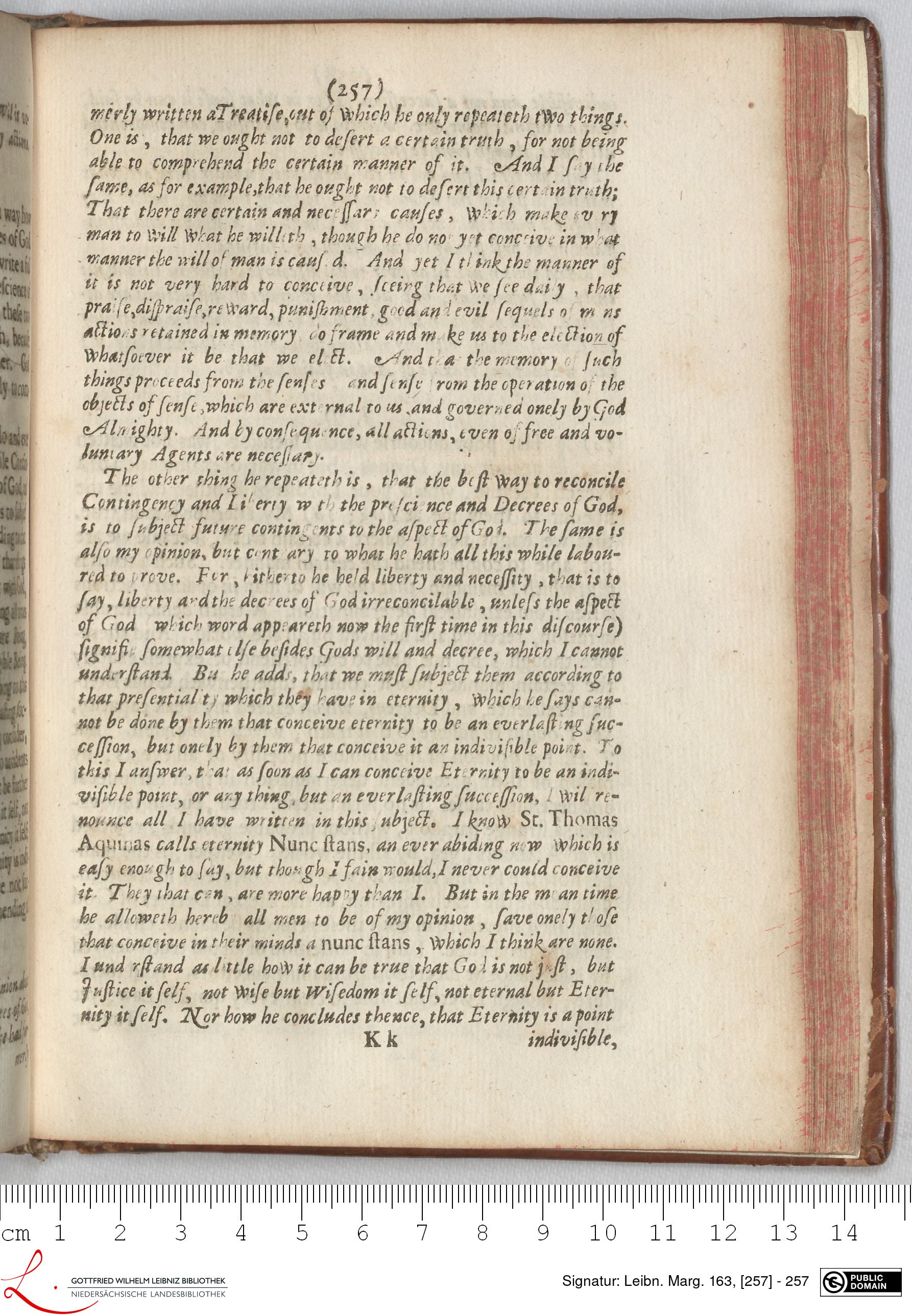
The machine reads it as
- 2
- merlys vritten a Freatise, ut o) Wohich he only repeat eth vo thines.
- Oneis, that me oncht noc eo desert a certoin truh, for not beine
- able ro comprehend the certain manner of it. And Y sayihe
- Came, as for example, that he ought not i0 deserrthis certuin truth;
- That there are certain and necessar: canses, Wih malee cV ry
- man to vill Btat he will. ch, thouch he do no yet concciv. in w’at
- manner ehe villos manis cans. d. And vet J el inte the manner of
- it is not very bard to conccive. sceine that ne sce dui y that
- prai se dispraise revard, punistment. Soc d an devil sequels ol m ns
- actiosretaine d in memory doframe andm le us tothe electionof
- Whatsoever it be that ve el et. Andi a thememory es such
- thines procceds from the senses and sense rom the operationoi the
- objects of sense, hich are ext rnal rous. and coverne d oncly by C;od
- Mlnighey. And byconsequ. nec, ullactins, cven os free and vo-
- nncary Asents are necessars.
- The otber chine herepeatethis, that the best vay eo reconcile
- Contingency and Li eriy w eh, the presei nee and Decrees of God.
- is ro subject fucure contincents torhe aspect of601. T hesame is
- also my pinion. but cent ary ro whar he hach all this hile labou-
- red roprove. For, tieherro he held liberry and necessity, thatis to
- say, liberty ardthe decrees of C’odirreconcilable, unlessthe aspect
- of Ciod rtich mord app. arech nom the first time in this discourse)
- sienifir Somembat ilse besides Gods will and decrce, which Tcannot
- anderstand. Bu he adds, that ve must subject them accordine to
- that presentiale, which they lave in eterniey, Which le says can
- not be done by them that conceive eternity to be an everlasti ns fnc-
- cession, but oncly by them thar conceive ir an indivisible point. 70
- this Lansiver, l’a as soon as J ean conceive Pterniey robe an indi-
- visible poine, or auy thins but an everlastins suecession, lWil re-
- nonnce all l have vritien in ehis, ubject. LknoW SC. ThAMAS
- AGuIaS calls eternity Nunc RanS, an ever abidine nem Wwhichis
- easy enor eh to say, but thos ch : fain rould. Lnever conld conceive
- it. Theychat c.n, are more hapry than L. But in the m. an time
- he allorveth hereb al men to be of my opinion. save onely Hl’ose
- that conceive incheir minds a nunc Rans,. Which Lthinke are none.
- Lund rstand as l’et le boir it can be true that 60 l is not just, but
- fustice ie sels, not wise but wrisedom it self, not eternal but Eter-
- nity it sels. Nor hor he concludes thence, that L. ternicy is a point
- K K
- indivisible
Cite
The Questions Concerning Liberty, Necessity, And Chance, fol. 257. Machine transcription, not an edition: Leibniz Legible (model FoNDUE-GD_v2_ft_Leibniz, run 74). https://leibnizlegible.com/page/1030877386:0257?run=74