A Discourse Concerning the True Notion Of The Lord's Supper, fol. -
Machine transcription. Not an edition. Errors are expected: about 8% character error rate on Latin and French lines, higher on German. Mean line confidence on this page: 0.90.
Original at the GWLB · Page image · Annotations (IIIF) · Download text
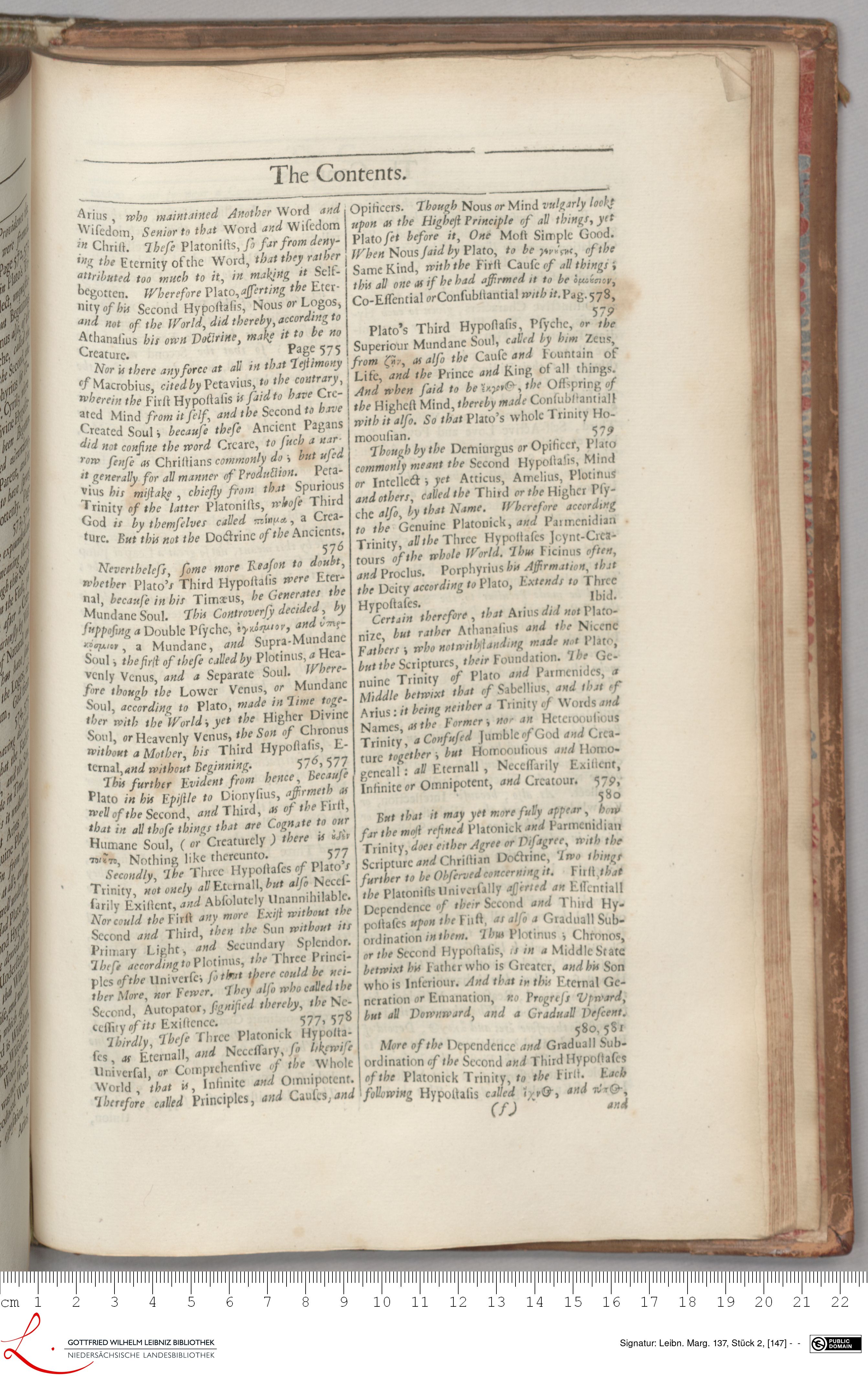
The machine reads it as
- THC COnFeNLS.
- Arius rohe maintained Anorher Word and, Opiticers. Thouch Nous or Mind vulearty loche
- Wisedom, Senior to that Word and Wiledom upon as the Eliebest Principlo of all ihines, vel
- in Christ. These PlatoniCs, so far from deny- Plato set before it, One Mon Simple Cood.
- ins ibe Ecerniey oEche Word, that they rather, Ir hen Nous said by Placo, 1o be zoruenc, of ibe
- attributed 100 much to it, in matine it SelF. Same Kind, with the First Cause os allthines:
- begocten. WBerefore Placo, asserrine the Lter.
- ebis all one as if hehad afirmed it 10 be ouoboror,
- niiros bis Second Aypostalis, NouS or L0805, CO. Fsencial or Consubllancia l with it. P~8. 578,
- and not of ihe Worid, did ihereby, accordins 10
- Achanalius bis oon Doctrine, make it 20 be no
- PaGC575
- PtatoS Third Aypostalis, PTChe, on ihC
- Suveriour Mundane Soul, called by him ZCus.
- Nor is there apoforce at all in that Testimony from Cui as also the Cause and Founcain oE
- Creature.
- e Macrobius, cired by Petarius, 1o the contrary,
- herein the Firs FIy Poctalis is said to have Cre-
- Lite, and ihe Prince and RinB OF aII chings.
- And wben said 10 b0 enzore, ihe OAprins os
- ared Mind from it setf. and ihe Second to bave the Hixhest Mind, thereby made ContubitanciaII
- Created Soul; because these AncienE PaGanS with it also. S0 that Placo S irhole Friniey H0.
- did not confine the mord Creare, to sueh a nar.
- rom sense as Chriltians commonly do; but used
- et generally for al manner of Production. Peta-
- moousian.
- Thoneh Bythe Demiurous or Opiticer, Placo
- commonty meant the Second Aypoctasis, Mind
- vius his mistate, chiesty from that Spurious or Incellect; vet AccieuS, Amelius, PlOcinuIS
- Friniey of ihe larter Platonists, nhose Third andorhers, called ihe Third or ihe Hister P(y-
- Cod is by themselves called moinua, a Crea- che also, Wy that Name. WBeresore accordin
- cure. But this nos the Doctrine os ihe AncientS. 10 ihe Genuine Platonick, aud Parmenidian
- 57C
- Nevertheless. (ome more Reason 10 doubt,
- ohether Placos Third Arpostalis vero Lter-
- nal, because in bis Timxus, he Generates ihe
- Mundane Soul. This Controversy decided, by
- supposins a Double PErche, irneruor, and ime-
- roopuor, a Mundane, and Supra. Mundane
- Soul; thefirst of these called by PlocinuS, a HCa-
- venly venus, and a Separate Soul. IrBere-
- Trinier, allihe Threc Eypollales sernc. Crea
- TOurS ofthe mbole Worid. Tbus FicinuS often
- and Proctus. Porphurius bis Afirmation ihac
- ihe Deier accordine 10 Placo, Lixtends 10 Threc
- Arpoctales.
- Ibid.
- Cerrain theresore, ibat Arius did not PIaco
- nire, but rather achanalius and ihe Nicene
- Pathers; ubo normithstandine made not PlacO.
- but the Scripeures, their Foundacion. IB0 GC-
- Fore iboneh ihe LOrver VenUS, or Mundane nuine Prinier os Placo and Parmenides, a
- Soul, accordine 1o Plato, made in Time 10gC-
- ber with ibe Worid; vet ihe Flisher Divine
- Soul, or Dleaventy Venus, ihe Son of ChrOnuS
- vithout a Morher, his Third FIypONalIS, L.
- ternal, and wirhout Becinnine.
- 576,57
- Tbis furrher Lvident from hence. Because
- Placo in his Epistle to Diony(iuS, affirmeth as
- vellos ihe Second, and Third, as of ihe FirH,
- abat in all ihose rhines that are Coenate 1e our
- Humane Sout (or Creaturely) ibere is esir
- 2012ro Blochine like Chereunto.
- 57
- Midale berroixt ibat of Sabellius, and 1Bst et
- Arius: it beine neirber a Friniey of Words and
- Names, as tbe Former; noc an Hecerooutious
- Trinier, a Consused Jumble of Cod and Crea-
- cure rocetber; bus Flomoonsious and HlomO-
- genealI: al EternalI. Necessarily Lxistent,
- Intinice or Omniporent, and CrCAIOUT. 579,
- 580
- Secondly, The Threc Lypoctales of Platos
- Bat ihat it may vet more fully appear, bon
- Far ihe most resined Placonick and P’armenidian
- Frinier, does either Aeree or Disaeree, with ihe
- Scrixture and Christian Doctrinc, Luo tbines
- Prinier pot oncto ab E ternaII, but also NCcCI- furiber 10 be Observed concernine it. FirH ihac
- Carilys Existene, and Absolutelr Unannihilable.
- ihe Placonists UniverCally asserred an L Nencia II
- Nor conld the First any more lxist without ihe Dependence os ibeir Second and Third HV-
- Second and Third, ihen ihe Sun without iis postates upon ibe FirA, as also a GraduaII Sub-
- Primarr LighC, and Sccundary Splendor. ordinacion in them. Zbus PlOcinus; ChionOS,
- hese accordineroPlocinus, ihe Three Princi-or ibe Second HypOctalis, is in a Midale ScacC
- ples osthe Univertes sorbut ipere contd be nei- beroixt his Pacher ertio is Greater, and his Son
- IBer MOrO, nor Perver. They also who called ibe
- Sccond, AucOpatOF, signisied thereby, ibe NC.
- CeMY its LXittence.
- 577, 570
- Tbiralo. Theso nc Tlaconicle IIypolta.
- reS, as Eternall, ana Necessary, so litervise
- eoto is Inseriour. And thas in phis Rcernal Ge-
- neration or Emanation, no Proeress Vprvard,
- but all Domumard, and a Graduall Descent.
- 580, 561
- Nore of the Dependence and GraduaII Sub-
- Univer (aI or Comprehentire of the Whole ordination of ihe Sccond and Third Erpoltates
- Worta pbat is, Intinice and Oimmipocent. of ihe Placonick Priniey 1o the FirII. Lact
- Theresore callea Principles, and Caules, and follomine HypOstalis called iyre, and nne
Cite
A Discourse Concerning the True Notion Of The Lord's Supper, fol. - . Machine transcription, not an edition: Leibniz Legible (model FoNDUE-GD_v2_ft_Leibniz, run 74). https://leibnizlegible.com/page/1066511403:0147?run=74