A Discourse In Vindication of the Doctrine of the Trinity, fol. XI
Machine transcription. Not an edition. Errors are expected: about 8% character error rate on Latin and French lines, higher on German. Mean line confidence on this page: 0.95.
Original at the GWLB · Page image · Annotations (IIIF) · Download text
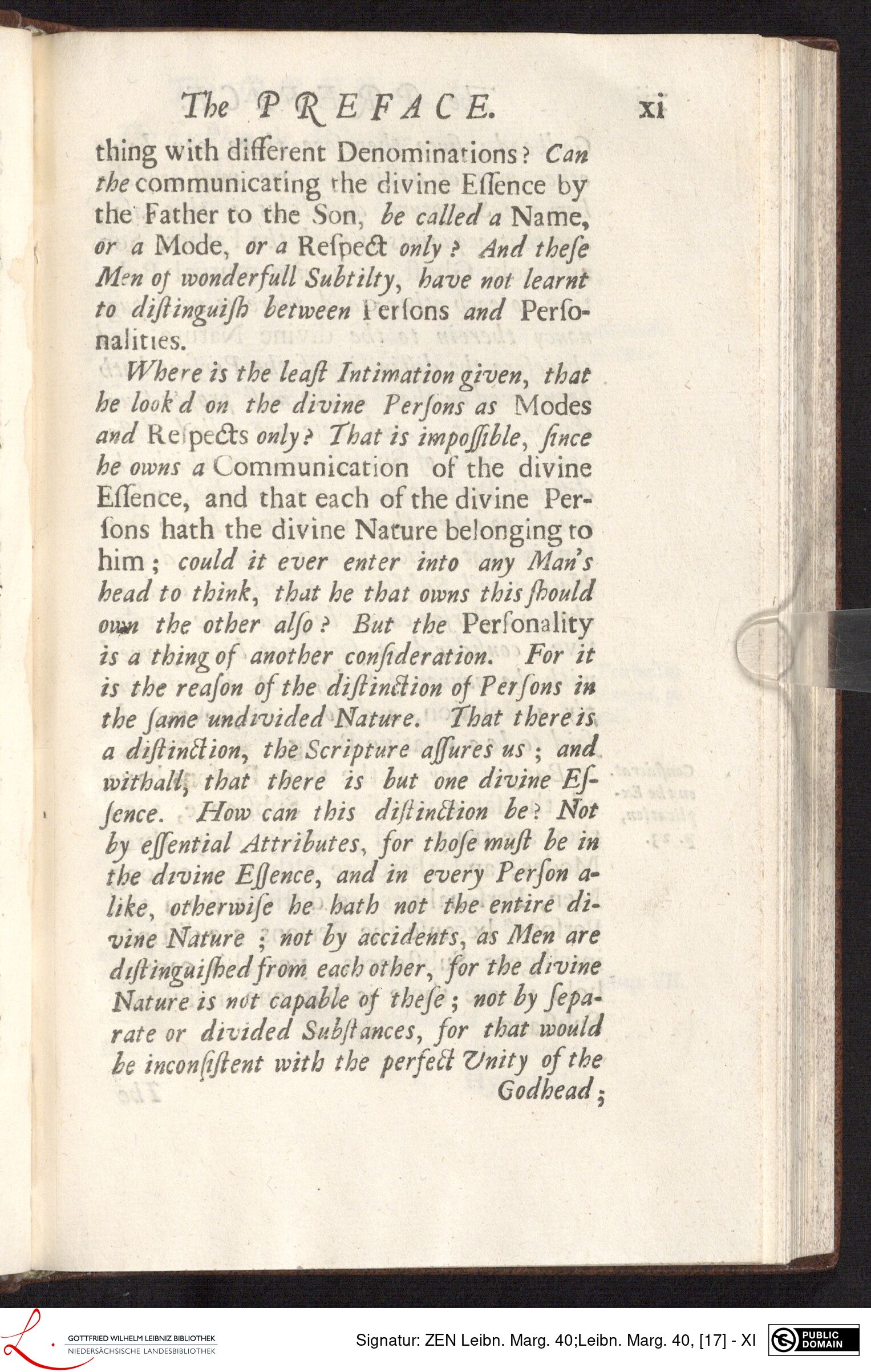
The machine reads it as
- The P R F F A C F.
- thins wich different Denominarions: Can
- the communicarins rhe divine Flsence by
- che Facher to the Son, be called a NaMC,
- or a Mode, or a Relvect ontr. And these
- Men os monderfuit Subtilty, have not learnt
- to distinguist berween lerlons and Perlo-
- nalities.
- Where is the least Intimation siven, that
- he loot d on the divine Persons as Modes
- and Respects ontr: Thatis impossible, since
- he vons a Communication ol the divine
- Fssence, and chac cach ot the divine Per-
- Tons hath the dirine Nacure belonoins to
- tum; could it ever enter into any Mans
- head to think, that he that oons this sould
- oun the other also: But the Perlonaliey
- is a thine of another consideration. For it
- is the reason of the distinction of Persons in
- the same undrvided Nature. That thereis
- a distinction, the Scripture assures us; and
- withall; that there is but one divine Fs
- sence. TTou can this distinction be. Not
- By essentiat attributes, for those must be in
- the droine Esence, and in every Person a-
- like othervise he hath not the entire di-
- vine Nature: not by accidents, as Men are
- distinenised from eachother, for the divine
- Nature is not capable of these; not by sepa-
- rate or divided Substances, for that vould
- he inconsistent with the perfect Onity of the
- Codhead;
Cite
A Discourse In Vindication of the Doctrine of the Trinity, fol. XI. Machine transcription, not an edition: Leibniz Legible (model FoNDUE-GD_v2_ft_Leibniz, run 74). https://leibnizlegible.com/page/727097563:0017?run=74