A Discourse In Vindication of the Doctrine of the Trinity, fol. XII
Machine transcription. Not an edition. Errors are expected: about 8% character error rate on Latin and French lines, higher on German. Mean line confidence on this page: 0.94.
Original at the GWLB · Page image · Annotations (IIIF) · Download text
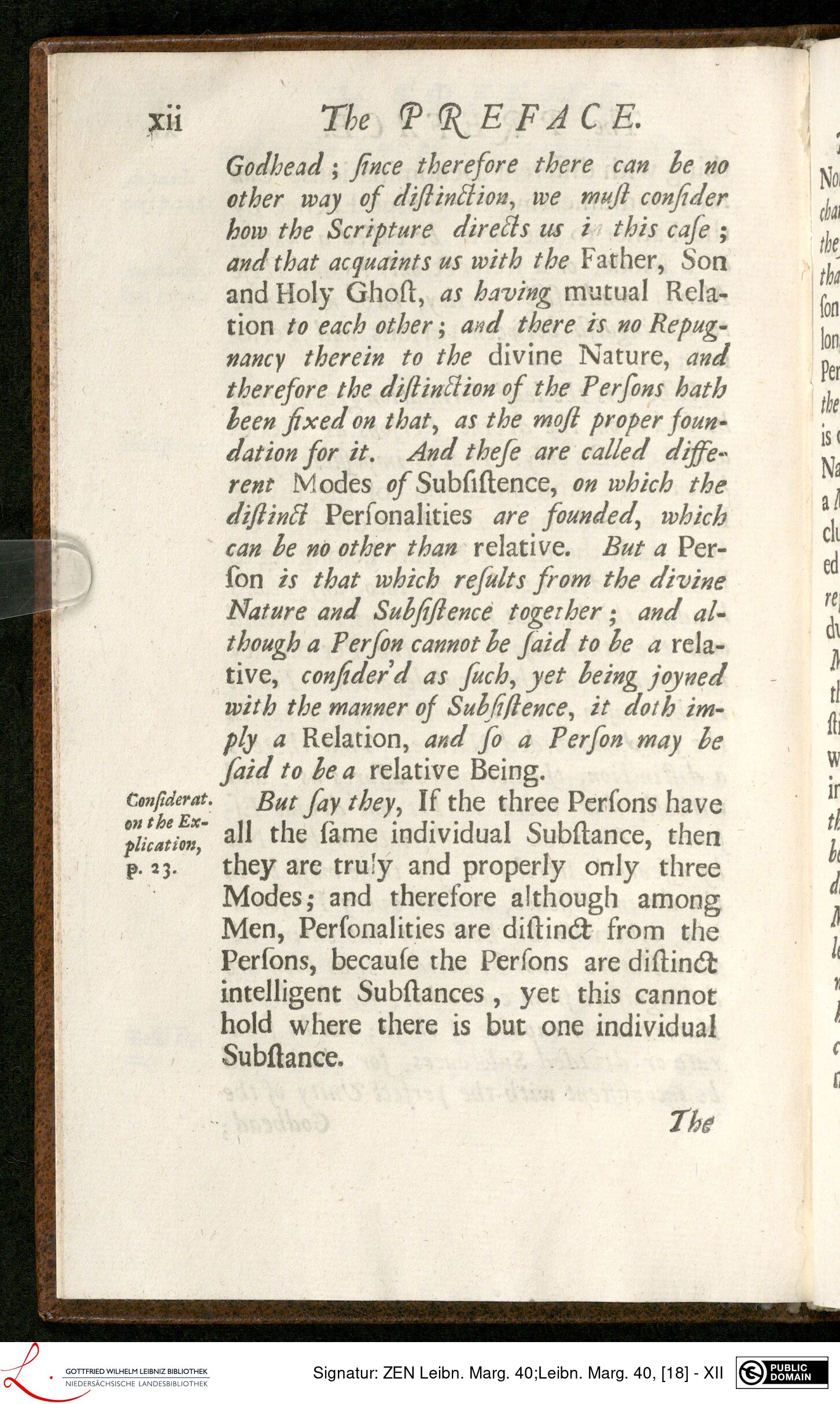
The machine reads it as
- The D R E S AC F.
- Codhead; since therefore there can be no
- other way of distinction, we must consider
- hou the Scripture directs us in this case;
- and that acquaints us with the l’ather, Son
- and Holy Cholt, as havins mucual Rela-
- tion io each other; and there is no Repue
- nancv therein to the divine WaturC, and
- therefore the distinction of the Persons hath
- been fixed on that, as the most proper foun-
- dation for it. And these are called disse-
- rent Modes of Sublctence, on Wwhich the
- distinet Perionalities are founded, which
- can be no other than relative. But a Per-
- Ton is that Which results from the divine
- Nature and Subsistence tocerher; and al-
- thouch a Person cannot be said to be a rela-
- tive, consider d as such, vet beine joyned
- vith the manner of Subsistence, it doth im-
- ply a Relarion, and so a Person may be
- said to be a relative Being.
- considerat. But sar ther, IFthe chrec Persons have
- plication, all the Came individual Subltance, then
- P. 23. ther are truis and proveriy omly chrec
- Modes; and theretore althoush amone
- Men, Perlonalities are diltinet trom the
- Perlons, becaule the Persons are dictinet
- intelligent subltances, vec chis cannoe
- hold irhere chere is but one individual
- Subctance.
- On tBe P. X-
Cite
A Discourse In Vindication of the Doctrine of the Trinity, fol. XII. Machine transcription, not an edition: Leibniz Legible (model FoNDUE-GD_v2_ft_Leibniz, run 74). https://leibnizlegible.com/page/727097563:0018?run=74