A Discourse In Vindication of the Doctrine of the Trinity, fol. 73
Machine transcription. Not an edition. Errors are expected: about 8% character error rate on Latin and French lines, higher on German. Mean line confidence on this page: 0.92.
Original at the GWLB · Page image · Annotations (IIIF) · Download text
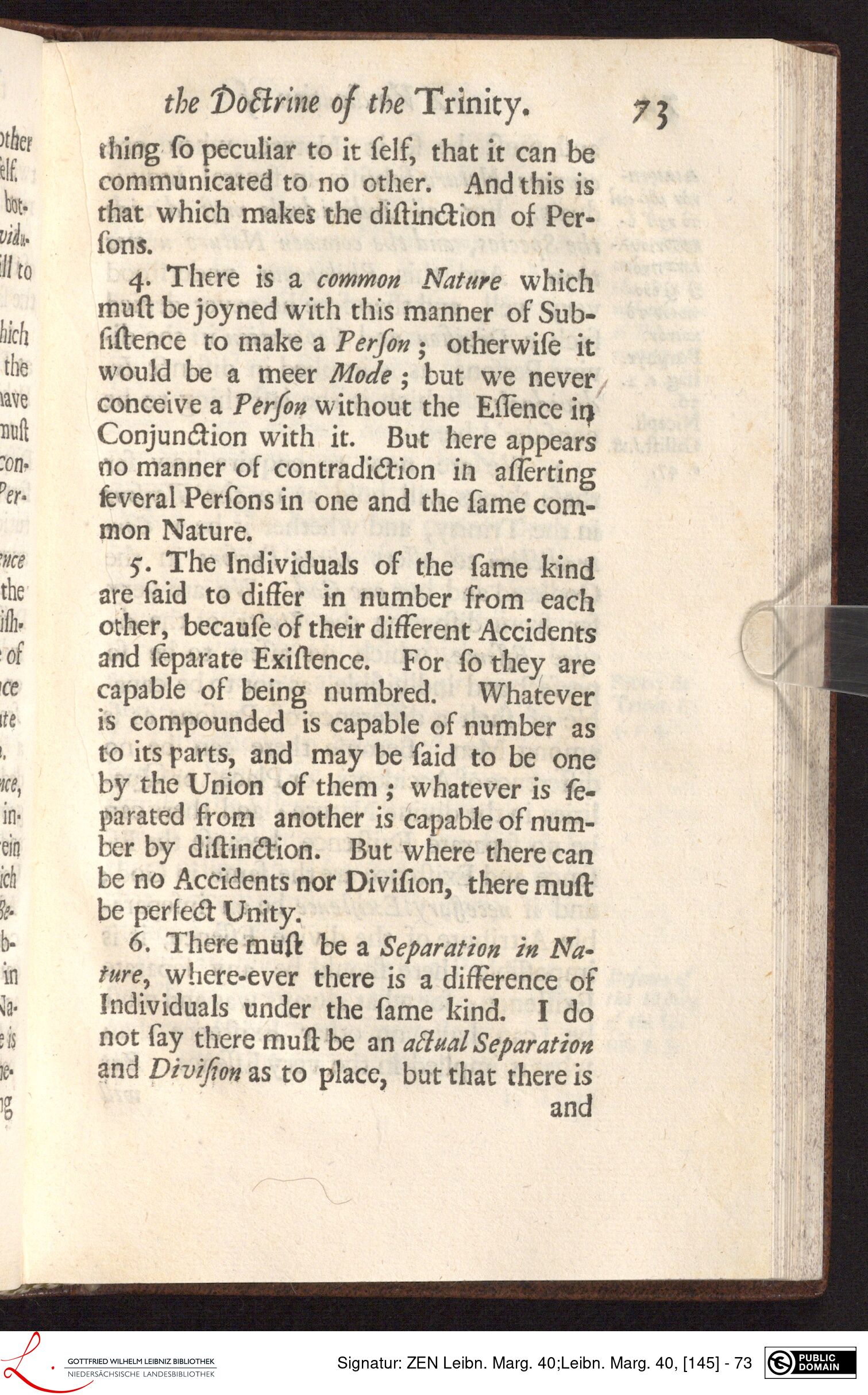
The machine reads it as
- COn
- et
- the Doctrine of the Trinier.
- ehing. (0 peculiar to it selF, that ic ean be
- communicated to no ottier. Andthis is
- thac wrhich matres che distinction ot Per-
- FOrS.
- 4. There is a common Nature Whrich
- muct De jorned rith chis monner ot Sub-
- Ciltence to makre a Person; otherwise it
- vould be a meer Mode; but e never
- conceire a Person wichour the Fssence in
- Conjunction with il. But here appears
- nomanner ot contradiction in altertine
- several Persons in one and the lame com-
- mon Naturo.
- 5. The Individuals oF the Came kind
- are said to dister in number trom cach
- octer, because of their difterent Accidents
- and separate Fxiltence. For (o they are
- capable ot beine numbred. Whatever
- is compounded is capable ot number as
- to its parts, and may be Paid to bc onc
- br the Vnion ot them; Whatever is se-
- parated trom another is capable ot num-
- ver by distinction. But where there can
- be no Accidentsnor Divition, there must
- De perteet Uniey.
- 6. There muse De a Separation in Na-
- sure, Wtrere ever there is a difference ot
- Individuals under the Pame Kind. 1d0
- not Pay there must be on actual Separation
- and Division 25 to placc, but that there is
- an
Cite
A Discourse In Vindication of the Doctrine of the Trinity, fol. 73. Machine transcription, not an edition: Leibniz Legible (model FoNDUE-GD_v2_ft_Leibniz, run 74). https://leibnizlegible.com/page/727097563:0145?run=74