A Discourse In Vindication of the Doctrine of the Trinity, fol. 72
Machine transcription. Not an edition. Errors are expected: about 8% character error rate on Latin and French lines, higher on German. Mean line confidence on this page: 0.92.
Original at the GWLB · Page image · Annotations (IIIF) · Download text
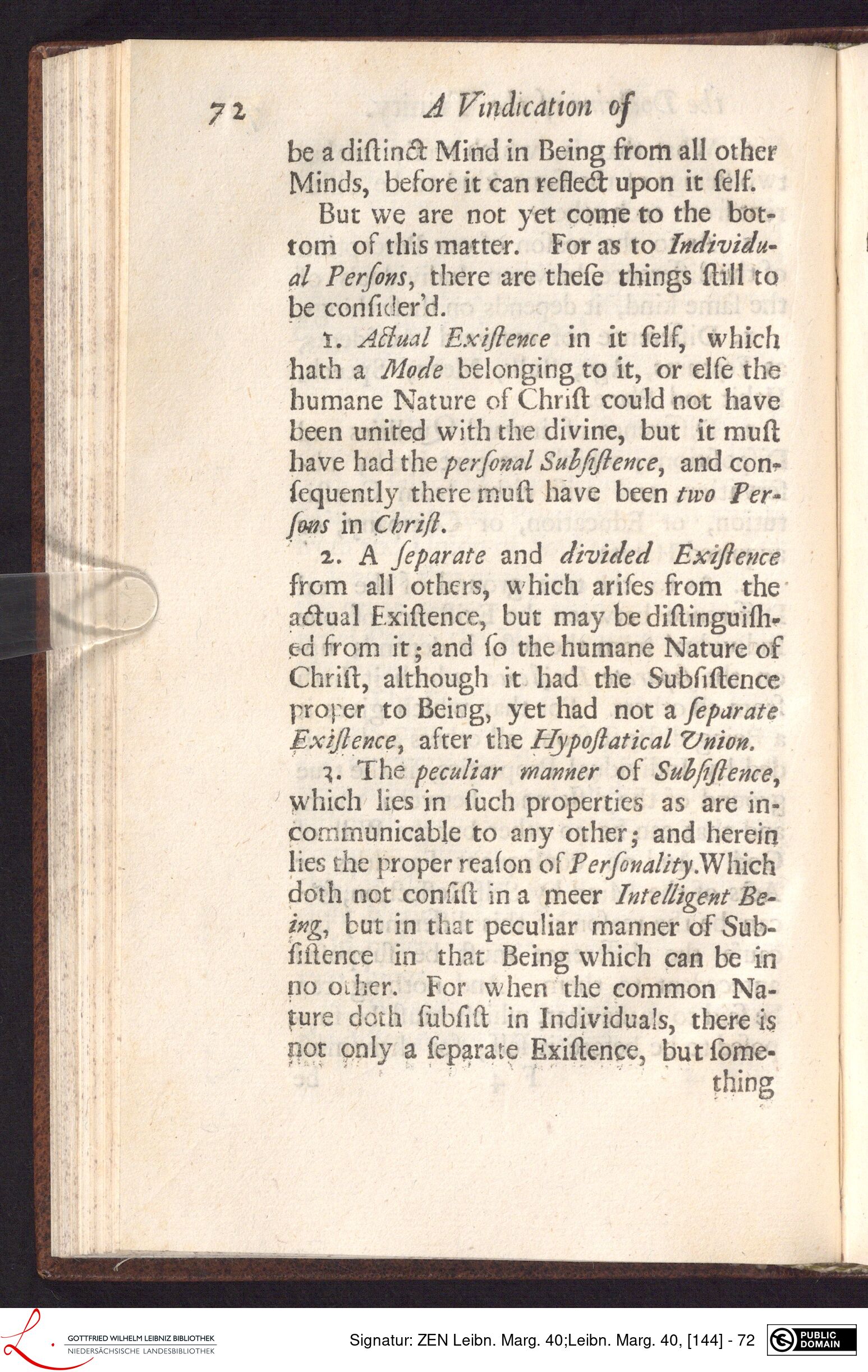
The machine reads it as
- AVindication of
- be a distinet Mind in Beins from all orher
- Minds, betore it can refect upon ic PelF.
- Buc we are not vet cometo the boc
- tom ot chismatter. For a5 10 Individu-
- at Persons, chere are these things RiII +0
- De consiclerd.
- +. Lctual Existence in it PeIF, ertrich
- hach a Mode belonsins to it, or elic thie
- humane Nature ot Christ could noc have
- Been united wich ehe divine, buc ic must
- have hadthe personal subsistence, and Con-
- sequenly there must have been rvo Per-
- sons in Christ.
- 2. R separate and divided Existence
- from all others, which arises trom the
- actual Exiltence, but mas bedistinguis.
- catrom it; and (o che humane Nature oF
- Christ, although ic had ehie Subsiltence
- prorer to Beins, yet had noc a separate
- Existence, alter che Lypostatical Vnion.
- 2. The peculiar manner oF Subsistence,
- Wrhich lies in Puch properties as arc in-
- conmunicable to any other; and herein
- lies the proxer realon of Personality. Which
- dorh noc consist in a meer Intellicent Be-
- ing, buc in that peculiar manner oF Sub-
- filtence in that Being erhich can DC in
- no oltier. For wvtien che common Na-
- cure dorh subsict in Individuals, there is
- noc ouly a separate Existence, bur lome.
- chire
Cite
A Discourse In Vindication of the Doctrine of the Trinity, fol. 72. Machine transcription, not an edition: Leibniz Legible (model FoNDUE-GD_v2_ft_Leibniz, run 74). https://leibnizlegible.com/page/727097563:0144?run=74