A Discourse In Vindication of the Doctrine of the Trinity, fol. 252
Machine transcription. Not an edition. Errors are expected: about 8% character error rate on Latin and French lines, higher on German. Mean line confidence on this page: 0.91.
Original at the GWLB · Page image · Annotations (IIIF) · Download text
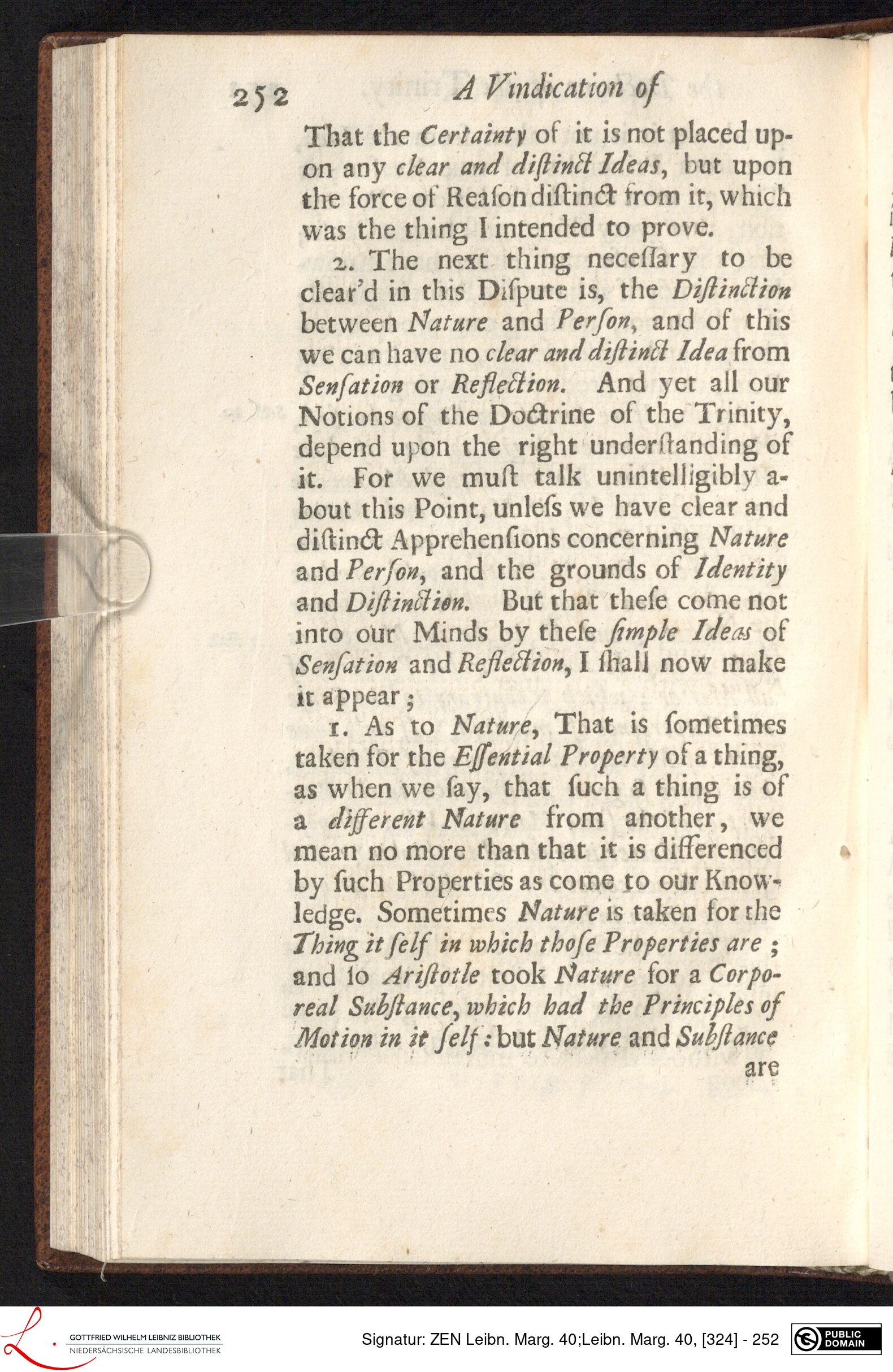
The machine reads it as
- AVindication of
- That ehe Cerraintr ol it is not placed up.
- on any clear and distinet Ideas, but uxon
- the Force ot Realondistinet trom ic, Wwhich
- iras the chine l’intended to prove.
- 2. The next thinq necelsary 1o bc
- eleard in this Dispure is, che Distinction
- betreen Nature and Person, and ot this
- e canhave no clear and distinet Ideatrom
- Sensation or Restection. And vet aIl our
- Nocions oF the Doctrine ol the Trinity,
- depend upon the riehe understandine ot
- ic. For ve must calk unintelligibly a-
- bout this Point, unless me have clear and
- distinet Aporehentions concernine Nature
- and Person, and the grounds ot Identity
- and Distinction. But chac thele come nOr
- into our Minds by chele simple Ideas ot
- Sensation and Reftection, T MalI no matee
- IE dPDeaT;
- T. AS t0 Nature, Thac is Pometimes
- talzen For the Fssential Properey olathins
- as Wrhen ve Cay, thac such a thine is ot
- a different Nature trom anocher, We
- mean no more than thac it is disterenced
- by Tuch Properties as come to our Rnon-
- ledse. Sometimmes Nature is tatren For che
- Thine it self in Which those Properries are;
- and l0 Aristoile cook Nature POr a Corpo-
- reat Substance, which had the Principles of
- Morion in it self: but Nature and substance
- ult
Cite
A Discourse In Vindication of the Doctrine of the Trinity, fol. 252. Machine transcription, not an edition: Leibniz Legible (model FoNDUE-GD_v2_ft_Leibniz, run 74). https://leibnizlegible.com/page/727097563:0324?run=74