A Discourse In Vindication of the Doctrine of the Trinity, fol. 253
Machine transcription. Not an edition. Errors are expected: about 8% character error rate on Latin and French lines, higher on German. Mean line confidence on this page: 0.91.
Original at the GWLB · Page image · Annotations (IIIF) · Download text
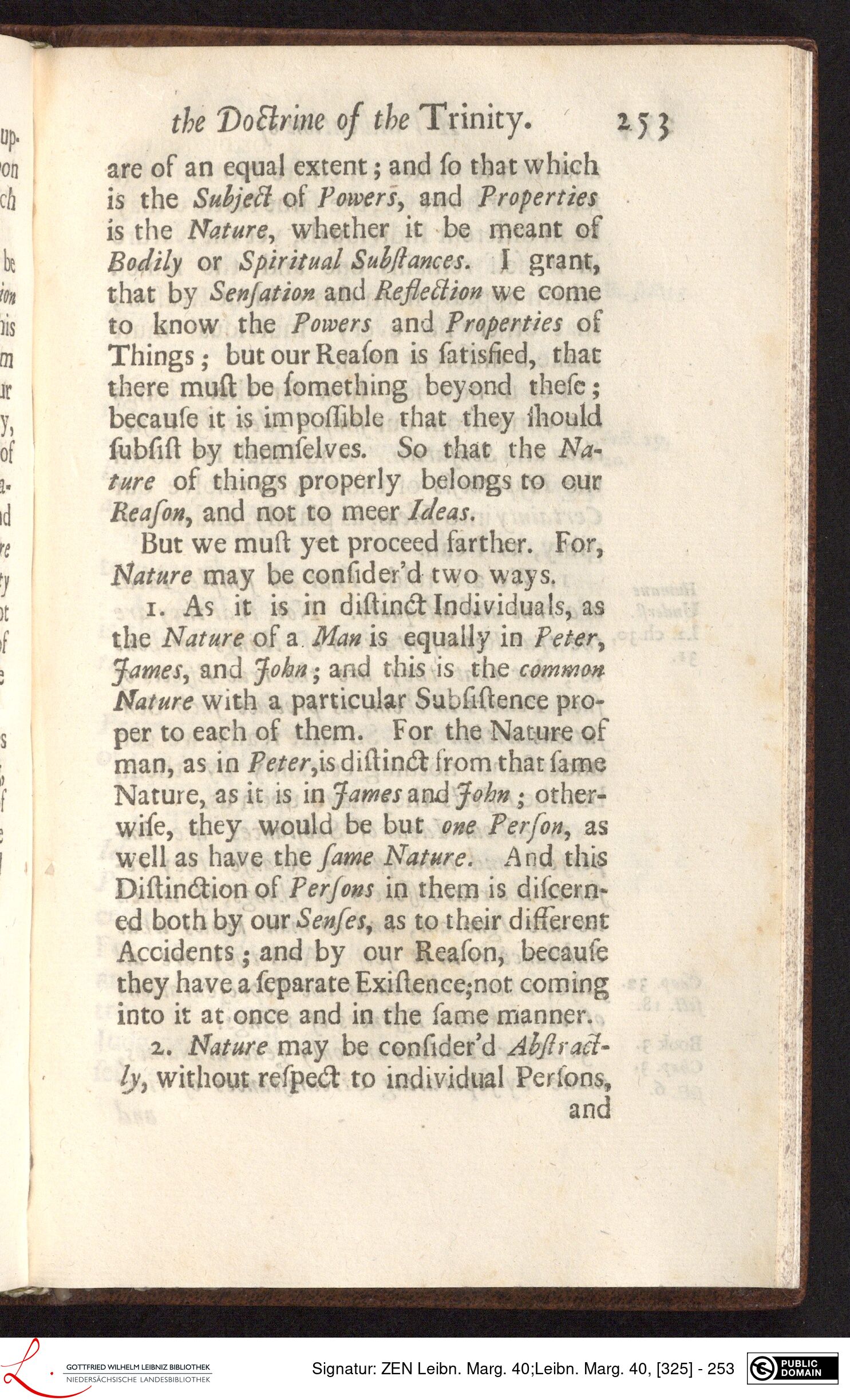
The machine reads it as
- the Doctrine of the Triniey.
- are oF an equal extent; and (o thac wwhich
- is the Subject ot Povers, and Properties
- is che Noture, Wherher it De meant ot
- Bodily Or Spiritual Substances. I srant,
- chat by Sensation and Reflection We come
- to bnow che Povers and Propenties et
- Things; but our Realon is Parissied, thac
- there must bo lomethins bezond chole;
- because it is impossible chac chey thould
- TublA by chemselves. So that eho Na-
- rure ot chines properly bolonss 1o Our
- Reason, and nor to meer Ideas.
- Bur e must yet procced Carther. FOr,
- Nature mas be consider d Evo Ways.
- T. A5 it is in distinet Individua l5, 25
- the Nature oF a. Man is equally in Peter
- Fames, and Fohn; and chis is che common
- Nature rich a parricular Sublictence pro-
- per to cach of them. For the Nature Ot
- man, 25 in Peter, is diltinet trom charlame
- NaTUrC, 25 IE 15 in fames and Fohn; Ocher-
- wile, ther vould be but one Person, as
- rell as have che same Nature. And chis
- Diltinction of Persons in them is discern.
- ed bochby our senses, as to their differene
- Accidents; and by our Realons becaule
- cher have a separare Lxillence;not comime
- into it ac once and in the lame rrianner.
- 2. Nature may be considerd Abstract.
- ly ichonr respeet to indiridual Pertons,
- aF
Cite
A Discourse In Vindication of the Doctrine of the Trinity, fol. 253. Machine transcription, not an edition: Leibniz Legible (model FoNDUE-GD_v2_ft_Leibniz, run 74). https://leibnizlegible.com/page/727097563:0325?run=74