A Discourse In Vindication of the Doctrine of the Trinity, fol. 254
Machine transcription. Not an edition. Errors are expected: about 8% character error rate on Latin and French lines, higher on German. Mean line confidence on this page: 0.91.
Original at the GWLB · Page image · Annotations (IIIF) · Download text
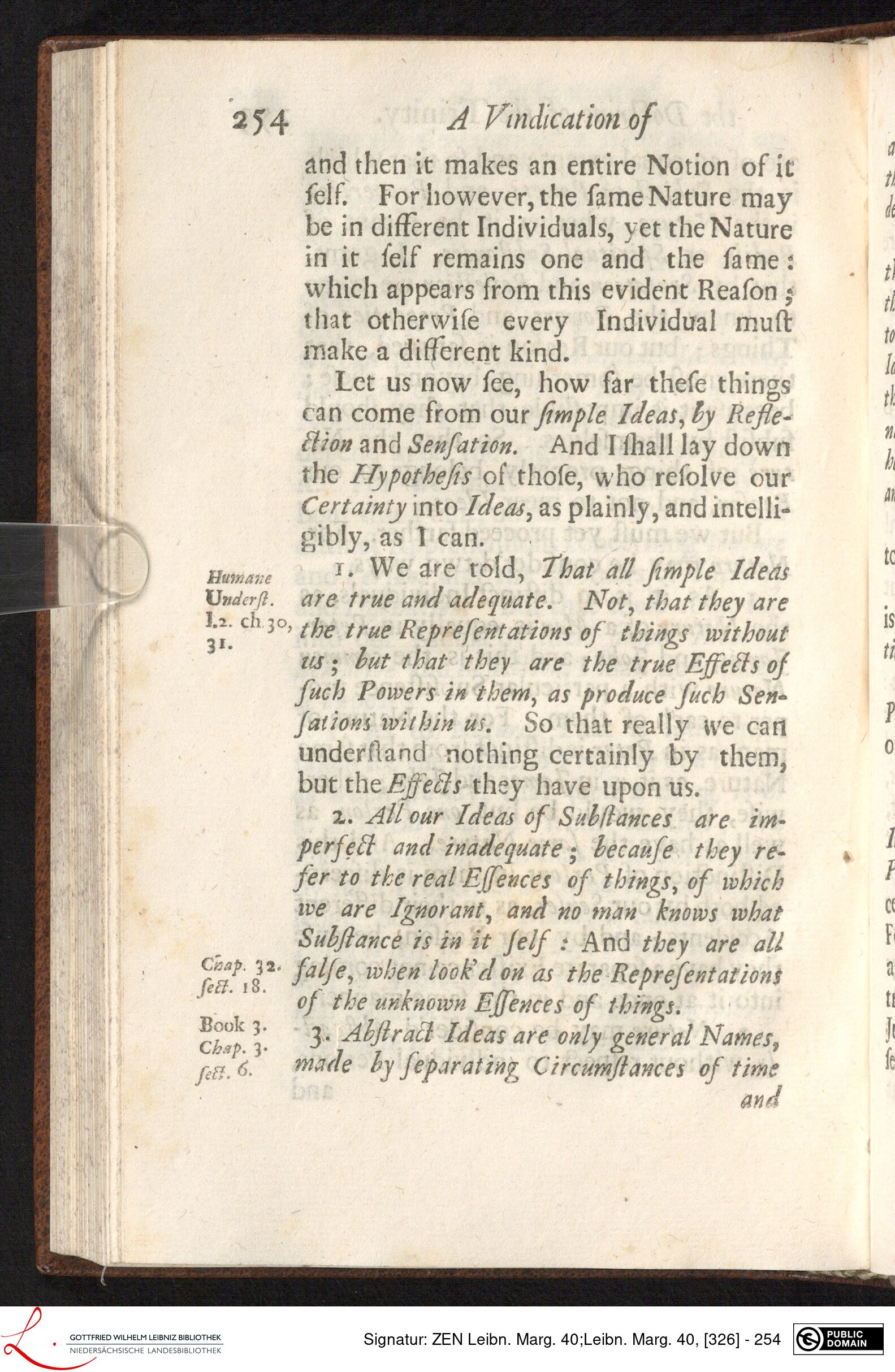
The machine reads it as
- A Vindication of
- and then it makces an entire Notion of ie
- self. Forhorrever, the same Nature may
- be in different Indiriduals, vet cheNature
- in it Telt remains one and the same.
- erhich appears trom chis cvidene Reasons
- chat otherwise everr Individual must
- malce a different kind.
- Tet us non sec, ho Par thele chines
- can come trom our simple Ideas, by Reste-
- etion and sensation. And TMaII lay domn
- ihie Typothesis ol thole, Wrho resolve our
- Certainty into Ideas, 25 plainly, and intelli-
- sibly, a5 I Can.
- T. We arc rold, That al simple Ideas
- Onderst. are true and adequate. Not, that they are
- l. 2. 3B the true Represencations of chines without
- CBaP. 32
- sect. 18.
- BogK 3.
- Chap. 3.
- us; but that ther are the true Pfects of
- Such Povers in them, as produce such Sen-
- sacions within is. 50 chac really ire can
- understand nochine certainly by them,
- but the sifects ther have upon u5.
- 2. All our Ideas of Substances are im-
- perfect and inadequate; because they re-
- fer to the real Pssences of thines, of Which
- ve are Tenorant, and no man tenous what
- Substance is in it sels: And they are alt
- Calse, When loote d on as the Representations
- of the untnoon Psences of thines.
- 3. Abstract Edeas are onty generat Names,
- sect. 6. made by separatine Circumstances of time
- 4
- Dumane
Cite
A Discourse In Vindication of the Doctrine of the Trinity, fol. 254. Machine transcription, not an edition: Leibniz Legible (model FoNDUE-GD_v2_ft_Leibniz, run 74). https://leibnizlegible.com/page/727097563:0326?run=74