Leibniz-Handschriften zur Philosophie LH 4, 6, 12a-e, fol. 8r
Machine transcription. Not an edition. Errors are expected: about 8% character error rate on Latin and French lines, higher on German. Mean line confidence on this page: 0.84.
Original at the GWLB · Page image · Annotations (IIIF) · Download text
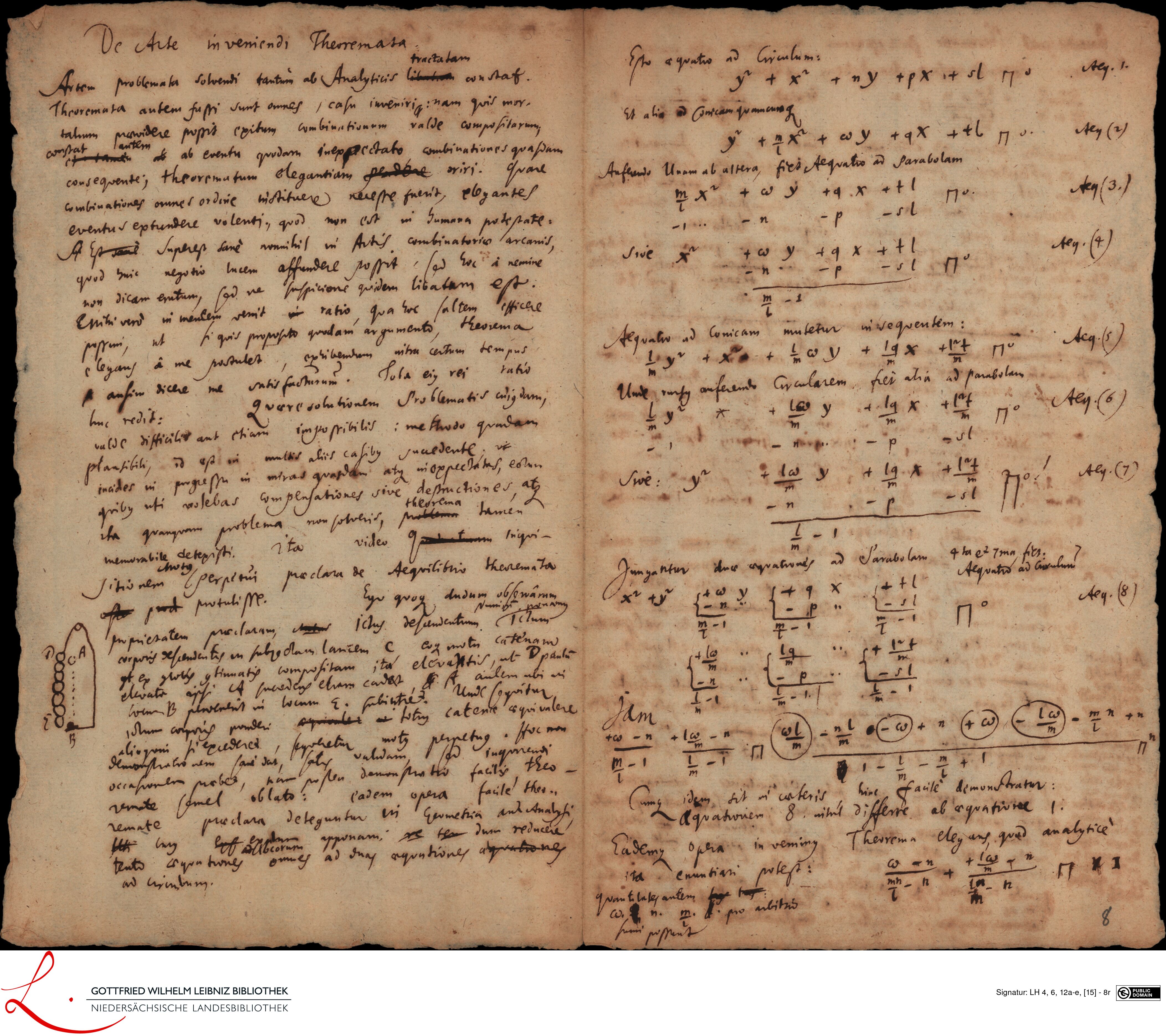
One image of two folio pages side by side, registered by the library under both labels (also fol. 7v); this page is its right half.
The machine reads it as
- Esto aequatio ad Circulum:
- + X + ny +pX 1+ sl B
- Et alia ad Conicam quamcumque
- y + n X + co y + qX + + 1 o.
- Auferendo Unam ab altera, fiet Aequatio ad Parabolam
- m X + c Y +4 X + tl
- n
- sive
- +g X +1
- + co
- Aequatio ad lonicam mutetur in sequentem:
- C y + X t m
- 4X +1+
- Une rursus auferendo Circularem, fiet alia ad parabolam
- + l y +. lg X. +
- m
- Mde:
- Aeg. 1.
- Eteu (2)
- A9 (3.)
- Aeq. (4)
- Acq. (5)
- Aeq. (6)
- Aeg. (7
- Dungantur duae aequationes ad Sarabolam
- + 4
- X
- +
- 4ta et 7ma, fiet:
- Aequatio ad circulum
- Aeq. (8)
- XV +y
- -n +ll n
- m)
- a(= Cd)+
- (4
- n
- +
- unus idem sit in caeteris
- aquationem 8. nihil differre ab aequatione 1.
- Eademue opera in venimus
- ita enuntiari potest:
- quantitates autem ctu:
- C0. n. m. d. pro arbitio
- sumi possunt
- hinc facile demonstratur:
- Theorema elegans, quod analytice
- co n
- + la n
- n
- 1
Cite
Leibniz-Handschriften zur Philosophie LH 4, 6, 12a-e, fol. 8r. Machine transcription, not an edition: Leibniz Legible (model FoNDUE-GD_v2_ft_Leibniz, run 74). https://leibnizlegible.com/page/00068635:0015?run=74