The Questions Concerning Liberty, Necessity, And Chance, fol. 198
Machine transcription. Not an edition. Errors are expected: about 8% character error rate on Latin and French lines, higher on German. Mean line confidence on this page: 0.91.
Original at the GWLB · Page image · Annotations (IIIF) · Download text
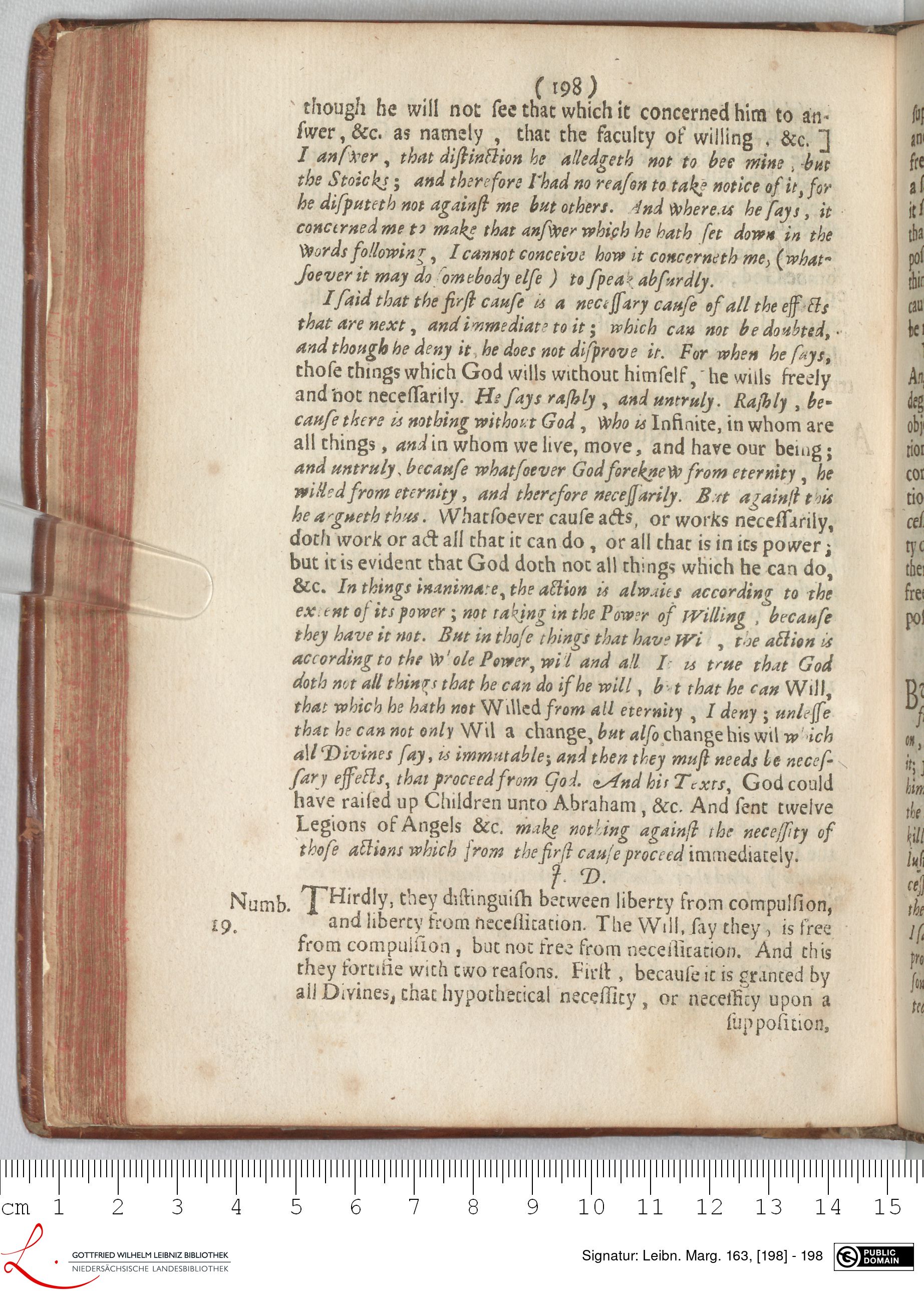
The machine reads it as
- (198)
- chouph he will noc sec chat which ie concerned him 10 an.
- siver, _c. a5 namely, ehac ehe Faculey ot willins. _C.
- T ansver, that distinction he alledceth not to bec mine. bue
- the Scoictes; and therefore lhad no reason to takee notice of il, for
- he disputeth noe acainst me butothers. And whereas hesays, it
- concerned me es mahe thar ansiver rhich he hath set dovon in the
- vords follorinz. Teannot conceive hon it concerneth me, (mhat-
- soeverit may do omebody et (e) 10 spea absuraly.
- Tsaid that the first cause is a necessary cause of all the ef. Ets
- that are next, and immediare toit; rhich can noc bedoubred,
- and thonchhe deny it, he does not disprove it. For when he says,
- chose chinss which Cod wills wichouchimsele, he wills trecly
- and noc necessarily. Fls saysrastly, and untruly. Rasly, be-
- canserhere is norbine withont God, Who is Intinice, in whom are
- allehines, and in utiom velire, more, and hare our beins;
- and untruly. becanse mhatsoever God foreteneW from eterniti, he
- mided frometerniey, and therefore necessarily. B. t azainst vois
- heareneththus. Whacloerer cause acts, or worts necellarily.
- doch mork or act all chac it can do, or all chac is in iEs pover;
- huc ic is eridene ehac Crod doch noc all chines which he can do
- _c. Inthines inanima: e, the action is almaies accordine to the
- ex ent ofirs porver; noc calins inthe Pover of willine. because
- they have it noc. But inthose chines tharhaverri, ehe action is
- accordine to the W’ole Porrer, mil and all T. Is true that God
- doch not al thines that he can do if he will, b. + that he can WViII,
- that which he hath not Nilled from all eternicy, I deny; untesse
- thac he can not ontr Nil a chanse, bur also chanse tis wil m’ich
- all Divines Cay, is immutable; and then ehcy must necds be neces-
- Cary effects, thar procced from G0d. And his Zcars, C0d could
- have railed up Children unto Abratam, _C. And sene evelve
- Lesions oFAnsels _C. mate notline acainst ihe necessity of
- those actions which from ehe first canse proceed immediarely.
- D.
- Kumb. T Firdly. ches distinguisti becveen liberey trom compulsion,
- and liberes trom necesticarion. ThC NVIII. Pay cher, istree
- Fromcompulion, bucnoc tree trom necellication. And chis
- chey forcitie ichemoreasons. Fielt, because ic is sxanced by
- aII Dirines, chac hypocherical necessiey, or neceltics upon à
- sup POCITIOn.
Cite
The Questions Concerning Liberty, Necessity, And Chance, fol. 198. Machine transcription, not an edition: Leibniz Legible (model FoNDUE-GD_v2_ft_Leibniz, run 74). https://leibnizlegible.com/page/1030877386:0198?run=74