The Questions Concerning Liberty, Necessity, And Chance, fol. 274
Machine transcription. Not an edition. Errors are expected: about 8% character error rate on Latin and French lines, higher on German. Mean line confidence on this page: 0.80.
Original at the GWLB · Page image · Annotations (IIIF) · Download text
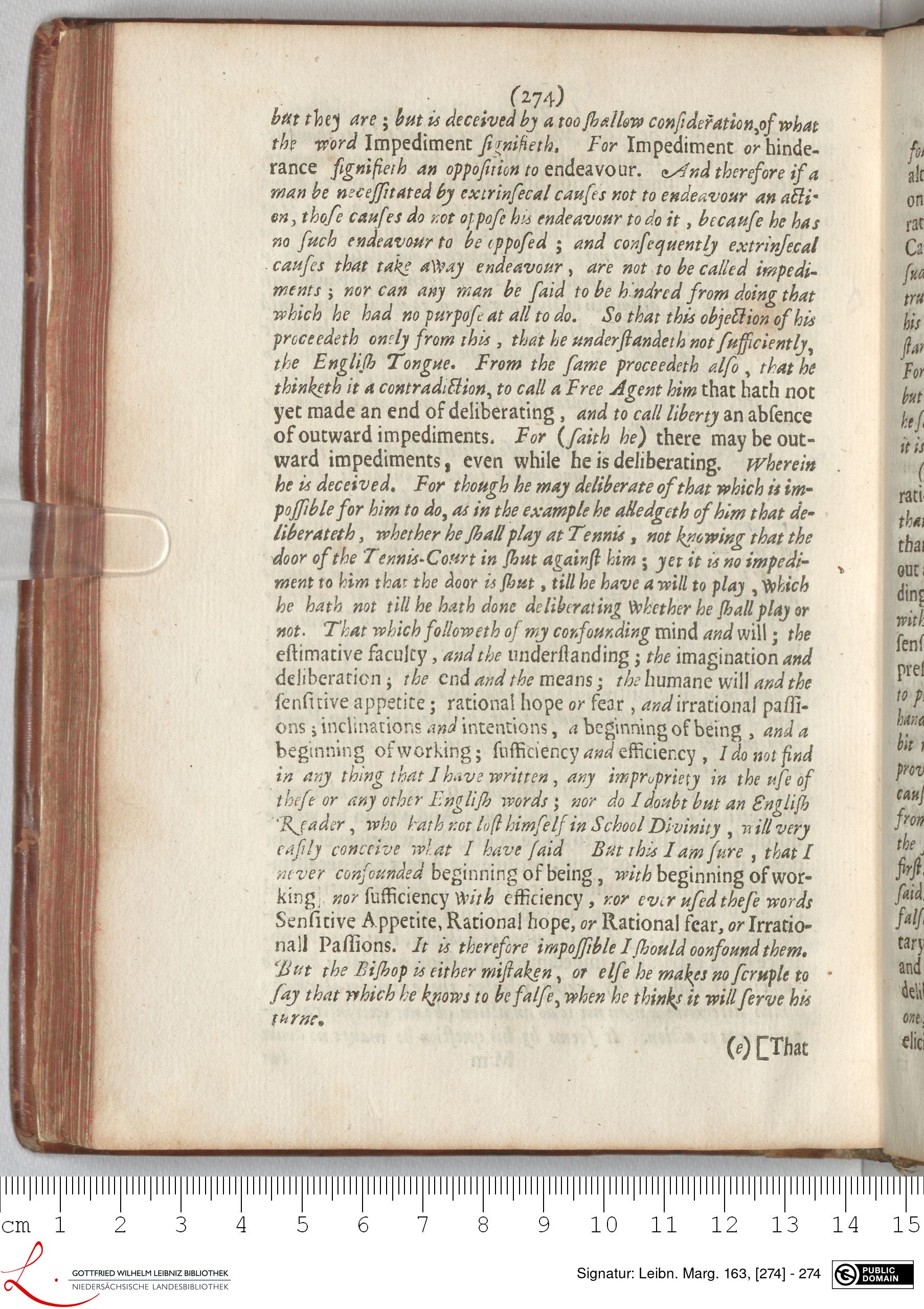
The machine reads it as
- 274)
- bat they are; but is deceived by a roostallom consideration, of what
- the mord Impediment sirnifieth. For Impedimene or hinde-
- rance fienifierh an opposirion to endeavour. And therefore is a
- man be necessitated by extrinsecat causes not to endeavour an acti
- en, those causes de noc oppose his ende avour to doit, becanse he has
- no such endeavour to be cpposed; and consequently extrinsecal
- causes that tate abray endeavour, are not to be called impedi-
- ments; nor can any man be said tobe h.nared from doine that
- ahich he had no purpose at alb +0 do. So that this objection of his
- proocedeth oncly from this, that he understandeth not sufficientr.
- the Enelis Fonene. From the same proceedeth also, that he
- thinheth it a contradiction, to call a Free Ac ent him chac hach noc
- vec made an end ot deliberatins, and to cal liberty an ablence
- OF ourard impedimenes. For (saith he) chere may be oue-
- Ward impedimenes, eren while heis deliberatins. Prherein
- heis deceived. For thonch he may deliberate of that rhichis im-
- possible for him to do, as inthe example he attede et hof him that de-
- liberateth, rhether he sall play at Tennis, not lenomine chat the
- door ofthe Zennis. Court in shut acainst him; per it is no impedi-
- ment tohim thar the door is sut, till he have a will eo play, wbich
- he hath not rill he hach done deliberatine Whether he Ball play or
- not. Fhat which follomethos my confoundine mind and will; the
- estimatire faculer, and the understandins; the imasination and
- deliberation; the end and the means; the humane will and the
- sensitire appetice; rational hove or Peor, and irrational passi-
- Ons; inclinations and incentions, a besimins ot beinz, and q
- hesimnins otvortins; susticiency and efticiency, Ido not find
- in any thins that Phaverritren, any impropriety in the use of
- ihesc or any ocher Fneliss mords; nor de Ldonbebut an Enelist
- Reader, nho tath ror losthimsels in School Diviniiy, nill very
- casity conceive wat Y have said But this Jam sure, that L
- never consounded besinnins ofbeins, mith beginnins oF vor-
- kins. nor susticienes wich efficiene, ron ever nsed these mords
- Senlicire Appecire, Racional hope, or Racional Fear, or Prratio-
- naI PasTIOnS. Et is therefore impossible sould confound them.
- But the Bistop is either mistaten, or else he males no scruple ro
- Say that erhich he knons 1o befalse, inhen he thines it will serve his
- TUYNCo
- 8
- Lal
- t
- +
- cH
- D
- B.
- P
- c
- sr
- It
- s
Cite
The Questions Concerning Liberty, Necessity, And Chance, fol. 274. Machine transcription, not an edition: Leibniz Legible (model FoNDUE-GD_v2_ft_Leibniz, run 74). https://leibnizlegible.com/page/1030877386:0274?run=74