Leibniz-Handschriften zur Mathematik LH 35, 3 A 23, fol. 11r
Machine transcription. Not an edition. Errors are expected: about 8% character error rate on Latin and French lines, higher on German. Mean line confidence on this page: 0.88.
Original at the GWLB · Page image · Annotations (IIIF) · Download text
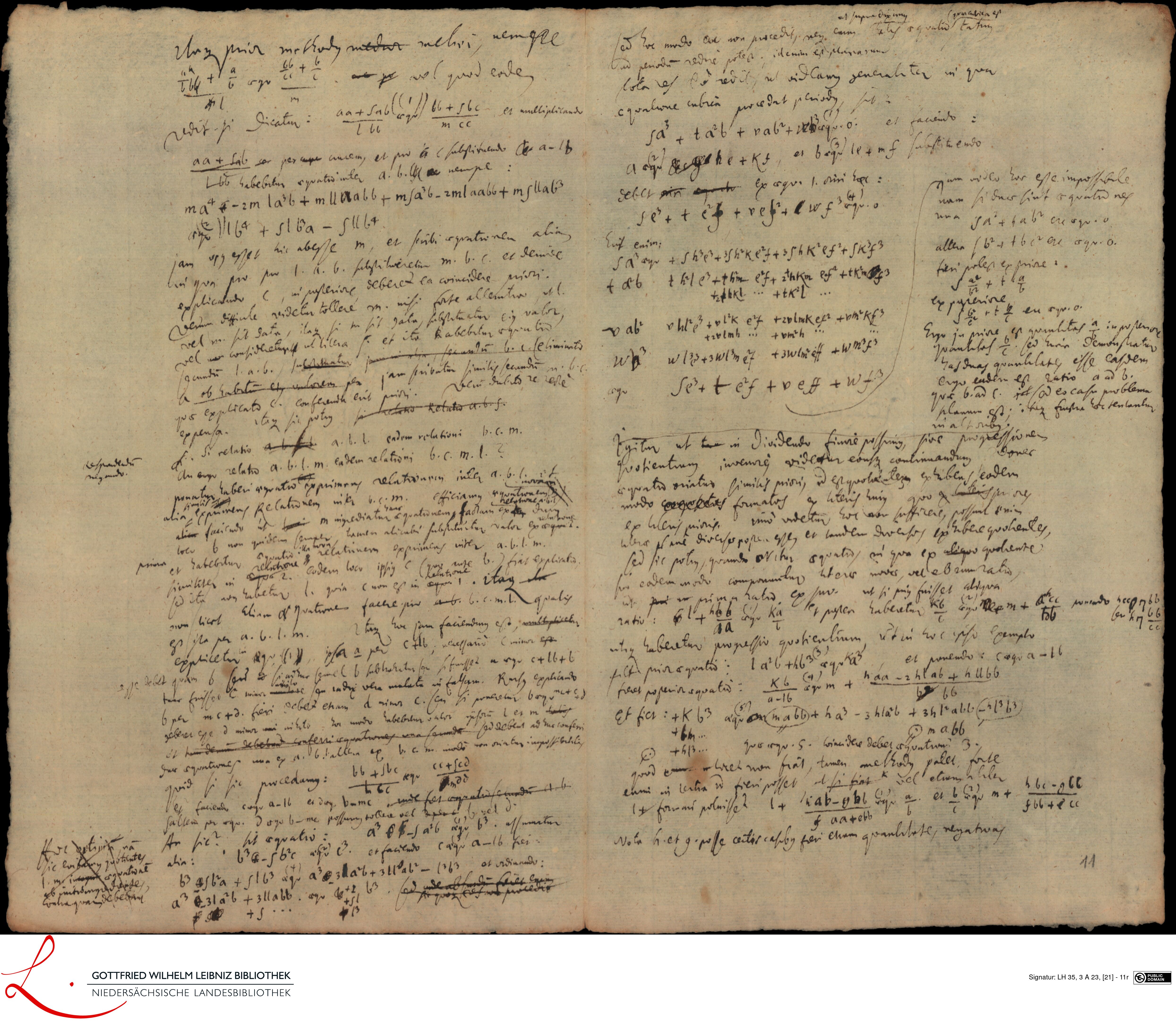
One image of two folio pages side by side, registered by the library under both labels (also fol. 10v); this page is its right half.
The machine reads it as
- ut supra diximus
- sed hoc modo non procedit, neque enim alis aequatio latim
- Vad periodum redire potest. idenim est planarum
- Nota res do revit, ut videamus generaliter in qua
- equatione cubrea procedat periodus, sit:
- sa, tab + vab + u aequ. 0. et faciendo:
- a equ he +RY, et baqu le + mf substituendo
- debet niri aeqo ex aequ. 1. oriri haec:
- se + t cf + vet+ CW f aequ. 0
- Euit enim.
- Sa aego + ShC + skK C f + 35hk ef +sKf3
- ab. +tl C2 + Ftim ef + Etitim ef LHKm 3
- vab
- Wa
- aequ
- t +hF 1. ... + tK I ...
- vhlB+Vk et +evlmk es +M Kf
- +vimh.. + vih..
- W l’3 +3Wm et tolm ef L WM 5
- Se+ t ef +v et +Wf.
- uium vodeo hoc esse impossibile
- nam si duae sint aequationes
- una sa +tab erc aequ. o
- altera (b + +b c erc aequ. 0.
- fieri potest expriore.
- et + t.
- ex pasteriore
- 62 + t _ er aequ. 0.
- Ergo iu priore est quantitas a in posterior
- quantitas. sed hiria demonstratur
- has duas quantitates esse easdem
- ergo eadem est ratio a ad b.
- quae b. ad C. sed eo casu problema
- planum est; taque frustia haec tentantur
- in altioribus.
- Egitur ut in dividendo finire possimus, sive progressionem
- quotientium invenores videttur eousque continuandum bonec
- aequatio oriatur similis priori, id est quolaeutem exhibens eodem
- modo formatos ex literis hujus quoq lateris priores
- ex literis prioris. Imo videtur hoc abu sufficere, possunt enim
- liberae plane diversa postea esse, et tandem diversos exhibere quotientes
- sed sic potius, quando oritur aequatios in qua ex aliquo quoliente
- suo eodem modo componuntur lterae novae, vel ebrum ratio
- ut i un primaratio ex sur. ut si prius fuisset aliqua
- (2)
- ratio: sl +hb aego ka et postea haberetur ib aeqo m + acC ponendo hcce ebb
- aa
- tob
- itique haberetur progressio quotientium, ut in hoc ipso exemplo
- fit prior aequatio. 1 ab +hb aequ’a, et ponendo: Caequ a - 1b
- fieret poserior aequatio: Xb aequm + haa - 2hl ab + h lbb
- 51
- (+)
- a - 1b
- bx b6
- Et fiet: +k b3 aquam mabb, + ha - 3 hlab + 3h I abb (h P3 b3
- +th..
- Sd nabb
- C) +h(.. quae aequ. 5. Coincidere debet aequationi 3.
- quod eu nlocet non fiat, tamen methodus patet forte
- enim in tertra id fieri posset ut si fiat vel etiam aliter
- 1+ formari poluisset l+ n ab - 9hb aqu a. et b lequ in +
- f aa tebb
- Nota h. et 9. posse certis casibus fieri etium quantitate, negativas
- (quaeculica est
- hbc - gCb
- fbb + e cc
- Cer hoi bb
Cite
Leibniz-Handschriften zur Mathematik LH 35, 3 A 23, fol. 11r. Machine transcription, not an edition: Leibniz Legible (model FoNDUE-GD_v2_ft_Leibniz, run 74). https://leibnizlegible.com/page/00068236:0021?run=74