Leibniz-Handschriften zur Philologie, Sprachwissenschaften LH 5, 6, fol. 13v
Machine transcription. Not an edition. Errors are expected: about 8% character error rate on Latin and French lines, higher on German. Mean line confidence on this page: 0.94.
Original at the GWLB · Page image · Annotations (IIIF) · Download text
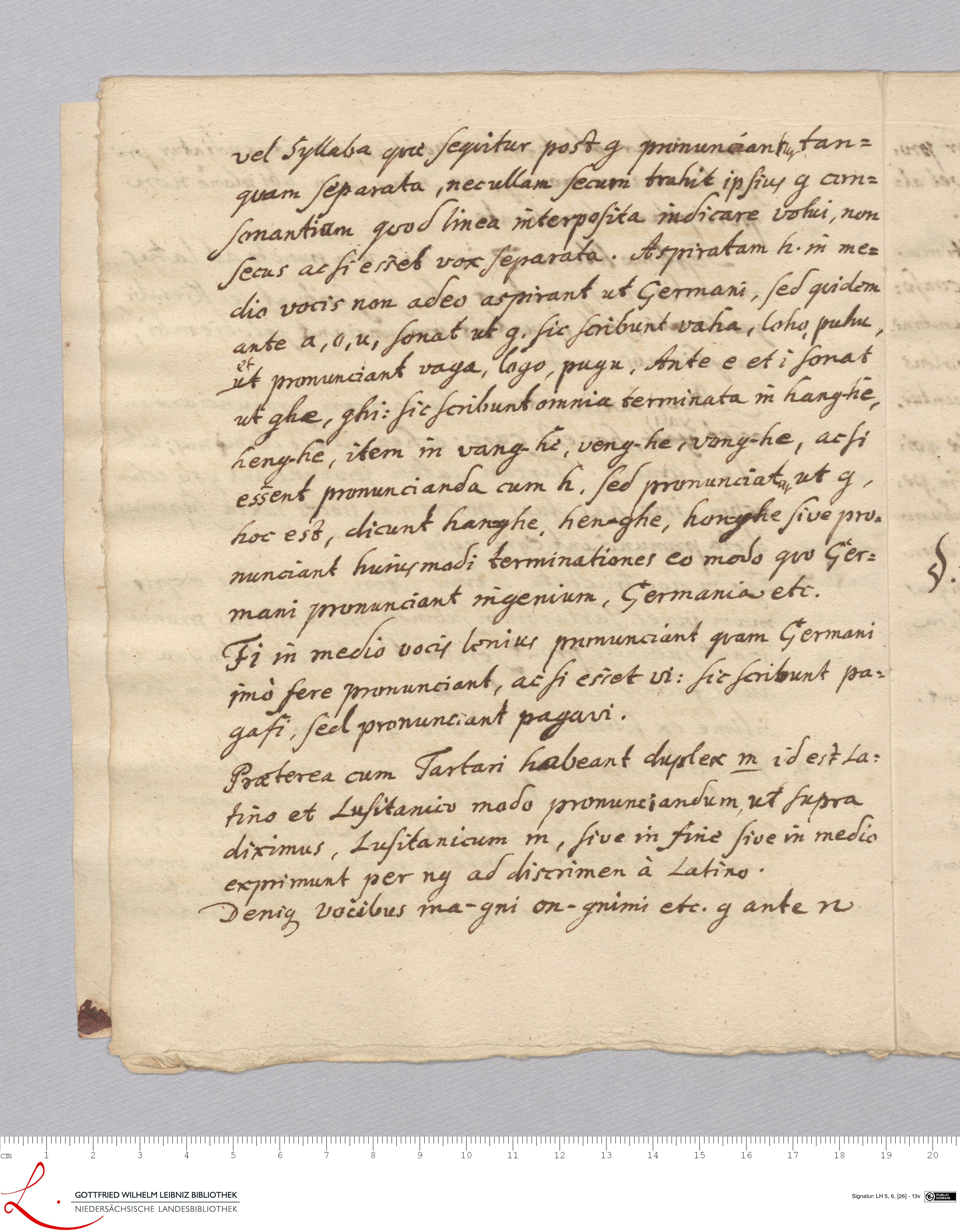
The machine reads it as
- vel syllaba quae sequitur postq pronuncantus tan-
- quam separata, necullam secum trahit ipsius q con-
- sonantiam quod linea interposita indicare volui, non
- secus acsi eiset vox separata. Aspiratam h. in me-
- dia vocis non adeo aspirant ut Germani, sed quidom
- ante a, 1, u, sonat ut g. sic scribunt vatia, loho putuc
- ut pronunciant vaga, lago, pugu. Ante e et i sonat
- et
- ut ghae, ghi: sic scribunt omnia terminata in hanghe
- henghe, item in vanghe veng hevonghe, acsi
- essent pronuncianda cum h, sed pronunciat, ut q,
- hoc est, dicunt hanghe, henaghe, honphe sive pro-
- nunciant hurus madi terminationes eo modo quo Ger–
- mani pronunciant ingenium, Germania etc.
- Li in mecho vois lonius prmunciant quam Germani
- imo fere pronunciant, ac si escet vi: sic scribunt pa
- gasi, sec pronunciant pagavi.
- Praeterea cum Tartari habeant duplex im id est La:
- tino et Lusitaniio maso pronunciansum ut supra
- diximus, Lusitanicum m, sive in fine sive in medio
- exprimunt per ny ad discrimen a Latino.
- Denique vocibus magni on-gnimi etc. q anten
Cite
Leibniz-Handschriften zur Philologie, Sprachwissenschaften LH 5, 6, fol. 13v. Machine transcription, not an edition: Leibniz Legible (model FoNDUE-GD_v2_ft_Leibniz, run 74). https://leibnizlegible.com/page/00068748:0026?run=74